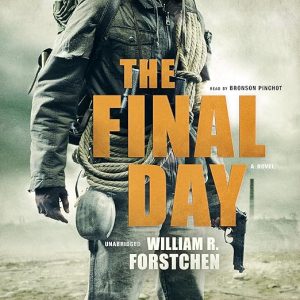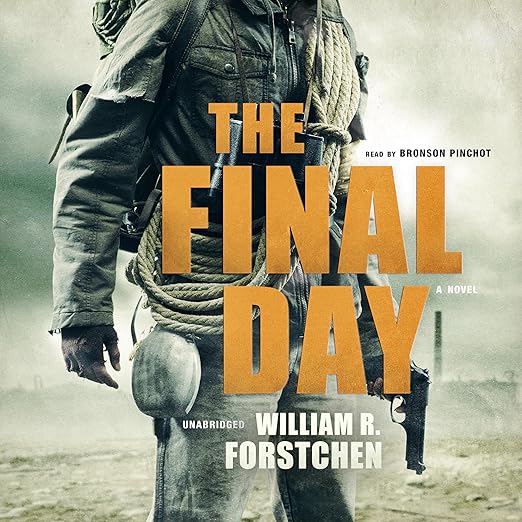
- Voice: Bronson Pinchot brings John Matherson's world to life with quiet authority, handling both the political urgency and the personal grief with equal steadiness.
- Big ideas: Post-EMP survival, sovereignty and constitutional crisis, friendship tested by duty
- Atmosphere: Tense and contemplative, with a deep vein of patriotic sorrow
- Worth it?: The most politically charged entry in the trilogy delivers a satisfying close for readers who have followed Matherson from the beginning, though newcomers will feel the weight of accumulated backstory.
I came to The Final Day already invested. I had spent the better part of two weekends working through One Second After and One Year After, and by the time I pressed play on this concluding volume I genuinely cared whether John Matherson's community in North Carolina made it out the other side. I finished the last two hours on a Tuesday evening, sitting in my kitchen long after I should have gone to bed, which is probably the most honest endorsement I can offer.
William R. Forstchen has spent three books building a world where the collapse of the electrical grid is not a backdrop but the central character, something that shapes every relationship, every decision, every moral calculation. The Final Day does not ease up on that premise. If anything, it gets heavier.
The plot hinges on a revelation that raises the stakes far beyond community survival: the remnant federal government is preparing to cede large portions of American territory to China and Mexico, and has suspended the Constitution to suppress resistance. What might sound like a political thriller setup is handled with more nuance than that summary suggests. Forstchen is interested in the psychology of loyalty and legitimacy, in what it means to serve institutions that have stopped serving their purpose. The scenes between Matherson and General Bob Scales, his old commanding officer and closest friend, carry the emotional weight of the entire book. Two men who share history, shared values, and now opposing orders, trying to talk honestly across a line that may be uncrossable. It is quiet, almost understated, and it works precisely because Forstchen has taken three novels to earn that moment.
What Stands Out
Bronson Pinchot's narration is the consistent glue across this series, and he continues to do good work here. He does not sensationalize. His delivery of Matherson's grief, his exhaustion, and his occasional flashes of defiant hope feels grounded in something real. The audio format suits this particular installment especially well because so much of the tension lives in dialogue, in the pauses between characters who are trying to say one thing and mean another. Pinchot handles those pauses with patience. Reviewer Charles F. Kartman noted the series is firmly fixed in place and sympathy for the survivors, and that rootedness is exactly what Pinchot captures in voice.
What to Watch For in The Final Day
The novel leans more heavily on political machinery in its third act than on immediate physical survival, and listeners who loved the grim, granular detail of rebuilding life after the EMP may find this shift slightly abstract. The federal government antagonist remains somewhat schematic, a collective authority rather than individual villains, which diffuses some of the tension that the Scales subplot builds so carefully. There is also an unevenness in pacing: the opening is measured and reflective, while the conclusion accelerates in ways that feel slightly compressed after three books of deliberate world-building. One reviewer described it as a wakeup call rather than pure entertainment, and that framing is accurate. This is not an audiobook where you turn your brain off.
Best Suited For
If you have already committed to the John Matherson series, you should finish it here. The trilogy is one of the more sustained explorations of post-grid America in audio fiction, and The Final Day lands its emotional conclusion even when the political scaffolding creaks slightly. If you are considering starting the series at book three, the experience will be thin. The story's power is cumulative, built from two prior volumes of loss and small victories. Come to this one informed. For readers drawn to near-future survival fiction that takes its premise seriously, from infrastructure failure to constitutional legitimacy, Forstchen remains one of the more thoughtful voices in the genre. His willingness to let the moral questions breathe, to resist easy resolution between Matherson's principled resistance and Scales's conflicted duty, is the series' most lasting quality, and this final volume is where it matters most.
Before You Listen
How does Bronson Pinchot handle the shift toward political drama in this third installment?
Pinchot manages the transition well. His narration stays grounded even when the story moves away from immediate survival and into constitutional crisis territory. He is particularly effective in the quieter dialogue-heavy scenes between Matherson and General Scales.
How does the EMP threat in this series compare to other post-apocalyptic audiobooks in terms of realism?
Several reviewers note that Forstchen, who has testified to Congress on EMP vulnerability, treats the threat with documentary seriousness. It reads less like science fiction and more like a thought experiment grounded in real infrastructure concerns. That is both its strength and the reason some listeners find it more sobering than entertaining.