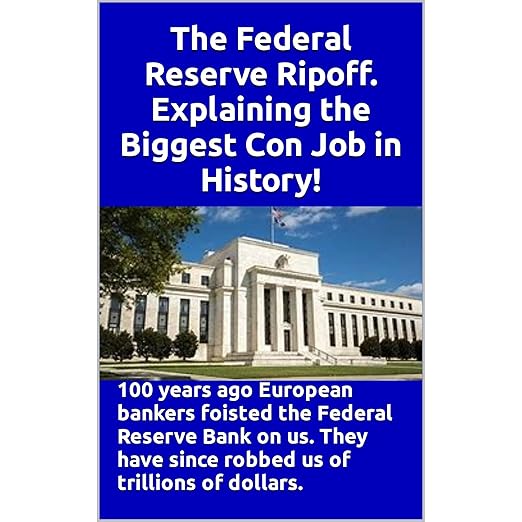
Conspiracy publishing has a house style, and this description hits every mark of it inside the first sentence: the exclamation, the direct address, the promise that everything will be explained. Michael Miller argues that the Federal Reserve was imposed on America by bankers who knew exactly what they were doing, and that a century of theft, war and lost prospects followed. Two hours and two minutes of audiobook carry that argument. Whether you find it convincing or not, the shape of the product is worth understanding before you spend anything on it.
Miller's Claim Targets Intent Over Mere Policy
Miller's claim is total rather than technical. On this account the Federal Reserve system was foisted on the country by, in the description's own words, very clever and dishonest European bankers, who then robbed Americans of trillions, engineered unnecessary wars for profit, and cost a generation their lives or their health roughly every twenty years. Nothing here is presented as a policy critique of central banking. The book takes a position on intent, which is a different kind of argument and needs a different kind of evidence.
Nobody has written a word about it on the page selling it. Four ratings have been left, no written responses at all, and the record has carried that state since January 2024. For a title working this territory, the silence matters more than it would elsewhere, because the usual way a buyer sizes up a book like this is by reading what its readers claim to have gotten out of it. That check is unavailable here.
Two Hours Fits a Position Paper Only
Two hours and two minutes is the single most informative number on this page. More than a century of monetary history, several wars and a claimed multi-trillion transfer cannot be documented in the time it takes to drive across a mid-sized state. What fits in that runtime is a position paper: the claim, the outline of the case, and the conclusion. Judged as a briefing for people who already accept the premise it is adequately sized. Judged as an investigation it is not, and the description never claims otherwise.
Nineteen thirteen is when the Federal Reserve Act became law, which is the century the copy is counting from, and the system's private-public structure has drawn genuine criticism from economists across the political spectrum ever since. That is the real ground underneath this book. Monetary policy critique is a serious field with serious internal disagreements about mandate, independence and accountability. What Miller offers is not that argument in miniature; it is a claim about deliberate deception, and listeners should be clear which of the two they are buying.
Software supplies the delivery. Where a reader's name would sit, the record says Virtual Voice, so nothing on this recording was performed by a person. That choice interacts badly with this specific text. Polemic runs on emphasis, on the pause before a figure lands and the lift under an accusation, and machine reading assigns its stresses from punctuation rather than from intent. Two hours of exclamation marks delivered at an even temperature is a strange listening experience, and it flattens exactly the quality the writing is relying on.
Four Ratings Cannot Produce This 4.4 Badge
Whole-star votes can only produce certain averages, and with four of them the reachable set runs 4.25, which displays as 4.3, and 4.5. The badge on this record says 4.4 from four ratings, which no combination of four votes can generate. Something is pooled, delayed or counted from a wider set than the number shown. It is a small discrepancy and it is not the author's doing, but on a page with no written responses the badge is the only signal available, and it does not hold up.
Our book explains it all, the copy says, while the byline names one person. First-person plural runs through the description consistently enough that it reads as authorial rather than as a slip, which suggests either a co-writer who has not been credited on this record or a publishing operation speaking as a house. Neither is disqualifying. Both are the kind of thing a buyer is entitled to know when the argument depends on who is making it.
Culprits in this account are identified by where they came from. The description names no institution, no legislator and no bank; it names very clever and dishonest European bankers, and builds everything else on that foundation. Attributing a financial conspiracy to the origins of the people alleged to run it has a long and ugly history in writing about central banking, and whatever Miller intends by it, that is the register a listener is buying. Anyone who would rather have the institutional critique without the ethnic framing should choose a different title.
You must understand the problem before you can solve it, the copy quotes approvingly, and then defines the solution as enough people learning the truth. As a theory of change that is circular, and it tells you what the book is for. This is a recruitment document rather than a program. It wants agreement, not action, and the two-hour runtime is calibrated for exactly that job.
Sympathetic Readers Are the Book's Plain Audience
Sympathetic readers are the audience, plainly and without much competition. Anyone who already holds this view of the Federal Reserve and wants it stated at length, in one sitting, will find the book does what it advertises. It also functions as a quick survey of the argument for a curious listener who wants to know what this literature claims before deciding whether to read further into it, provided that listener treats every figure as a starting point for verification rather than as a settled number.
Anybody looking for monetary policy, banking regulation or an account of how the system actually operates should go elsewhere, and so should anyone who wants the accusations sourced. The description offers no citations, no named institutions and no methodology, and two hours leaves no room for any. Add a machine-read delivery and an unexplained rating badge, and what you have is a short, forceful statement of a position, useful to people who share it and unlikely to move anyone who does not.
In Brief
- Subjects: Central banking as deliberate deception, war profiteering, lost prosperity, truth-telling as remedy
- Tone: Urgent and accusatory, delivered at an even machine temperature
- Bottom line: A two-hour position paper for listeners who already agree, with an unsourced case, a synthetic reading and a rating badge that does not add up.
Common Questions
Who narrates The Federal Reserve Ripoff audiobook?
No human reader is credited. Virtual Voice occupies the slot, which is the label for text-to-speech, so the delivery is generated rather than performed. On a text built from exclamations and direct appeals, that neutral machine cadence works against the writing, and a sample will show you within a minute whether you can tolerate it.
Does the audiobook explain how the Federal Reserve works, or argue against it?
An argument, and an unambiguous one. It asserts that the system was imposed deliberately and that the harm since has been intentional rather than incidental. Historical events appear as illustrations of that claim rather than as a chronology, so anyone wanting an account of how the institution works should look elsewhere.
Can two hours really cover a hundred years of monetary history?
Not as documentation, and the book does not attempt it. Two hours and two minutes accommodates a thesis, a sketch of supporting claims and a conclusion, which is the format of a briefing rather than an investigation. Treat the runtime as an honest signal of scope before you judge the contents.