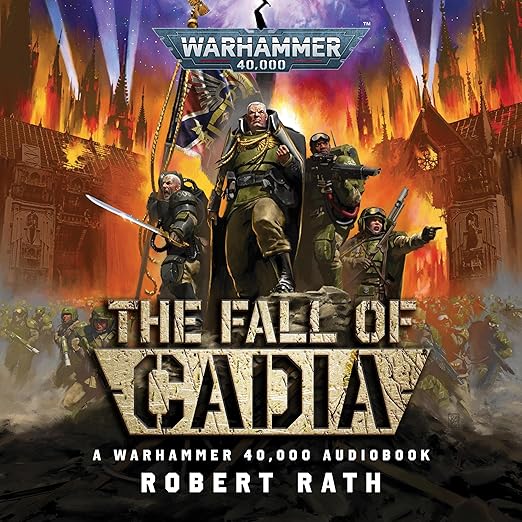
I came to The Fall of Cadia already knowing the outcome. This is the nature of tie-in fiction for a universe with a heavily documented canon: the planet does not survive, the Great Rift opens, and nothing in the Warhammer 40,000 setting will ever be quite the same again. What I did not know, and what Robert Rath makes genuinely surprising over nearly twenty hours, is how the catastrophe unfolds at the human level. I started listening on a Friday night with low expectations and something approaching skepticism about whether a war novel set in the grimdark far future could sustain itself across that runtime. By Sunday evening, I had an answer.
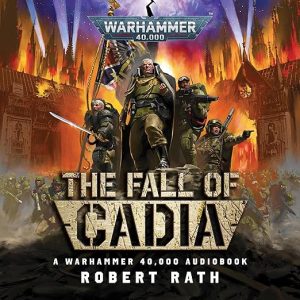
The Fall of Cadia covers the Thirteenth Black Crusade, Abaddon the Despoiler's final assault on the fortress world that has stood as humanity's bulwark against the Eye of Terror for thousands of years. Lord Castellan Creed leads Cadia's defense with the haunted certainty of a commander who suspects the assault he has already repelled was merely prologue. He is correct. What follows is a war novel told from dozens of perspectives, scaling from command tables to pylon fields, from the orbit where Abaddon's alliance frays at every seam to the ground where rank-and-file soldiers of the Imperium discover what it actually means to hold a line.
The challenge of any ensemble war narrative is keeping individual lives legible within mass catastrophe. Rath largely succeeds at this. Major Hellsker and Captain Kestral, noted by a reviewer as standout character work, are drawn with specific behavioral tics that distinguish them from the wider cast. The Battle Sisters Eleanor and Genevieve serve a different narrative function, representing the fanatical devotion that is simultaneously the Imperium's greatest strength and its most troubling quality. Abaddon's perspective chapters are particularly effective: seeing the Thirteenth Black Crusade from the Despoiler's vantage point gives the antagonist a strategic coherence that many 40K villains lack.
A reviewer accurately observed that the book covers a major established plot point in the 40K universe with a scale that encompasses both high command and foot soldiers. That dual perspective is the structural choice that makes The Fall of Cadia more than a battle chronicle. Rath is interested in what it costs specific people to participate in civilizational-scale violence, and he keeps that question alive even during the broadest tactical passages.
Why Listen to The Fall of Cadia
Seddon's narration is essential to making this audiobook work at its length. The Fall of Cadia has a cast of characters that would test any narrator's stamina, and Seddon manages it with a discipline that is evident from the early chapters. He does not attempt to dramatically distinguish every character through broad vocal performance, but instead works with register, pace, and subtle tonal shifts that keep the listener oriented even during rapid perspective changes. The command sequences, where multiple officers speak in quick succession during battle, are handled particularly well.
The prose that Rath delivers is dense with 40K nomenclature, and Seddon navigates it without the stumbles or audible hesitations that plague less well-prepared narrators of tie-in fiction. His delivery of the novel's quieter passages, the scenes between battles where characters reckon with what is coming, benefits from a restraint that the more operatic sequences could occasionally use. When the scale of the final assault becomes overwhelming, that is intentional on Rath's part, but Seddon's reading of it becomes slightly uniform across the longest siege sequences. It is a minor flaw in an otherwise strong performance.
What to Watch For in The Fall of Cadia
The Warhammer 40,000 universe has produced thousands of novels, and the quality varies enormously. What distinguishes The Fall of Cadia within that output is Rath's evident interest in the political and moral dimensions of the conflict rather than the hardware. Abaddon is presented not as a straightforward villain but as a strategist whose alliance is held together by mutual self-interest that constantly threatens to dissolve. The Imperium's defenders are portrayed not as heroic ideals but as people performing heroism under conditions that have stripped most conventional meaning from it.
One reviewer called this an incredible sci-fi war novel for fans of both 40K and the genre more broadly, and I think that assessment holds. The universe's specific lore is assumed rather than explained, meaning newcomers will be lost, but readers with even passing familiarity with the setting will find Rath working at the higher end of the franchise's literary ambitions.
Who Should Listen to The Fall of Cadia
The Fall of Cadia is not an entry point into Warhammer 40,000. It is a novel written for readers who already understand what Cadia represents within the setting, why the Thirteenth Black Crusade matters, and who Abaddon is. Listeners without that background should start elsewhere. For established fans, this is a novelization that treats the source material seriously and delivers the emotional weight that the setting's most significant story event deserves. Nearly twenty hours is a genuine time commitment, but the novel earns most of it.
What Rath achieves across this runtime is something that tie-in fiction rarely manages: the feeling that you have lived through a catastrophe alongside characters you actually care about. The famous last phrase of Cadian defiance, which appears in the final chapters and will land with the weight it deserves only for readers who have spent the preceding hours in these characters' company, is the kind of ending that justifies the investment. It is earned not by the lore but by the novel itself.
At a Glance
- Narrator: David Seddon handles the vast ensemble cast with disciplined consistency, keeping dozens of characters audibly distinct across nearly twenty hours without ever losing the thread.
- Subjects: Last stands and the cost of loyalty, corruption within alliance, the scale of apocalyptic warfare
- Tone: Epic, relentless, and genuinely grim
- Bottom line: Robert Rath delivers the definitive novelization of Warhammer 40K's most consequential battle event, with a scope that earns its near-twenty-hour runtime.
Before You Listen
Do I need to know Warhammer 40K lore before listening to The Fall of Cadia?
Yes, this novel assumes substantial familiarity with the setting. It does not explain who Abaddon is, why Cadia matters, or what the Eye of Terror represents. First-time readers should start with introductory 40K novels like the Horus Heresy series before approaching this one.
Is The Fall of Cadia standalone, or does it require reading specific prior Black Library novels?
It functions as a standalone within the 40K timeline, but readers familiar with previous Thirteenth Black Crusade novels and Cadia-focused stories will have a richer experience. The novel positions itself as the definitive account of this event rather than a sequel to specific prior works.