Quick Take
- Narration: Travis Baldree brings his characteristically warm, unhurried energy to an ensemble cast that genuinely benefits from his range across distinct character voices.
- Themes: Found family and trust, systemic dysfunction and the cost of compliance, identity and self-knowledge under pressure
- Mood: Cozy with genuine stakes, funny and tender with flashes of existential unease
- Verdict: Travis Baldree narrating a cozy LitRPG with a found-family ensemble and nearly two million Royal Road views is exactly as good as it sounds, and probably better.
I listened to the first few hours of The Fabric of Reality on a Friday evening when I wanted something that would make me feel better about people. That sounds like faint praise, but it is not: the specific pleasure this audiobook delivers is the sense of four genuinely different characters learning to trust each other under circumstances that actively discourage it. Travis Baldree’s narration, warm and precise in equal measure, is a significant part of why that works as well as it does.
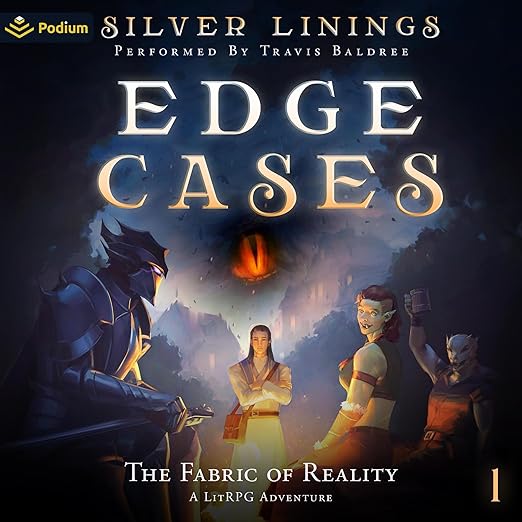
Silver Linings debuts here with a LitRPG that had already accumulated nearly two million views on Royal Road before the audio release, which tells you something about the size of the audience that had been waiting for this. The setup involves four oddballs thrown together by a malfunctioning system: Derivan, an enchanted suit of armor experiencing an existential crisis about consciousness and personhood; Misa, a half-orc who loves exploiting the system’s mechanics; Vex, a lizardkin wizard who has run away from his family; and Sev, a cleric who would rather have tea with his god than formally worship him. That last detail alone should tell you the register Silver Linings is working in. This is fantasy that takes its characters’ interiority seriously while refusing to be earnest in a boring way.
Our Take on The Fabric of Reality
The book is often compared to a TTRPG campaign, and one reviewer put it cleanly: Edge Cases feels like a TTRPG campaign in a way that almost nothing has. What that means in practice is that the party dynamic matters as much as the plot mechanics, and the characters feel like the product of genuine creative affection rather than genre calculation. Derivan’s existential crisis is played for both comedy and genuine pathos simultaneously, which is a difficult tonal balance to maintain. Misa’s relationship with the system is described by reviewers as one of the more interesting skill set constructions in the LitRPG genre. The worldbuilding raises meta-level questions early and keeps raising them, and the mystery about what is wrong with the system in the Prime Kingdoms is genuinely interesting rather than perfunctory.
Why Listen to The Fabric of Reality
Travis Baldree is one of the most reliable narrators working in cozy and secondary-world fantasy, and his rapport with this ensemble is evident throughout. He differentiates the four leads convincingly without resorting to exaggerated character voices, and the humor lands at the right moments because his timing is calibrated well. At nearly fourteen hours, it is a complete and satisfying listen for the first book, not a frustrating setup for a series. Listeners who found Baldree’s own novel Legends and Lattes congenial will recognize the same commitment to character warmth alongside actual narrative stakes. The two works share a sensibility: danger is real, but so is the possibility of people genuinely helping each other.
What to Watch For in The Fabric of Reality
One thoughtful reviewer raised fair questions about pacing in certain sections and whether the story’s meta-level structural ambitions will stay coherent as the series develops across future volumes. The first book establishes the ensemble and raises the central mystery about the malfunctioning system without fully resolving it, so listeners who prefer tight, standalone conclusions may find that the ending points forward more than it lands. The LitRPG mechanics are present throughout but worn lightly enough that genre newcomers are unlikely to feel excluded by unfamiliar vocabulary or conventions.
Who Should Listen to The Fabric of Reality
Listeners who enjoy cozy fantasy with genuine tension, or LitRPG readers who want more character interiority than the genre typically delivers, are the natural audience for this series opener. The LGBTQ+ genre tag reflects inclusive characterization that is organic to the story rather than decorative, which matters for readers who are tired of representation treated as an add-on. If you have bounced off harder, more number-crunching LitRPG in the past, this is a very good experiment in a different mode of the genre. If you already trust Baldree’s narration from other projects, this is an easy recommendation to make without reservation.
Frequently Asked Questions
Do I need to have read the Royal Road version to enjoy the audiobook?
No prior reading is necessary. The audiobook covers the first volume as a complete entry point, and the story introduces its world and characters fully. Familiarity with the Royal Road version may heighten appreciation for certain authorial choices, but the audio experience stands entirely on its own.
How present are the LitRPG mechanics, and do they require genre familiarity?
The game mechanics are woven into the world rather than dominating the text. System notifications, stat references, and ability descriptions exist but do not clutter the narrative. Listeners new to the genre should be able to follow without difficulty; experienced readers will recognize familiar structures used with some genuine inventiveness.
Is Travis Baldree’s narration a major reason to choose the audio version over the ebook?
Yes. Baldree’s ability to differentiate an ensemble cast while maintaining the cozy register is a significant part of what makes the experience work. The character voices, particularly for Derivan and Sev, benefit from his sense of comic timing and warmth, and the humor throughout lands better in audio.
Does the story resolve, or does it end on a cliffhanger?
The first volume reaches a meaningful stopping point while leaving the larger mystery open. Multiple reviewers mention the ending felt like a natural chapter close rather than an artificial hook. The series structure is ongoing, but book one is not punishingly incomplete as a listening experience.