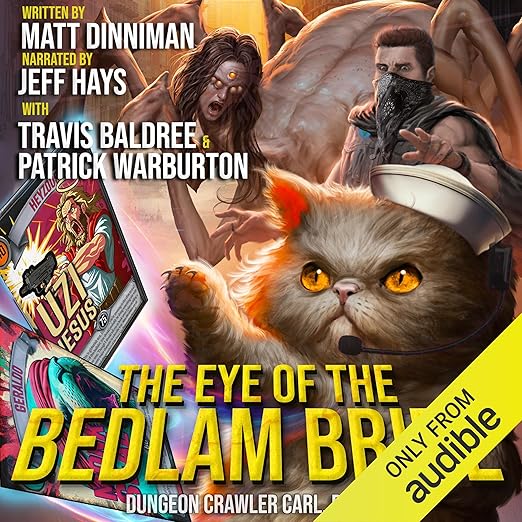
I came into The Eye of the Bedlam Bride having finished book five the week before, which means I had approximately zero emotional distance from the events of the seventh floor when Carl and Donut stumbled onto the eighth. Matt Dinniman uses that momentum mercilessly. The opening of this novel does not give you time to catch your breath, and then it deliberately slows down in a way that is initially disorienting and eventually, about fifty pages in, reveals itself as one of the more formally interesting choices in the series.
This is book six of Dungeon Crawler Carl - a LitRPG series about humans trapped inside a massive dungeon operated as a galactic reality TV show - and it is not, in any practical sense, an entry point. If you have not read or listened to the prior five volumes, none of the emotional stakes of this review will land correctly. Start from book one. But if you are already in the series, book six is where Dinniman fully commits to the mythology he has been building, and the Bedlam Bride herself is the payoff of that commitment.
Shi Maria's Card-Game Floor Turns Genuinely Threatening
The eighth floor's conceit is elegant and slightly disorienting: a map based on Earth's final days before the collapse, populated by intangible ghosts going about their lives in ignorance of imminent doom, with legendary creatures drawn from real-world geographic lore inhabiting the same space. Carl and Donut must capture six of these creatures and build a card deck - a structure that one reviewer accurately summarized as Pokemon Trading Card Game if you had to capture the Pokemon yourself first, which is a perfect encapsulation.
The Bedlam Bride, Shi Maria, is described in the synopsis and in the novel itself with a specific kind of dread: she is intelligent, she was married to a god now missing, and her special attack is known to drive one insane. The beware, beware framing is not marketing copy - she is the first creature in the series who genuinely threatens Carl on a level beyond physical danger. The encounter between Carl, Donut, and Shi Maria is where the novel earns everything it has been building toward.
Hays Handles Every Register on the Eighth Floor
Jeff Hays is the reason this series has the audio reputation it has. He does not narrate a cast of characters - he performs them, with distinct voices, tonal ranges, and comic timing that vary from character to character without ever losing the thread of the narrative. The system notifications, the monster dialogue, the increasingly unhinged announcements from the dungeon's management: Hays handles each register with complete control. At 26 hours and 46 minutes, this is an enormous commitment, and the production quality justifies every hour of it.
Reviewer Kevin Co called this another fantastic entry in the series, noting the card-based mechanic specifically. Reviewer Bethany Salas captured the specific challenge of the Earth-memory sequences - the way being back on Earth gives the book a different vibe that initially felt odd but found its rhythm - which is actually a useful preparation for listeners who might find the opening chapters disorienting. The disorientation is intentional and resolves.
Faster Writing and a Darker Emotional Swing
One reviewer raised a recurring criticism across multiple volumes: the writing is in need of some editing, not in the craft sense but in the mechanical sense. Dinniman writes fast and publishes at a pace that the polish does not always match. There are passages that could be tighter, and some of the worldbuilding detail that long-term readers love is also the content that new readers would find indulgent. If you have read five books and are here for book six, this is not news - you have made your peace with it. If you are new to the series based on the premise, start from book one and make your assessment of the style before committing to six volumes.
The series' tonal range - genuinely funny, genuinely sad, genuinely disturbing, often in rapid succession - is more extreme in book six than in prior volumes. The Shi Maria storyline goes to dark emotional territory. Listeners who have been charmed by the humor of earlier books should know that this installment uses that charm as leverage to deliver harder hits.
Five Books Deep Is the Only Entry Point
Existing Dungeon Crawler Carl listeners who are current through book five. This is not a qualification; it is a structural requirement. The emotional stakes, the mythological context, and the character relationships all depend on five prior books of accumulation. Coming in at book six is not meaningful reading.
For potential new listeners: the series is one of the most committed creative achievements in LitRPG audiobook production, and Jeff Hays's narration is among the best in the genre. Start from book one. If the humor and humanity of the first volume resonate, you will read all six and want more.
Key Details
- Voice: Jeff Hays is the defining element of the Dungeon Crawler Carl experience, and he delivers book six with the same full-cast energy and tonal range that has made this series' audio production a benchmark for LitRPG.
- Big ideas: power through collectivity versus individual heroism, the weight of accumulated consequences, game mechanics as moral framework
- Atmosphere: Chaotic, funny, emotionally sucker-punching - often all three within a single chapter
- Worth it?: The sixth floor raises the stakes and complicates the world in ways that reward the investment of five prior books, with the Bedlam Bride herself emerging as one of the series' most genuinely unnerving creations.
A Few Questions About The Eye of the Bedlam Bride
Jeff Hays is listed as narrator - what should new listeners expect from his performance of this series?
Hays performs the Dungeon Crawler Carl series as a full-cast production with distinct voices for each character, tonal range across comedy, horror, and emotional drama, and specific vocal treatments for the dungeon's system notifications and management announcements. His performance is widely considered one of the defining elements of the series and a benchmark for LitRPG audio production. The 26-hour runtime at this level of performance is a significant commitment.
The synopsis mentions Earth's 'final days' as the setting for the eighth floor - is this a time travel or memory sequence, and how does it work within the LitRPG framework?
The eighth floor is a map constructed to resemble Earth in its final days before the collapse that created the dungeon. The inhabitants are described as ethereal, intangible ghosts going about their lives oblivious to impending doom. It is not time travel in the conventional sense but a dungeon-built simulation or memorial layer - the mechanics are explained within the fiction, and while the setting initially feels disorienting compared to earlier floors, it resolves into a coherent framework within the opening chapters.