Quick Take
- Narration: Hollie Jackson handles Ariane’s perspective with clear control, distinguishing a strong cast of secondary voices without losing the story’s political tension.
- Themes: Vampire hierarchy and freedom, political maneuvering in an ancient society, loyalty under pressure
- Mood: Intricate and atmospheric, with bursts of sharp action
- Verdict: A serious second installment for readers who want vampire fiction that treats its own mythology with genuine rigor rather than using it as backdrop for romance.
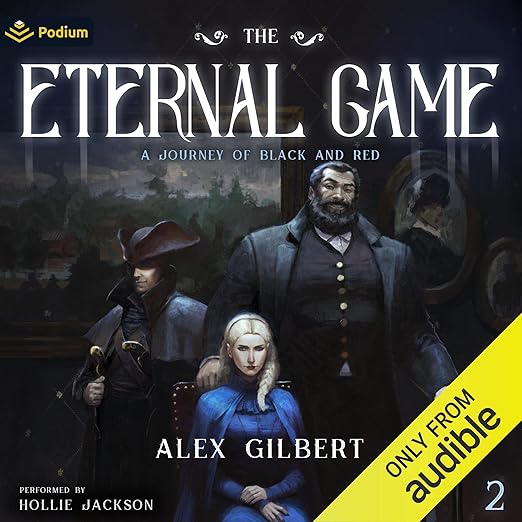
I picked up the first book in this series on a recommendation that compared it to Vampire: The Masquerade, and I finished the second one, The Eternal Game, on a rainy Tuesday evening when I had meant to only listen for an hour. That is the clearest endorsement I can give this kind of series: it doesn’t just hold your attention, it makes the negotiation for your time feel worth it. Alex Gilbert is doing something specific here, and by the second installment it is clear that this is a deliberate, world-built project rather than a vampire story assembled from familiar parts.
Hollie Jackson narrates across nearly twelve hours with consistent command of the material. Ariane’s interiority is rendered with intelligence rather than melodrama, and Jackson differentiates the secondary cast, including Loth, Dalton, and the Choctaw seer Nashoba, in ways that feel grounded in character rather than just vocally distinct. The audiobook format benefits this particular novel because the political complexity of the vampire society requires careful attention, and Jackson’s pacing helps listeners track who is aligned with whom and what each development costs.
Our Take on The Eternal Game
The central tension of this second installment involves Ariane’s attempt to reclaim her status as a free entity in a rigidly hierarchical vampire society that does not easily grant that kind of autonomy. What distinguishes Gilbert’s approach from most contemporary vampire fiction is the seriousness with which the political structure is treated. The clans have distinct supernatural traits and entrenched interests, and Ariane’s navigation of those interests is genuinely complex. One reviewer noted that the vampires here function the way you would expect real vampires to function if they existed: not as romantic figures, not as angsty outsiders, but as ancient power structures with all the institutional inertia and internal betrayal that entails. That framing captures what makes this series interesting.
Why Listen to The Eternal Game
The case for this as an audiobook specifically rests on two things. First, the world-building is dense enough that Hollie Jackson’s steady narrative voice provides a useful anchor. Listeners who are unfamiliar with the first book, A Memory of Flame, will feel the gap, this is emphatically not a standalone entry. But for listeners who have spent time in Gilbert’s Georgian countryside with Ariane already, the second book delivers on the promises made in the first one. Reviewers consistently note that the emotional stakes increase as the series progresses, and by the end of this installment the action sequences and character relationships have taken on a weight that earlier chapters were building toward. One reader described reading it cover to cover in a single sitting; on audio that kind of sustained engagement is harder to replicate, but the same narrative momentum is present.
What to Watch For in The Eternal Game
This is book two of a series, and it requires familiarity with the first installment to function fully. The stakes are higher here than in the opening book, but the payoff is proportional. Listeners should know going in that the protection of Ariane’s territory brings complications that feel earned rather than contrived, and that the friends she has gathered around her, including the burly scholar Loth and her human vassal Dalton, are given room to develop in ways that distinguish this from vampire fiction where secondary characters exist primarily as plot devices. One reviewer warned that the emotional hits near the end come harder than expected. That is accurate and worth noting: Gilbert is not primarily writing action sequences, even when action is happening. The political and relational stakes are where the real investment lives.
Who Should Listen to The Eternal Game
Listeners who completed the first book in the Journey of Black and Red series and found it compelling should come to this one immediately. Readers who enjoy vampire fiction rooted in political hierarchy and genuine consequence rather than romantic tension will find Gilbert’s approach refreshing. This is less well suited to listeners looking for a self-contained story, those who prefer lighter paranormal fare, or anyone who finds extensive world-building more exhausting than rewarding. The LGBTQ+ tagging on this series is relevant, though the book’s primary energy is political and action-driven rather than romantic.
Frequently Asked Questions
Do I need to read the first book in the Journey of Black and Red series before starting The Eternal Game?
Yes, firmly. The second installment picks up Ariane’s story directly and assumes familiarity with the world, the vampire clan structure, and the relationships established in the first book. Starting here would be confusing.
How does Hollie Jackson handle the large supporting cast in this installment?
Jackson differentiates the main characters clearly and keeps the secondary cast distinguishable without overplaying any of the voices. Ariane’s perspective remains the grounding thread, and Jackson holds that center well across nearly twelve hours.
Is the vampire mythology here more traditional or does it take a distinct approach?
It takes a distinct approach informed by tabletop RPG traditions rather than contemporary romantic fiction. Reviewers specifically compare it to Vampire: The Masquerade, with clans, hierarchies, and supernatural distinctions that feel thought-through rather than decorative.
Does The Eternal Game end on a cliffhanger or resolve its main storyline?
Based on reader accounts, the installment builds to a significant emotional and narrative escalation that leaves threads deliberately open for the next book. Several reviewers noted the ending lands with genuine impact.