Quick Take
- Narration: Declan Winters brings Gillian Hamilton’s fish-out-of-water city-boy anxiety to life without overplaying the comedy, and handles the Gunner scenes with enough heat to make the attraction credible.
- Themes: Forbidden partnership becoming romance, steampunk frontier adventure, identity across the law
- Mood: Playful and propulsive, with genuine romantic warmth beneath the action
- Verdict: A brisk and inventive series opener that earns its premise, magic, steam, and the American frontier is a combination that works better than it has any right to, and Poe’s character chemistry is the reason.
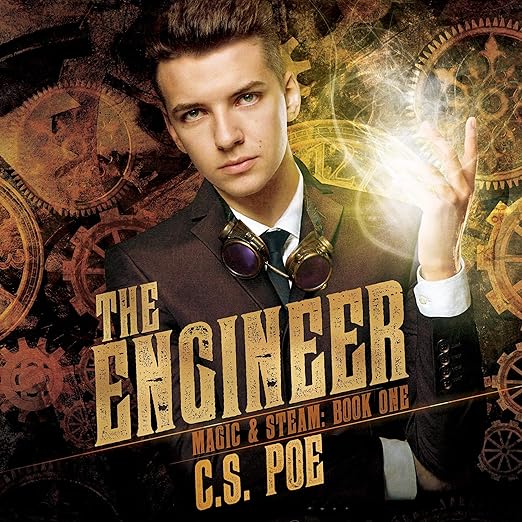
I put The Engineer on during an afternoon when I wanted something I could finish in a single sitting without investing in a long commitment. At two hours and thirty-four minutes, it is a novella rather than a novel, and C.S. Poe makes that length work in a way that longer books often fail to. There is no padding here, no structural indulgence, no scene that exists to fill time. Every chapter advances either the external plot or the central relationship, and the result is a book that moves like the Gatling gun contraptions its villain deploys: with mechanical efficiency in service of something that actually wants to hit its target.
The premise is 1881 Arizona, steampunk flavor, with a Federal Bureau of Magic and Steam whose special agents wield casting abilities alongside conventional law enforcement tools. Gillian Hamilton is one of those agents, a city boy from New York, technically elite, socially awkward in exactly the way that makes him charming rather than irritating. His assignment is Shallow Grave, Arizona, where a madman engineer called Tinkerer is attempting to control the town’s silver mines. The complication is Gunner the Deadly, the country’s most infamous outlaw, who is hunting Tinkerer for his own reasons and who proposes a temporary partnership with Gillian that both of them know is a very bad idea.
How Poe Builds the World Without Slowing the Story
Worldbuilding in a novella is an exercise in economy. Poe does not stop to explain how magic casting works in any systematic way, trusting that the context will make the mechanics clear as they appear. This is the right call for the format: a two-and-a-half-hour audiobook cannot sustain the kind of extended world-explanation that an eight-hour fantasy novel can earn. What Poe delivers instead is atmosphere, the feel of the frontier, the social dynamics of a small Arizona town in 1881, the particular texture of a world where steam technology and magical ability coexist as unremarkably as telegraph lines and six-shooters. The worldbuilding is present in the details rather than the exposition, which is exactly how it should work at this length.
The Bureau of Magic and Steam is a nicely observed institution: hierarchical, bureaucratically self-important, sending its best agent across the country to deal with a problem that is, for Gillian, professionally routine until it stops being routine. The Tinkerer’s scheme is appropriately outlandish, illegal magic, Gatling gun contraptions, silver mine takeover, and functions primarily as a mechanism for getting Gillian and Gunner into the same scenes, which is where the book is most alive.
The Chemistry That Makes the Series Worth Starting
Several reviewers describe the Gillian and Gunner dynamic as the book’s central achievement, and one reader who came in as a series skeptic described this entry as potentially edging past Poe’s celebrated Snow and Winter series. That is strong praise from a committed reader of Poe’s work, and it is justified by how efficiently the central dynamic is established. Gillian is the tightly laced-up lawman who is aware of the attraction and distressed by it. Gunner is the outlaw who makes no particular effort to conceal his interest. The tension is well-calibrated, present enough to power the emotional plot, controlled enough to feel like it is building toward something rather than resolving immediately.
Declan Winters’s narration handles both characters with the right tonal differentiation. Gillian’s internal anxiety is present in the delivery without tipping into the kind of excessive agonizing that can make first-person romantic protagonists tiresome. Gunner comes through as genuinely dangerous as well as attractive, which matters for the dynamic to work: an outlaw who does not feel like a threat is just a love interest in a costume.
What the Novella Length Costs
One reviewer described feeling like they were reading a chapter of fan fiction due to the length, and while I think that is too harsh, the observation points to something real: The Engineer establishes a world and a relationship and then closes at the moment those things are ready to become something larger. This is the structural reality of a series opener in novella form. The individual entry is intentionally incomplete, a first chapter rather than a full story, and readers who want a satisfying standalone conclusion will need to go into the series knowing that the relationship arc extends well beyond this volume.
Multiple reviewers describe going immediately to book two, which is probably the right response. At this length, the investment is minimal enough that evaluating it purely as a standalone is slightly unfair. The question is whether Poe establishes enough to make you want more, and the answer, for the right reader, is unambiguously yes.
Who Should Listen, Who Should Skip
Listen if you enjoy M/M romance with action and adventure framing, if steampunk frontier settings appeal to you, if you are looking for a series starter that does not demand a massive upfront time commitment, or if C.S. Poe’s name already means something to you. Skip if you need complete narrative resolution within a single entry, if novellas consistently leave you feeling shortchanged regardless of quality, or if you have no appetite for explicit romantic content in a genre setting. The heat level is present but not the primary focus in this first book.
Frequently Asked Questions
Is The Engineer a standalone, or do I need to commit to the full Magic and Steam series?
It is book one in the Magic and Steam series, and it functions as a series opener rather than a complete standalone, the relationship arc begins here but extends through later entries. At under three hours, the time commitment for sampling is minimal, and most readers find themselves continuing immediately to book two.
How explicit is the content in The Engineer compared to later books in the series?
The first book establishes the attraction and tension without fully resolving it in explicit terms, it is more romantic heat than graphic content. Reviewers of later entries suggest the heat level increases as the series progresses. If you are concerned about content level, this is a relatively safe entry point.
Does Declan Winters’s narration handle the outlaw-versus-lawman dynamic effectively?
Yes. Winters differentiates Gillian’s anxious-city-boy energy from Gunner’s dangerous outlaw confidence in a way that makes the attraction credible rather than convenient. The internal monologue sections, which are heavy in a first-person romance novella, are handled without becoming tedious.
Is prior knowledge of C.S. Poe’s other series, like Snow and Winter, necessary or useful?
Not necessary at all. The Magic and Steam series is completely separate, set in a different world with different characters. Familiarity with Poe’s general style, the character-chemistry focus, the balance of genre adventure and romantic development, is useful context, but the book stands entirely on its own.