Quick Take
- Narration: Jason Zenobia delivers a clear, steady read suited to the informational density of five compiled manuscripts, professional without being expressive.
- Themes: Soviet endurance and institutional failure, the human cost of ideological war, Stalin’s military purges
- Mood: Dense and comprehensive, a survey rather than an immersion, informative but not cinematic
- Verdict: A useful overview collection for listeners new to the Eastern Front, with clear limitations for those who want depth or scholarly rigor.
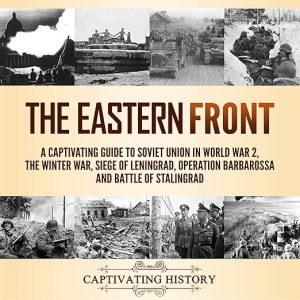
I came to this Captivating History collection on a Sunday afternoon when I wanted context, not drama. I had been thinking about the Battle of Stalingrad after finishing Anthony Beevor’s account, which is immersive and granular to the point of exhaustion, and wanted something that placed that battle inside the larger pattern of the Eastern Front without requiring another eight hours of dense historiography. The Eastern Front turned out to be precisely that: an overview collection that covers the ground without demanding that you already know it.
The product is five previously published Captivating History manuscripts compiled into a single nine-hour audiobook: Soviet Union in World War 2, The Winter War, Leningrad (the Siege), Operation Barbarossa, and Stalingrad. Each section functions as a standalone introduction to its subject. Together they trace the arc of the Eastern Front from the context of Stalinist purges through the decisive Soviet victory at Kursk and beyond.
Our Take on The Eastern Front
The Captivating History series has a specific approach that this audiobook exemplifies: accessible, conversational, and broad-stroked. One reviewer describes the writing as having "a chatty, conversational style that may be aimed at kids, but adults can benefit from reading it as well." That is a fair characterization. The prose does not condescend, but it also does not assume prior knowledge, which makes it genuinely useful for listeners coming to this subject without a background in World War Two’s eastern theater.
The strongest section, by most listener accounts, is the Stalingrad manuscript, the battle that turned the war on the Eastern Front is inherently the most dramatic material, and the overview format handles it effectively by focusing on the strategic and human arc rather than tactical detail. The Winter War section is also notably solid, covering the Russo-Finnish conflict of 1939-1940 with enough specificity to explain why the Red Army’s poor performance in Finland gave Hitler false confidence about Operation Barbarossa.
Jason Zenobia’s narration is professional and serviceable, he reads clearly and maintains appropriate pacing for informational content. He is not asked to bring dramatic texture to the material, and does not try to impose it.
Why Listen to The Eastern Front
The case for this audiobook is the same as the case for any good survey: it gives you the map before you walk the territory. If you want to understand how five separate campaigns, the Finnish war, the siege of Leningrad, Barbarossa, Stalingrad, and the broader Soviet experience, connect to each other, this nine-hour package covers all of them in sequence. That connective structure is more useful than five individual audiobooks listened to separately, because it allows the causality to become clear: how Stalin’s purges of the officer corps led to catastrophic early failures, how those failures were eventually reversed, how Soviet industrial capacity and human resilience combined to defeat a militarily superior invasion force.
One reviewer opens with the book’s most striking frame: a 1941 Soviet newspaper excerpt that captures the attitude that allowed the USSR to absorb losses that would have collapsed other nations. That frame, what it took to endure, is the emotional core of the collection.
What to Watch For in The Eastern Front
The credibility concern raised by one reviewer is worth taking seriously: the author or authors are not identified, and the work contains no footnotes or index. This is standard for the Captivating History series, which prioritizes accessibility over scholarly apparatus. If you need sources for further research or are using this for academic purposes, you will need to find them elsewhere. As a starting-point orientation to the subject, the content is reliable in its broad outlines, but it cannot be cited.
The five-manuscript structure also means some repetition of context across sections, each chapter re-orients listeners to the broader war situation, which can feel redundant if you listen to all five consecutively.
Who Should Listen to The Eastern Front
Strong choice for listeners who know the Western Front of World War Two reasonably well but have less familiarity with the Eastern theater, which claimed far more lives and arguably did more to determine the war’s outcome. Also suitable for anyone who wants a structured overview before moving on to more detailed accounts, Beevor on Stalingrad, David Glantz on Barbarossa, or Harrison Salisbury on Leningrad.
Not recommended for historians or listeners with existing depth in the subject, the overview format will cover little new ground. Skip also if you need documented sources or scholarly analysis rather than accessible summary.
Frequently Asked Questions
Does this audiobook cover the entire Eastern Front, or just selected battles?
It covers five major subjects: the Soviet war experience broadly, the Winter War with Finland, the Siege of Leningrad, Operation Barbarossa, and the Battle of Stalingrad. These are the pivotal events of the Eastern Front, though the later Soviet offensives of 1943-1945 receive less attention than the earlier defensive phase.
Who is the author, and how reliable is the content?
The Captivating History series does not identify individual authors, which is a legitimate concern for listeners who want to evaluate sources. The content is broadly accurate in its outlines but lacks footnotes and cannot be used as a citable academic source. It works as an accessible introduction, not as a scholarly reference.
How does Jason Zenobia’s narration handle material this dense?
Zenobia reads clearly and maintains appropriate pacing for informational content. He is not an expressive narrator, this is not a performance, but his delivery suits the overview format, which prioritizes information transfer over atmosphere.
What should I read or listen to after this if I want to go deeper?
Anthony Beevor’s Stalingrad offers far more detail on that battle. David Glantz’s work on Barbarossa is the scholarly standard. Harrison Salisbury’s The 900 Days covers the Leningrad siege at length. All three are available in audio form.