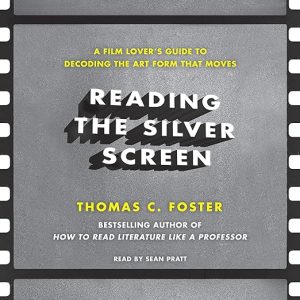
Movies teach you a grammar nobody ever sits you down and explains, and Thomas C. Foster spends this audiobook naming its parts. He built his reputation on How to Read Literature Like a Professor, and here the same investigative habit moves from the page to the screen: every art form runs on a set of practices and if-then propositions that amount to rules, film included, and the interesting things happen at the moments a director follows them or refuses to. Eleven hours and forty-two minutes of that, with the AFI hundred-year lists supplying most of the evidence.
This UK Reviewer's Reader Is Not Sean Pratt
Twice in one response the word reader turns up, and neither time does it mean Sean Pratt. Filed from the United Kingdom in January 2021, that four-star is grading itself rather than the performance: the writer settles on three stars as a self-assessment, then credits the book with achieving its effect in spite of the three-star reader receiving it. Worth untangling before you go hunting this page for performance notes, because that particular word is doing entirely different work here.
Under that confusion sits the strongest recommendation the page offers, and it is behavioral rather than aesthetic. Not that the argument convinced, not that the prose sang, but that films looked different afterward and kept looking different. Foster is chasing precisely that outcome, wanting viewers to notice what they have always processed without registering. Discovering his work at all gets called a boon in that same response, which is generous phrasing from somebody who nearly filed three stars.
Grammar First, Then What Breaking the Rules Does
Extremely informative and highly entertaining, says the five-star from May 2020, calling the combination a strong one. That is the plain version of what Foster does well. His register never leaves the classroom: state a claim, pull an example from a picture most people have seen, make the mechanism visible, move on. Nothing in it demands a film-studies vocabulary you do not already have, and nothing in it condescends to you for lacking one.
Grammar comes first and everything else is built on it. Foster establishes that film has rules, then works through how the language of film delivers the purpose behind a story and the message a director wants an audience to carry out of the theater, then turns to what breaking those rules accomplishes. Classic and current pictures both, foreign and domestic, sorted into categories that are frankly idiosyncratic, which turns out to be the reason they hold your attention.
Sean Pratt takes the entire eleven hours alone, and this material makes one very specific demand. Foster's method is to describe a shot and then explain what the shot is doing, which means long stretches of visual description delivered to somebody who cannot see the frame. Pace decides everything there: too brisk and the image never assembles behind your eyes, too slow and the analysis loses its thread. One credited voice on a book of images is a real production decision.
Descriptions Only Land if You've Seen the Film
October 2016 brought the only three-star here, and its objection is structural rather than sour. Much of the book, it reports, consists of detailed descriptions of particular films; where you have seen the picture, those passages deepen it and surface details you missed, and where you have not, almost nothing transfers. Large sections got skipped as a result. That same verdict also wants Foster to say more plainly which films he loves and which he cannot stand.
Skipping is the part that does not survive the format. An eye skids down a page of plot description in a few seconds and rejoins the argument on the far side; an ear either sits through it in real time or fumbles for a scrub bar and guesses where the analysis resumes. Anybody arriving without a broad viewing history will spend genuine minutes inside accounts of movies they have never watched, and no quality of reading repairs that.
Two smaller facts belong on the record. Averaged out, the four written verdicts land on four stars flat against the 4.4 displayed over seventy-two ratings, so the people who only clicked came away happier than the people who wrote paragraphs. And the shelving is simply wrong: a study of film grammar sits filed under history and religion with a Religious tag attached to it, a category path no honest browse would ever produce.
Movie Buffs With a Deep Back Catalog
Movie buffs with a deep back catalog are the natural buyers, and the November 2016 four-star sketches one exactly: comfortable with old and new pictures, never having gone deeper into the art that produces them, and finding the working definitions of frame, scene and shot enough to sharpen everything watched afterward. Foster writes toward that person throughout, somebody carrying the viewing hours and no vocabulary to organize them with.
Aspiring screenwriters and directors get named as an audience too, along with students, though this is not a craft manual and never pretends otherwise. Recognition is what it teaches, not construction. Somebody drafting a script will take more from the chapters on rule-breaking than from the ones establishing the rules, and anybody teaching an introductory course inherits a ready-made sequence with quotable definitions already built into it.
Give it a miss if your viewing is thin, because the examples carry the argument and an unseen example carries nothing. Anybody hoping for a critic rather than a teacher should also pass, since Foster is describing a method instead of ranking a canon and keeps his enthusiasms mostly offstage. Print wins outright for anyone who plans to pause a film and look.
Common Questions
Do you need a broad viewing history to follow this audiobook?
It helps enormously. Foster builds his arguments on extended accounts of specific pictures, most of them drawn from the AFI hundred-year lists, and those passages land completely differently depending on whether the film already lives in your memory. Somebody who has worked through that list will follow every move. Somebody who has seen a handful will lose whole stretches.
Does eleven hours and forty-two minutes feel long for a single audiobook about film?
The length comes from the method, which is cumulative: rules first, then the language built on them, then the pictures that break them. Concepts divide cleanly, so twenty-minute sessions work well. Only the extended descriptions of individual films drag, and those are exactly where an impatient listener reaches for the skip control.