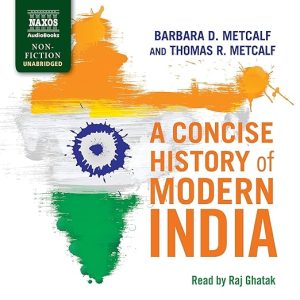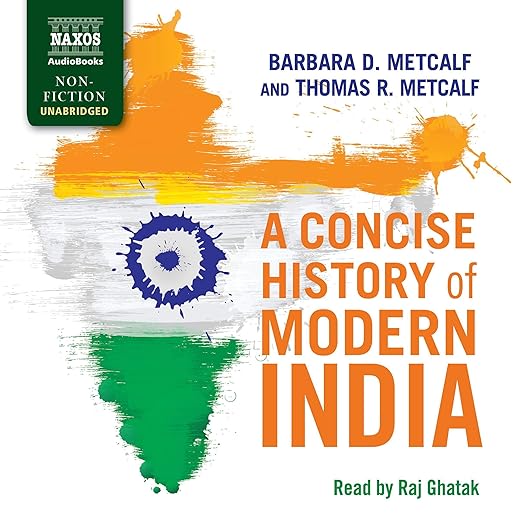
Two historians wrote A Concise History of Modern India, and just one of them appears on the byline of this audiobook. Barbara D. Metcalf and Thomas R. Metcalf are both named in the description; the credit line reads Barbara Metcalf, minus the middle initial. That sounds like pedantry until you go looking for the edition you just heard in a library catalog and find yourself unable to match it to anything.
Choosing a Spine From the Mughals to Now
Mughals to the present is the span, which for one volume borders on reckless, and the book survives it by choosing a spine. The narrative follows the imaginative and institutional structures that sustained and transformed India, first under British colonial rule and then, after 1947, as an independent country. Social and economic development and cultural life are woven through that political thread rather than quarantined into their own chapters, which is the harder way to build a survey and the more useful one.
Declining to Lecture, and an Unstated Revision
Rahul Srivastava's four-star response from January 2013 puts a finger on the quality that makes it usable: the book declines to lecture. The account gets called good and possibly impartial, and the compliment is specific, that the connection to global affairs is drawn without the authors arriving at a closing chapter of solutions the country never requested. Most Western writers cannot resist that ending, the response argues, and this one does.
Naxos AudioBooks issued the recording in March 2019, eighteen years after the book first appeared, and that interval raises a question the page never answers. The description places the final chapter between 1990 and the Congress electoral victory of 2009, so whatever was recorded, it was not the 2001 original. Which revision reached the studio is left completely unstated, and for a survey whose usefulness depends on where it stops, that omission is not trivial.
Ghatak's Casting Removes a Constant Friction
Tater's March 2020 response is the standard use case in miniature: bought for a class, exactly what was needed. This is a set text from the Cambridge Concise Histories series and it behaves like one, favoring orientation and coverage over argument. If your aim is to follow a conversation about modern India rather than to take a position inside one, that shape is precisely right, and a recording makes the groundwork portable.
Institutions rather than chronology give the book its organizing idea, and at this altitude that is the better choice. Instead of marching through administrations, the narrative keeps asking what structures held, what people imagined those structures were doing, and how much actually changed hands in 1947 beyond the flag. Dates still arrive in quantity, but they arrive attached to something, which is the only way a survey this compressed stays navigable in audio.
Raj Ghatak takes the reading, and on a book like this the casting carries real weight. The text is thick with Indian place names, institutions, movements and personal names, and a reader who moves through them without hesitation removes a friction that would otherwise interrupt every other sentence. The listing supplies the credit and stops, so the performance itself remains undescribed on the page.
Reviews About Parcels, Not About the History
Lifelong Reader filed the lowest grade on the listing, three stars in April 2018, and the complaint is the one this format sharpens: a wild gallop through reams of dates, people and places. That response also argues the account is slanted, shading the errors of the colonial period, a charge worth knowing about whether or not you end up agreeing with it. On the pacing objection, I think it is straightforwardly correct.
Three of the five written responses on this page describe a parcel rather than a book. Delivery times, packaging and the state of the parcel on arrival: all five stars, all pooled into the same 4.2 alongside the two responses that engage with the history itself. A rating assembled that way is reporting on fulfillment, and the figure at the head of the page cannot distinguish between the two.
Density is the deeper caveat. Compressed synthesis rewards somebody who can stop on a paragraph and come back to it, and heard straight through, that same paragraph becomes six proper nouns in a row with no handhold. No companion timeline, map, chapter outline or glossary is listed with this recording, and those are exactly the materials a book of this kind normally leans on to stay usable.
Fair for a Class, Fair for the Ground Covered
Undergraduates working through an assigned reading list, and anybody shadowing a course from outside it, are the natural audience. Gabrielle's March 2021 entry is unintentionally the most honest thing on the page: bought for a class, impossible to resell once the class ended, still sitting on a shelf two years later. That is the ordinary life cycle of a set text, and the audio version at least spares you the shelf space.
Listeners who want a story rather than a survey should look elsewhere. This is synthesis, not narrative history; it does not build toward scenes or personalities, and the Mughal material, the colonial century and the post-independence decades all get handled at the same steady altitude. Anybody arriving from popular history expecting momentum will read that evenness as coldness, and the density will make the eleven hours feel longer than they are.
Eleven hours is fair for the ground covered, and for the right listener this is an efficient way to acquire a working outline of two centuries. My reservations sit with the page rather than the book: a co-author named in the description but absent from the credit, an unidentified revision, an empty series number, and an average carrying three responses about postal delivery. The scholarship underneath all of that is solid and well organized.
Good to Know
Why does the byline on this audiobook name only one Metcalf?
No explanation is given. The description credits Barbara D. Metcalf and Thomas R. Metcalf as joint authors, while the credit line shows Barbara Metcalf alone and drops the middle initial. Both are standard cataloging slips on audio editions, but the result is a page that under-credits one of the two writers.
Does the audiobook cover Indian history after 2009?
No. The description places the closing chapter between 1990 and the Congress electoral victory of 2009, and although the recording appeared in 2019, nothing indicates an update past that point. A decade of subsequent Indian politics falls outside what you will hear.
Is this part of a series, and does the order matter?
It belongs to the Cambridge Concise Histories, though the volume number field on the listing is blank. Nothing in the description depends on another title in the set, so you can start here without hunting down a predecessor first. The series field carries no ordering information of any kind.