Quick Take
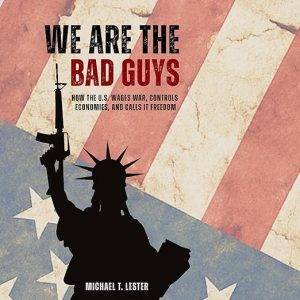
- Narration: Michael T. Lester narrates his own work, and the self-narration carries the weight of his personal reckoning, a Marine pilot confronting what his service actually meant.
- Themes: US foreign policy, covert intervention, the gap between stated values and documented action
- Mood: Measured and unsettling, documentation-forward
- Verdict: Lester’s insider credentials and two decades of research give this critique genuine authority, though listeners unfamiliar with Zinn or Bacevich may find the framing disorienting at first.
I was somewhere over the Atlantic when I started this one, which felt appropriate. There is something about the suspended geography of long-haul travel that makes you receptive to arguments about the gap between how countries see themselves and how they are experienced from the outside. Lester opens with exactly that gap, the disconnect between the liberation narrative he was trained to deliver and the faces of people in the countries where he flew combat missions who did not look particularly liberated.
That is a strong hook, and Lester earns it. He is not a journalist writing from the outside in. He is a Naval Academy graduate and former Marine combat pilot who served across Asia and the Middle East and spent twenty years afterward trying to reconcile what he witnessed with what he had been told. The book is the product of that reconciliation: a synthesis of declassified documents, leaked cables, and serious historians that connects what Lester calls the coups, sanctions, and covert operations that American foreign policy has deployed across Latin America, the Middle East, Africa, and Southeast Asia.
The Credibility the Title Depends On
The provocative framing, “we are the bad guys”, could easily collapse into polemic, and with a different author it probably would. What keeps it grounded is Lester’s methodology and his background. He has read the historians seriously. He is working from Howard Zinn and Andrew Bacevich and similar scholars, but he is also reading the primary sources: declassified documents, congressional testimony, cables that were not meant to be public. He is not making things up. He is connecting things that are documented but kept compartmentalized in how they are taught.
The reviews from listeners confirm what the author claims about his method. Multiple reviewers describe the book as “both impartial and very informative,” which is notable given how charged the subject matter is. The question he is asking, what if the American self-image as the global force for democracy does not match the historical record, is not a question most Americans are asked to engage with in school. Lester argues it is a question the world sees the answer to clearly.
Self-Narration as Testimony
Lester narrates his own book, and that choice matters here more than it would for most titles. This is not a professional narrator delivering someone else’s argument. It is the man who flew the missions reading his own conclusions about what those missions meant. There is a weight to that which a third-party narrator could not replicate. When Lester describes the gap between what he was told and what he observed, you are hearing someone who has actually processed that dissonance across two decades. The narration is not polished in the commercial audiobook sense, but the authenticity it carries more than compensates.
What the Book Does Not Do
This is not a measured, both-sides policy analysis. Lester is making an argument, and he states it plainly: American foreign policy has systematically undermined the democratic values it claims to represent, and the documentation exists to prove it. Listeners who come expecting even-handed geopolitical analysis will be frustrated. The book also covers an enormous amount of territory, Latin America, the Middle East, Africa, Southeast Asia, across eleven hours, which means individual case studies do not get the depth a full monograph would provide. Think of it as a synthesizing overview for listeners who want to understand the pattern before diving into the regional literature.
Who Should Listen / Who Should Skip
Listeners who enjoyed Howard Zinn’s A People’s History or Andrew Bacevich’s critique of American militarism will find this a useful synthesis. Veterans and military readers who have served in the regions Lester covers and noticed the same disconnect he describes will find it validating and specific. Listeners who want a balanced foreign policy primer or who are encountering this critique for the first time may need supplementary reading to contextualize Lester’s claims. Anyone expecting the prose precision of a major press publication should calibrate expectations, this is an independently produced work, and it reads like one in places.
Frequently Asked Questions
Does Lester take a partisan political position, or does the book apply across party lines?
The critique is historical rather than partisan. Lester documents interventions across Republican and Democratic administrations and explicitly frames the book as pro-truth rather than anti-American or ideologically aligned.
Is the audiobook based on the physical book, or is it a different product?
The audiobook is Lester narrating the same content as the print edition. One reviewer mentions buying the physical book after listening to the author and finding the experience of reading it valuable as a complement.
How does this compare to Zinn’s A People’s History for listeners who have already read that?
Zinn covers domestic history and labor; Lester’s focus is almost entirely on US foreign policy and covert operations abroad. They are complementary rather than overlapping in their primary subject matter.
Does the book address the post-9/11 period and the wars in Iraq and Afghanistan?
The synopsis indicates Lester draws on his service experience across Asia and the Middle East, and the book traces a century of intervention, which includes the post-2001 period.