Key Details
- Read by: Michael E. Gerber self-narrates with the seasoned confidence of someone who has delivered this particular framework to business owners across many industries and knows exactly where the arguments land.
- At its heart: The technician-to-entrepreneur transformation, systems thinking over tactical firefighting, building a brokerage that runs without its owner
- Vibe: Practical and clarifying, with the slightly urgent quality of a business coach identifying a pattern you have been too close to see
- Short version: Essential reading for real estate brokers who have built a successful practice but suspect they have built themselves a job rather than a business.
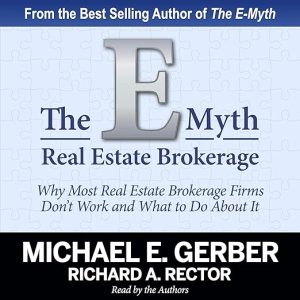
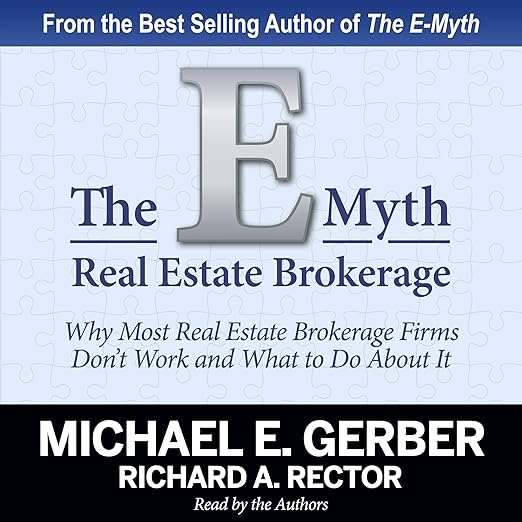
Michael E. Gerber's E-Myth concept has been applied to so many professional niches since the original publication that it is worth asking, with each new edition, whether the adaptation genuinely serves the specific profession or simply changes the industry nouns in the examples. The E-Myth Real Estate Brokerage audiobook, which Gerber narrates himself in collaboration with real-estate-broker expertise from Richard A. Rector, answers that question more satisfyingly than most entries in the series. The brokerage-specific material gives the framework enough friction to feel genuinely applied rather than cosmetically adjusted.
Rector's Three Roles Turn Brokers Into Entrepreneurs
The central argument is the one Gerber has been making since the original E-Myth: most small business owners are technically skilled people who started businesses based on that technical skill and then discovered they had inadvertently created a job that requires them to be present for everything. The real estate brokerage context sharpens this diagnosis usefully. A broker who is also managing listings, handling client relationships, training agents, and handling compliance is doing every job except the one that an owner of a business should be doing, which is building systems that allow the business to function without their constant intervention.
Rector's contribution is the specific application layer. The book covers the transition from real estate broker to broker-manager-entrepreneur, a three-role framework that maps onto the brokerage structure in ways that feel specific rather than generic. The sections on building management systems for agent performance, client intake, and transaction management use examples that are recognizable to anyone who has worked in or around a real estate brokerage. One reviewer described getting golden nuggets from each E-Myth book they read, a consistent pattern for Gerber's series, and this edition delivers those nuggets in the right professional context.
Gerber's Unhurried Self-Narration Fits Six Efficient Hours
Gerber self-narrating is both a feature and a characteristic of this series. His delivery has the quality of someone who has given this talk many times, knows exactly where the inflection should fall, and has no interest in performing for the microphone. At six hours and forty-nine minutes, this is an efficient listen. The audiobook format works well for business frameworks like this one because the structure is sequential and the key concepts reinforce each other better when heard continuously rather than read in interrupted sessions. Gerber's voice carries the authority of long experience, and his pacing allows the ideas to land without feeling rushed.
Working In Your Business Versus Working On It
Listeners who have already read the original E-Myth or other industry-specific editions will recognize the framework immediately. The central distinction between working in your business and working on your business is established early and returned to throughout. If that distinction is new to you, it will be genuinely clarifying. If you have already internalized it from prior reading, the value here is in the brokerage-specific application rather than the framework itself. One reviewer noted that all of Gerber's books are all pretty much the same, which is accurate in the sense that the philosophical architecture does not change between editions. The question is whether the specific application serves your situation.
The book does not cover real estate markets, pricing strategy, or the technical mechanics of running a brokerage in the regulatory or compliance sense. It is exclusively focused on the organizational and entrepreneurial dimensions of brokerage management. Readers looking for guidance on the former will need to look elsewhere. But for the specific problem the book addresses, which is how a technically skilled broker builds an organization that scales without burning out its owner, the audiobook provides a clear, actionable framework.
Gerber's fundamental insight, that the person most qualified to perform a technical service is often the least qualified to run a business built around that service, applies with particular force in real estate brokerage, where the technical skill of closing deals and managing clients is highly visible and immediately compensated, while the organizational work of building systems sits invisibly in the background. A broker who is excellent at the former and neglects the latter finds herself, typically, working harder as her business grows rather than less hard, because growth without systems just means more of everything demanding her personal attention. The E-Myth Real Estate Brokerage names this trap clearly and provides a vocabulary for thinking past it. That vocabulary, working in versus working on, the technician versus the entrepreneur, is simple enough to dismiss as jargon but precise enough to actually change how a practitioner thinks about what they are building. Gerber's self-narration delivers this vocabulary with the confidence of someone who has seen how badly the naming of the problem was needed.
Made for Brokers Still Working In the Business
Real estate brokers who are currently working in their business rather than on it, handling everything personally, and wondering why growth feels like it just creates more work rather than more freedom, will find this audiobook speaks directly to their situation. Agents considering the move to owning their own brokerage will benefit from understanding the organizational design questions before they make that transition. Anyone already familiar with the E-Myth framework who wants the real estate application layer will get exactly what they are looking for.
Skip if you are looking for market analysis, sales strategy, or compliance guidance for running a brokerage. This is an organizational and entrepreneurial framework, not a real estate business manual. The value is in the systems thinking, and if you have already read and internalized the original E-Myth, the incremental insight here is in the examples rather than the principles.
Do I need to have read the original E-Myth before listening to this audiobook?
No, but it helps. The audiobook is designed to stand alone and Gerber establishes the core framework from scratch. However, readers who have already read the original E-Myth Revisited will move through the foundational sections quickly and get to the brokerage-specific material faster. First-time Gerber readers will find the philosophical foundation clearly explained.
How does Michael E. Gerber's self-narration compare to a professional narrator for a business audiobook?
Gerber is an experienced speaker who has delivered this material many times, and it shows in the narration. His delivery is authoritative and confident without being theatrical. For business audiobooks built on a consistent philosophical framework, self-narration from the original author often works better than a third-party narrator, because the author's own phrasing and emphasis carry the argument as intended.
Does this audiobook address the operational aspects of running a real estate brokerage?
It covers the organizational and entrepreneurial dimensions, not the technical or regulatory ones. The book focuses on systems design, the transition from tactical to strategic thinking, and how to build a brokerage that functions without the owner doing everything. For compliance, transaction management mechanics, or market strategy, you will need additional resources.