Quick Take
- Narration: Tom Brooks delivers the material competently, though the instructional content is sometimes too dense for pure audio consumption without reference material nearby.
- Themes: AI tools for business, Microsoft 365 monetization, entrepreneurship in the AI era
- Mood: Energetic and practical, though unevenly so across chapters
- Verdict: Useful for Microsoft-ecosystem users wanting a quick-start framework for AI-assisted income, but the more technical sections assume a baseline familiarity that not all listeners will have.
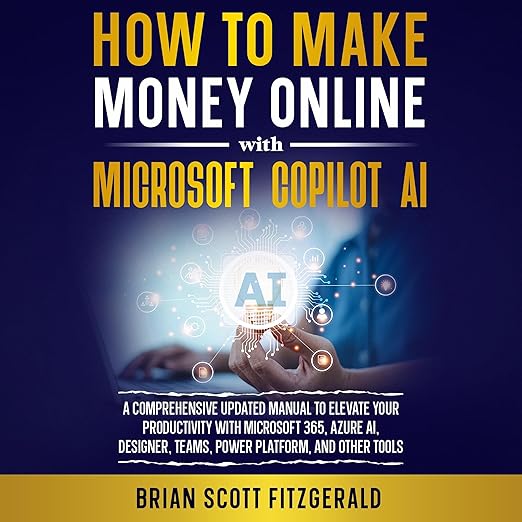
I listened to this one during a stretch of evening walks, which turned out to be an imperfect match. Brian Scott Fitzgerald’s guide to monetizing Microsoft Copilot AI is the kind of instructional content that benefits from having a screen nearby, and the walks meant I was taking mental notes rather than acting on anything. By the third chapter I had started saving timestamps to return to later, which is either a sign of dense practical value or a format mismatch, probably both.
The book aims at a specific and genuinely timely target: people who are already inside the Microsoft 365 ecosystem and want to understand how Copilot and associated tools like Power Platform, Azure AI, and Designer can be turned into income-generating assets. Fitzgerald covers a range of approaches, from freelance content work to building products, to the more complex territory of starting an AI-assisted business. The scope is ambitious for five hours and twenty-five minutes, and the ambition is both the book’s strength and its most honest weakness.
Our Take on the Microsoft Copilot Monetization Framework
Fitzgerald structures the book around Microsoft’s AI ecosystem rather than general AI principles, which is a useful narrowing. There is no shortage of books telling readers that AI will change everything; this one attempts to tell readers how to use one specific AI product suite to generate revenue. The bite-sized case studies that reviewers highlight do make the possibilities feel concrete rather than theoretical, and the end-of-chapter checklists give the audio format a navigational structure it would otherwise lack.
The limitations reviewers note are real. The sections on Azure dashboard navigation assume familiarity that some listeners will not have, and the marketing chapter covers ground more shallowly than the technical tutorials justify. One reviewer with a 3-star assessment notes that the book repeats itself in places and that some of the advice will age quickly given how rapidly Microsoft’s AI tools evolve. That caveat is worth holding in mind: any book tied to a specific software product’s capabilities has a shelf life.
Why Listen to the Microsoft-Specific Approach
What separates this from generic AI-income books is the Microsoft-specific grounding. Fitzgerald covers the integration between Copilot and Word, Excel, Teams, and Power Platform in enough detail that someone already working inside that ecosystem will recognize their actual tools rather than abstract concepts. A content creator who relies on Microsoft 365 will find more directly applicable material here than in a book that talks about AI platforms in general terms. One reviewer who primarily uses ChatGPT found the book useful precisely because it exposed them to a parallel ecosystem they had not explored, which suggests the book works as a cross-training resource as much as a dedicated Copilot guide.
What to Watch For in the Instructional Audio Format
The format presents real challenges for step-by-step technical guidance. Fitzgerald’s walkthroughs are better consumed with the accompanying material open, and audio alone will leave some listeners feeling like they have understood the concept without the ability to execute the specific steps. The list-heavy sections, covering 50 ways to make money with Copilot and similar structures, compress well in print but become harder to retain in pure audio. Listeners who plan to revisit the material in written form will get more from the audiobook than those expecting to absorb actionable instructions in a single listen.
Who Should Listen to How to Make Money Online with Microsoft Copilot AI
This title suits Microsoft 365 users who are already comfortable with the suite and want a structured framework for turning Copilot into a revenue tool. It also works as a quick-scan overview for entrepreneurs who want to understand what is possible before deciding whether to go deeper. Listeners who are completely new to Microsoft’s tools or who have no existing relationship with the 365 ecosystem will find the learning curve steeper than the book’s entry-level framing suggests. Those wanting a comprehensive business strategy guide will find this too narrowly tactical; those wanting only Copilot tutorials will find it too broad.
Frequently Asked Questions
Is this book specifically about Microsoft Copilot, or does it cover other AI tools as well?
The primary focus is Microsoft’s AI ecosystem: Copilot, Power Platform, Azure AI, Designer, and Teams integrations. Some broader AI business principles are covered, but the book consistently returns to Microsoft-specific applications.
How quickly will the content in this book become outdated given how fast AI tools evolve?
Some reviewers flag this as a legitimate concern. Microsoft’s Copilot capabilities are updated regularly, and specific walkthrough steps may change. The strategic frameworks are more durable than the software-specific instructions.
Does Tom Brooks’ narration handle the technical content effectively?
Brooks delivers the material clearly and maintains a consistent pace. The challenge is the format itself: step-by-step software instructions are genuinely harder to absorb in audio than in written form, regardless of narrator quality.
Is there a significant overlap between this book and free Microsoft tutorials available online?
One reviewer notes that Microsoft provides free tutorials and documentation on Copilot, and some of the conceptual ground in this book is covered there. The book’s value is in the business framing and structured income strategy around those tools rather than the tool documentation itself.