Quick Take
- Narration: Joel Leslie is an exceptionally strong choice for this material, handling the tonal swings between exasperated humor and genuine emotional stakes with real skill.
- Themes: Faerie exile and identity, forced proximity romance, found purpose through unlikely partnership
- Mood: Witty, warm, and occasionally tense, with strong comedic timing throughout
- Verdict: The second Fae Out of Water entry builds meaningfully on the first and gives Mal enough rough edges to make his eventual arc feel earned rather than inevitable.
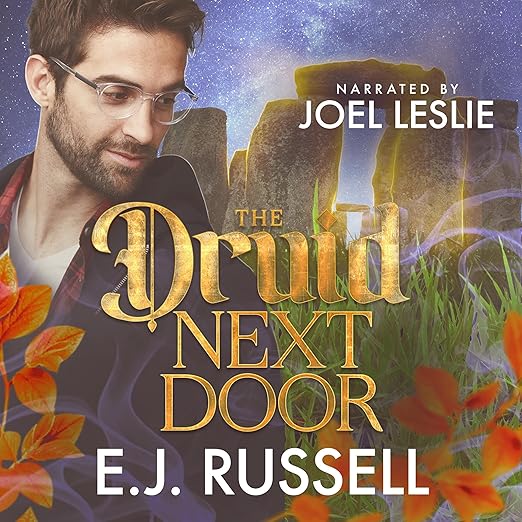
I had not read the first book in E.J. Russell’s Fae Out of Water series before picking up The Druid Next Door, and I spent the first forty minutes of Joel Leslie’s performance trying to calibrate to a world built by a book I had not heard. That was mildly disorienting, but not prohibitively so. By the time the central premise clicked into place, the forced-proximity dynamic between exiled fae enforcer Mal Kendrick and environmentalist professor Bryce MacLeod had generated enough specific friction to carry me forward regardless of my gaps in series knowledge. I should note that multiple reviewers strongly recommend reading Cutie and the Beast first; they are almost certainly right, and I am reviewing from the position of someone who did not take that advice and paid a mild price for it in the opening chapters.
The setup is precise and pleasingly absurd: Mal has been stripped of his right hand’s power and exiled from Faerie, and finds himself living next to a man who argues with him about recycling. When Mal discovers Bryce is actually a druid, and when they end up magically shackled together, the plot mechanics that follow are elaborate in the way that LGBTQ+ paranormal romance tends to be, but Russell executes them with enough wit and genuine character investment to keep the scaffolding from showing through the surface.
A Hero Built Specifically Not to Be Likable First
Mal is the book’s most interesting structural choice. He is not charming in the conventional romance hero sense. He is snippy, evasive, and periodically dishonest in ways that have real plot consequences. One reviewer articulated this precisely: Mal might have been snippy, moody, and not all together honest, but he did leave the house. That is a low bar to clear, and the reviewer acknowledged it while also noting that his genuine admiration for Bryce’s good qualities made the relationship convincing despite the rough edges and difficult early behavior.
Russell is not trying to sand down Mal’s character flaws in service of a smoother reading experience. The damaged former Queen’s Enforcer, mourning the loss of his power and his place in a world he understood, is genuinely disagreeable at points. That specificity makes his eventual shift feel grounded rather than arbitrary. Bryce, by contrast, is steadier and more immediately appealing, which creates an effective asymmetry: the reader roots for them together partly because Bryce can see past what Mal cannot yet see in himself, and that gap is used deliberately to generate both tension and warmth as the story progresses.
Worldbuilding That Earns Its Own Complexity
The second book in a paranormal series faces a specific challenge: it needs to complicate and expand the world established in the first book without requiring constant recaps that slow the narrative momentum. Russell largely manages this. The Fae politics, the rules around druids, the structure of the Outer World and its relationship to Faerie, these are introduced with enough context to function without feeling like infodumps aimed at readers who missed the first entry. One reviewer noted that thanks to all the worldbuilding in the first book, the plot in this one was able to be much more complex while still being a fun read.
The traditional fairy and folk tale elements are woven in carefully. Russell does not simply reference the folklore; she uses it structurally, as the basis for actual plot mechanics rather than atmospheric texture. The ancient secret that drives the third act, and the price attached to the drunken bargain Mal makes early in the story, have consequences that feel genuinely consequential rather than decorative. This is paranormal romance that takes its own rules seriously, and that commitment pays off in the final act.
What Joel Leslie Brings to the Performance
Joel Leslie is one of the more consistently reliable narrators in the MM romance and LGBTQ+ paranormal space, and his work here reflects that reputation. The challenge with a character like Mal is maintaining the prickliness that makes him specific without making him unpleasant to listen to for ten hours. Leslie threads that needle by finding the humor underneath the defensiveness, which is exactly where it lives in Russell’s writing. His Bryce is warmer and more open, and Leslie differentiates the two men clearly enough that their dynamic is audible even in passages without explicit dialogue tags.
The comedy lands particularly well in the audio format. Russell writes the kind of deadpan absurdism that needs a narrator who understands timing, and Leslie does. The recycling argument that opens the book, Mal’s internal commentary on the indignities of exile, the increasingly complicated logistics of being magically bound to someone you have decided to dislike: these sequences benefit from a performer who can pace a comedic moment rather than simply read through it. For listeners who enjoy paranormal romance with genuine wit and a hero who earns his ending the hard way, Leslie’s performance makes this one of the more satisfying audio experiences in the genre.
Series Placement and Listener Expectations
The Druid Next Door carries a 4.4 rating across 749 listeners, which is strong for a second-in-series entry that multiple reviewers note benefits substantially from having read the first book. Listeners who come in cold, as I did, will find the first hour or so requires calibration. Listeners who arrive from Cutie and the Beast will find the payoff considerably richer. Russell has built a world with enough internal consistency to support complex plots, and the Fae Out of Water series as a whole earns a recommendation for readers who enjoy paranormal romance with genuine wit and heroes who are interesting precisely because they are not immediately appealing. The ten-hour runtime is appropriate for the amount of plot and character development Russell is managing, and Leslie makes every one of those hours worth occupying.
Frequently Asked Questions
Can The Druid Next Door be listened to without having read or heard the first Fae Out of Water book?
Technically yes, but most reviewers and the author position it as a series that benefits from sequential reading. The plot begins immediately after events in Cutie and the Beast, and characters from that book appear with context that will be richer for listeners who know their backstory.
How does E.J. Russell handle the forced-proximity trope in a MM paranormal romance context?
Russell uses the magical shackling mechanic to create genuine interdependence rather than simple proximity. The shackling has plot consequences that force both characters into situations neither would choose, and the resulting conflict is used to develop character rather than simply delay the romance.
Is Mal a difficult character to spend ten hours with given his described moodiness and dishonesty?
Reviewers are split slightly on this. His sharp edges are real and have plot consequences, but Russell frames them as symptoms of loss and exile rather than character deficits. Most listeners who engaged with the book found his arc satisfying precisely because the rough start made his growth feel authentic.
Does Joel Leslie’s narration work for a book that blends paranormal tension with comedic moments?
Yes, and this tonal range is arguably where Leslie’s performance excels most. He maintains Mal’s prickliness without making it unpleasant over ten hours, and his sense of comedic timing allows the absurdist humor in Russell’s writing to land as written rather than getting flattened by straightforward delivery.