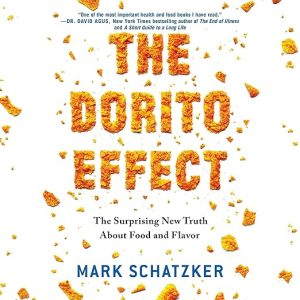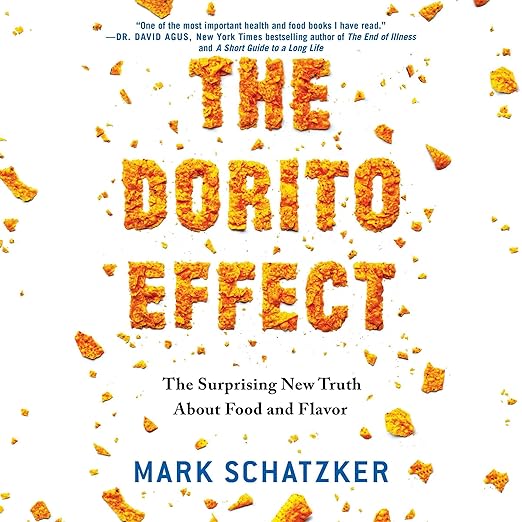
Tomatoes taste like less than they used to, and the opening move of this audiobook is to insist that the observation is data rather than nostalgia. Mark Schatzker's argument runs like this: since industrial food production took hold in the 1940s, we have been breeding and growing the taste out of what we eat, and simultaneously building a flavor industry worth billions to spray it back on. The result is a national diet that increasingly resembles a Dorito, food engineered to be bland and then dressed in chemicals until it becomes irresistible. Obesity, the book notes, now trails only smoking among preventable causes of death.
Schatzker's real contribution is to move the blame off the nutrient. Half a century of food argument has been spent prosecuting fat, then carbohydrates, then sugar, then wheat, then high-fructose corn syrup, and this book proposes that the search failed because the problem was never chemical composition at all. It is behavioral, and flavor is the lever. We eat too much of the wrong things because our appetite has been given false signals, taught to expect nutrition where none arrives. That reframing is the reason the book has outlasted the shelf of diet titles it was published beside.
Breeders come off worst, and one response identifies the mechanism cleanly: seed stock and livestock were selected for the biggest, fastest yields, which made sense to anyone farming, while the specialists doing the selecting never treated taste as a variable worth measuring. Do that for eighty years and you get livestock that weighs more and tastes of less. The book's most persuasive stretches are historical rather than polemical, tracing how each decision looked reasonable in isolation and how the accumulated result became a food supply nobody chose. The same logic runs through the flavor houses on the other side of the ledger, an industry the book values in the billions, whose entire function is to manufacture the sensation that farming stopped producing. Neither side set out to make anyone sick.
Patton Steadies Eight Hours of Flavor Science
Readers arriving from the ultra-processed food conversation will find this the earlier and more surprising book. One response came to it from Ultra-Processed People by Chris van Tulleken and rates the pair together, which is the right frame: van Tulleken prosecutes the processing, Schatzker prosecutes the flavor, and the two arguments interlock rather than repeat. What makes this one land is that it ends somewhere hopeful. The thesis is not that flavor is the enemy but that flavor is the solution, and the closing chapters argue that agriculture is on the edge of taking taste seriously again.
Credit for the reading goes to Chris Patton, and the job here is a particular one. Eight hours and seventeen minutes of interviews, agronomy, chemistry and brand names has to stay audible as a single argument, which asks for steadiness and clean signposting rather than character work. Test it on a chapter of technical material rather than on the introduction, since the introduction is the most rhetorically polished part of the book and tells you least about the seven hours that follow it.
One Vote, a Decimal Point, and a Wrong Shelf
Precision on this listing is decorative. A rating quoted to one decimal place sits above a counter reading a single vote, and a decimal place implies a sample large enough to move by tenths, which one vote is not. The writing underneath accumulated across six years and runs to five detailed assessments, which is where the actual information lives on this page. Worth noting alongside it: the shelf. This listing files a book about public health and industrial agriculture under home and garden, which is where nobody looking for it will think to search.
Cost is the strongest objection in the pool and it comes from a four-star response, which describes the elaborate dinner staged near the end of the book, where roughly a hundred guests eat food as it used to taste, and points out that such food is financially out of reach for most people. Mass production, that reading argues, keeps the masses fed whatever it has done to flavor. The book does not really answer this. Its prescription, as another reader spells out, means walking away from supermarkets and fast food almost entirely, which is a large ask presented as a personal choice.
Cooks, Gardeners, and Parents of Picky Eaters
Cooks and gardeners will enjoy this most, because the book explains a frustration they already have: why supermarket produce disappoints and why the versions that still taste of something cost what they do. Anyone who reads food journalism should hear it too, since the flavor thesis has since become background assumption in the field and this is where much of it was argued first. A science argument built from field visits and interviews, rather than from studies recited at a distance, has its own readership, and this ranks among the better examples of it. Parents trying to work out why a child rejects vegetables that taste of nothing will find an explanation here that does not blame the child, which is a more useful thing to carry into a kitchen than most nutrition advice manages.
Shoppers hoping for a plan will find less than they want. This is a thesis with implications rather than a program, and the implications get expensive fast. Anyone already deep in the ultra-processed food literature will recognize a fair amount of the terrain, and anyone who dislikes a single idea pressed for eight hours should know that the Dorito comparison returns often enough to become a refrain. Neither is a reason to skip it, but both are reasons to sample before committing a working day of listening.
Before You Listen
Is the audiobook a diet book or a food industry book?
An industry book. The argument concerns how crops and livestock were bred for yield rather than taste, and how a flavor industry grew up to compensate. Weight and health appear as consequences of that history, but you will not find meal plans, macros or a program to follow here.
How does it differ from Ultra-Processed People?
Different levers. Van Tulleken's book prosecutes industrial processing and its effects on the body, while Schatzker prosecutes the disappearance of natural flavor and the synthetic replacements sprayed on afterward. They cover overlapping ground from opposite directions, and readers of one routinely report finishing the other.
How technical does this audiobook get?
Just over eight hours, and the technical material is handled through reporting rather than jargon. Expect plant breeding, animal husbandry and flavor chemistry explained by way of farms, laboratories and interviews. No scientific background is assumed at any point in the argument.
Why is this shelved under home and garden?
It is a cataloguing decision rather than a description. The genre field reads home and garden with a Food and Wine tag, while the content belongs with nutrition, agriculture and public health. If you are browsing by category, expect to find this one filed away from the books it argues with.