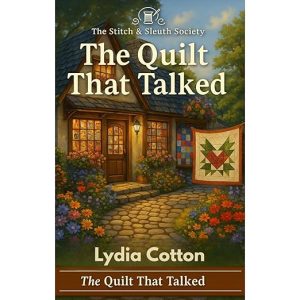
A bloodstain in the center of a donated quilt is exactly the kind of detail that makes cozy mystery readers sit up straighter. Lydia Cotton's audiobook The Quilt That Talked, the fifth book in the Stitch and Sleuth Society series, opens with precisely that hook: Ruby and her friends at The Cozy Thimble expect a charming piece of Sweetwater Falls history and instead find evidence of violence stitched right into the fabric. The premise is specific and the setup is clean, which is more than can be said for plenty of books in this genre that mistake atmosphere for plot. The AI-generated Virtual Voice narration does not bring the warmth the genre calls for, but the story itself moves with purpose.
Stitches in the Quilt Hide a Penfield Secret
Cotton's series has a reliable structure: a tight ensemble of female friends in a Southern small town, a mystery with roots deeper than its surface circumstances, and a setting that gives quilting and craft a genuine function in the story rather than just window dressing. In this installment, the Stitch and Sleuth Society, comprised of Ruby, Bea, Maude, Tilda, and the rest of the crew, unravels a decades-old secret connected to the Penfield House. The clues are literally stitched into the seams of the donated quilt, which is a satisfying use of the crafting motif: the object itself becomes a historical document, with its history encoded in its construction and now demanding to be read.
The mystery involves family secrets, forged identities, and a buried past that someone in Sweetwater Falls is willing to act violently to preserve. Cotton handles the revelation pacing with a sure hand. The book is short at just under ninety minutes in audio form, which means the mystery does not linger or overstay its welcome. Every scene earns its place. The threat level stays calibrated to the cozy end of the spectrum: the stakes feel real but the tone never tips into genuine darkness, which is exactly what the genre promises and what regular readers of it expect and rely on.
The Southern charm that Cotton builds through her prose is one of the series' consistent pleasures. The Cozy Thimble as a setting does real work here, grounding the investigation in a community space where the friendships feel lived-in and the politics of small-town memory are handled with affectionate specificity. The friendship dynamics between the ensemble members drive the emotional texture of the book just as much as the mystery plot does, which is characteristic of the cozy mystery form at its best.
Flat Narration, a Genuinely Compact Mystery
The Virtual Voice narration is the most significant caveat here. AI-generated narration has come a long way in basic legibility, and this production is clear and correctly paced. But the specific pleasures of a cozy mystery, the warmth of ensemble friendships, the humor of small-town social dynamics, the Southern charm Cotton clearly works to build through her prose, are precisely the qualities that benefit most from a skilled human reader. What the narration delivers accurately it also delivers flatly. Listeners who have strong feelings about voice performance quality should weigh that against the content's appeal before committing to the audio format.
What the audio format does serve well is the book's compact structure. At under two hours, this is a natural listen for an afternoon with something in your hands, which fits the quilting-circle spirit of the series better than it might seem. The mystery resolves satisfyingly within its compressed runtime, and Cotton does not pad the story to meet an arbitrary length expectation. The book also includes a quilt block pattern and piecing directions for the Foliage block, which is a nice touch in the print version though obviously not experienced directly in audio form.
Book Five Reads Fine Without the Earlier Four
Cotton's publisher positions this as readable as a standalone despite being Book 5 in the series, and that claim largely holds up. The friendships within the Stitch and Sleuth Society carry history that you will sense rather than fully understand if you come in cold, but the mystery itself is self-contained and fully coherent for new arrivals. The emotional weight of long-term friendships does not hit with full force without the earlier volumes, but the plot mechanics work on their own terms without requiring prior context.
The runtime is genuinely short, which is either a feature or a limitation depending on your listening habits. Cozy mystery readers who want a longer, more immersive experience will finish this in a single sitting and want more. That may not be a complaint so much as an invitation to start the series from the beginning, where the ensemble dynamics have more room to develop and the community of Sweetwater Falls builds its full texture.
The mystery itself moves through familiar cozy beats, but Cotton handles the pacing with enough control that the formula never feels mechanical. The reveal arrives at the right moment and carries genuine weight because the Penfield House backstory has been built carefully enough that the truth of it lands rather than simply explaining itself. For a book this short, that structural efficiency is its own kind of craft.
Quilters and Cozy Mystery Fans, Mind the Runtime
This audiobook will connect most strongly with readers who already love cozy mysteries, particularly those that center female friendship, Southern settings, and craft-adjacent sleuthing. Quilters specifically will appreciate Cotton's use of the medium as a narrative device rather than a decorative backdrop. Those coming in expecting a longer, more atmospherically rich listen should note the ninety-minute runtime and calibrate accordingly. Listeners with a strong preference for human narration over AI performance may want to revisit if a cast recording becomes available.
Can The Quilt That Talked audiobook be enjoyed without having listened to the earlier books in the series?
The mystery itself works as a standalone. The ensemble dynamics and history between the Stitch and Sleuth Society members carry more weight if you have read earlier volumes, but Cotton writes the relationships clearly enough that new listeners can follow without feeling lost.
How is the Virtual Voice narration in this audiobook compared to a human performer?
The narration is clear and correctly paced but lacks the warmth and comic timing that cozy mysteries particularly benefit from. The Southern ensemble banter and friendship dynamics read more flatly in AI-generated narration than they would in the hands of an experienced audiobook voice actor.
Does the audiobook include the quilt block pattern mentioned in the book description?
The quilt block and piecing directions for the Foliage block are part of the printed book. In audio format, this supplemental material is not experienced directly, though the mystery plot stands fully on its own without it.
Is The Quilt That Talked appropriate for listeners who do not quilt?
Entirely yes. The quilting setting provides texture and a clever plot device in the donated quilt with the bloodstain, but no crafting knowledge is needed to follow or enjoy the mystery. It is a character-driven small-town whodunit that happens to be set in a quilting circle.