Quick Take
- Narration: Emily Ellet delivers a performance that keeps the academic setting grounded, handling Evan’s interiority with enough warmth to sustain a 13-hour listen through some slower middle sections.
- Themes: Found family and institutional conspiracy, coming-of-age and growing confidence, magic as craftsmanship
- Mood: Propulsive and character-driven, with a satisfying escalation of stakes
- Verdict: A strong second entry for readers already invested in Evan’s world; the series rewards patience and benefits significantly from listening in order.
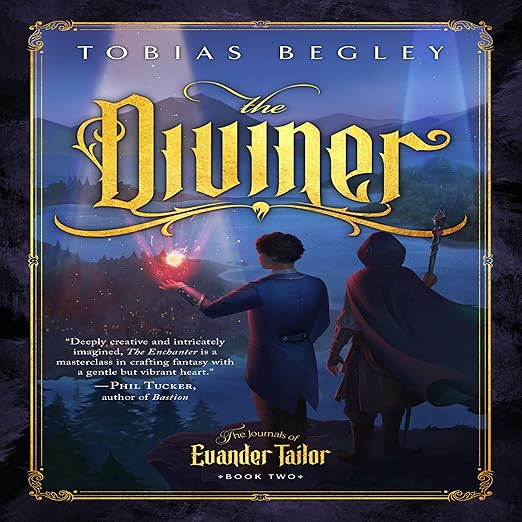
I came to The Diviner already having listened to the first book in Tobias Begley’s Journals of Evander Tailor series, which had done something I always appreciate in fantasy: it built its magic system from first principles, making enchantment feel like a discipline that could be studied and mastered rather than a narrative convenience. The second installment picks up where that left off, with Evan returning to Yesgol academy carrying considerably more weight than he did as a first-year student.
The setup involves debts, emerging abilities, and the slow revelation that the institutional hierarchy Evan has been navigating hides something considerably more troubling beneath it. It’s the classic second-book move, expanding the world’s moral geography without dismantling what made the first entry work. Begley handles it with more confidence than many debut series manage.
Our Take on The Diviner
What distinguishes this series from the crowded magical academy space is the specificity of its magic mechanics. Enchanting and divination as Begley constructs them are not mystical talents that arrive fully formed. They require study, failure, iteration, and a working understanding of the underlying principles, which Begley describes in enough detail that readers who enjoy the craft of learning will find something satisfying here. One reviewer compared the enchanting process to circuit board design and found it mundane; I read that same detail as the point: magic that works like engineering is interesting in different ways than magic that works like inspiration.
Evan himself is a careful characterization. He’s the kind of protagonist who succeeds through intelligence and preparation rather than natural superiority, and his timidity, noted by more than one reviewer as a defining trait, serves as something to move through rather than something to celebrate. By the end of this volume, he’s a more decisive person than he was at the start, and that arc is earned rather than declared.
Why Listen to The Diviner
Emily Ellet’s narration continues to be a genuine asset to the series. She finds Evan’s voice early and maintains it across thirteen hours, which is the real test of any audiobook narrator on a long-form work. The supporting cast is differentiated enough that listeners won’t lose track of who is speaking even in dialogue-heavy sequences, which is a specific challenge in fantasy with large ensemble casts.
The conspiracy plot that escalates through the second half is the most compelling element of the book. Begley resists the temptation to resolve it cleanly, leaving the Ligature, the governing body whose involvement Evan begins to suspect, as a genuinely ambiguous institution rather than a cartoon villain organization. That ambiguity creates the kind of tension that makes readers want to move immediately to the next volume, which reviewers note is exactly what many of them did.
What to Watch For in The Diviner
The characterization critique leveled by one thoughtful reviewer, that the book’s character development is flatter than its world-building and magic mechanics, deserves consideration. Begley invests heavily in system and setting; the secondary characters in particular could use more texture. Evan’s boyfriend, whose presence was a notable element of the series’ LGBTQ+ representation, figures into the story but remains somewhat underwritten relative to his narrative significance.
The pacing in the middle third requires patience. Yesgol’s academic rhythms are rendered in detail that will feel immersive to some listeners and slow to others. If you got through the comparable sections of book one without difficulty, you’ll be fine here. If those sections tested your patience, the stakes are higher enough in book two that you may find them easier to sit through.
Who Should Listen to The Diviner
Listeners who finished the first Journals of Evander Tailor book and found the world convincing should hear this. It doesn’t function as a jumping-in point for new readers; the serialized storytelling assumes prior investment, and important character relationships only carry weight if you’ve seen them develop. Fantasy readers who value systematic magic over spectacle, and who are comfortable with a protagonist who thinks his way through problems rather than fighting his way out of them, will be well-served. Skip it if you haven’t read the first book, or if you found Evan’s passive characterization in that volume frustrating.
Frequently Asked Questions
Can The Diviner be listened to without reading the first book in the Journals of Evander Tailor series?
Not effectively. The book is deeply serialized and assumes familiarity with Yesgol, the magic system, and Evan’s relationships from book one. Starting here would mean missing a significant amount of character and world context.
How does Emily Ellet’s narration handle the distinction between enchanting and divination as separate magical disciplines?
She treats the technical explanations with the same matter-of-fact seriousness as the character scenes, which helps maintain immersion during the more instructional passages about how each discipline works.
Is the LGBTQ+ content in The Diviner primarily in the background, or does it play a meaningful role in the plot?
Evan’s relationship with his boyfriend is present and treated as a normal part of his life rather than a narrative issue to be resolved. It’s integrated rather than foregrounded as a theme, with the romantic subplot serving character rather than messaging.
Does the conspiracy plot that opens in The Diviner reach any resolution, or does it carry entirely into book three?
It develops significantly and some threads are addressed, but the larger question of what the Ligature is hiding remains open at the end of the book. It’s structured to pull readers forward into the third volume rather than offering a complete resolution.