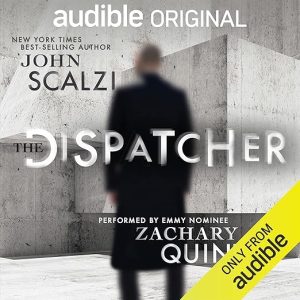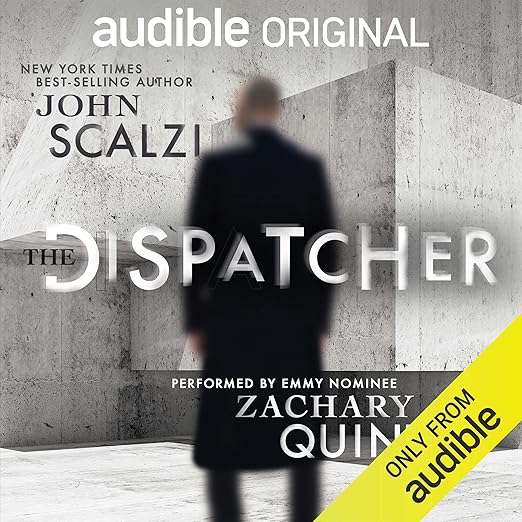
There's a version of The Dispatcher's central conceit that could have gone badly wrong in less careful hands. The idea, that intentional murder almost never sticks, that anyone killed deliberately wakes up in their bed hours earlier, that this has fundamentally reorganized the relationship between violence and mortality, is the kind of premise that needs a writer willing to follow its implications rather than just use it as a backdrop. Scalzi follows the implications. He can't follow all of them in two hours, but he follows enough to make this feel like a genuine exploration rather than a gimmick.
I listened to this on a weeknight when I wanted something that would engage without demanding the kind of sustained attention a twelve-hour thriller requires. The Dispatcher is exactly calibrated for that listening mode: tight, confident, and designed from the ground up for audio.
Our Take on The Dispatcher
Tony Valdez is a licensed Dispatcher, a professional whose job is to kill people who are about to die anyway, giving them a second chance by resetting them to their bed rather than letting them die permanently from an accident or violence that qualifies as unintentional. The profession exists at a legal and moral gray area that Scalzi sketches efficiently: Dispatchers are regulated, licensed, observed. There are liability questions. There are cases where the rules don't apply cleanly. There is corruption.
When Valdez's friend and fellow Dispatcher goes missing, the story becomes a detective narrative layered over the speculative infrastructure. The mystery plotting is serviceable without being the main event, Scalzi uses it as a vehicle to get Valdez moving through the world he's built, which lets the world-building happen organically through incident rather than exposition. One reviewer's assessment, a light, pulpy detective story with an unusual sci-fi conceit, is accurate and not a criticism. The lightness is intentional. The pulpiness serves the two-hour format.
Why Listen to The Dispatcher
Zachary Quinto is the primary reason to prioritize audio for this one. His casting as Tony Valdez isn't incidental, Quinto brings years of genre credibility from Star Trek and Heroes, and he deploys it here with a quiet intensity that suits a character who kills people professionally and has made his peace with it. The AudioFile Earphones Award acknowledges what the performance delivers: a voice that makes Valdez feel inhabited rather than performed, capable of the dry wit Scalzi's dialogue requires and the tension his plot demands.
The 2017 Audie Award for Best Original Work confirms that this is a production that understands what audio-first fiction can do. The novella was written directly for this format, not adapted from print, and that origin shows in how economically everything is structured. There's no fat here. Every scene does work.
What to Watch For in The Dispatcher
The central conceit, as one reviewer honestly notes, doesn't fully hold up to scrutiny if you press on it. The rules governing when murder does and doesn't reset, who counts as intentional, how the system handles edge cases, what happens in ambiguous situations, are not completely worked out. Scalzi knows this and largely sidesteps it by keeping the story moving fast enough that you don't have time to pull threads. That's a valid authorial choice for a two-hour novella, but listeners who like speculative fiction to build airtight systems may feel the seams.
It's also worth flagging that this is a standalone story, not an obligation. The Dispatcher universe has expanded since this original, there are additional entries in the series, but this first installment resolves cleanly. You're not being set up for a commitment you haven't agreed to.
Who Should Listen to The Dispatcher
Science fiction listeners who enjoy concept-forward stories and don't require epic length to feel satisfied. This works especially well for audiobook listeners who are newer to the format and want something that demonstrates what audio-first fiction can do. Fans of John Scalzi's other work, Old Man's War, Redshirts, will find this characteristic of his voice: smart, confident, and willing to have fun without sacrificing the ideas. The two-hour runtime makes it ideal for a commute or a short flight.
What is The Dispatcher's origin as an Audible Original, and does that affect the listening experience?
The Dispatcher was written specifically for audio release, not adapted from a print novel. That origin shapes its economy, the story is tight, efficiently structured, and designed to work in two hours without feeling truncated. Scalzi built it for this format, and it shows.
Does the central premise, that intentional murder resets the victim, hold up to logical scrutiny?
Not entirely, as Scalzi would likely acknowledge. The story doesn't build an airtight ruleset for all edge cases. It moves fast enough that most listeners don't have time to pull threads while listening, but readers who prioritize internally consistent speculative systems may feel the gaps.
Is The Dispatcher part of a series, and do I need to read further?
There are additional entries in the Dispatcher series that have followed this original, but the first installment resolves as a standalone. You are not dropped into an ongoing narrative that leaves you stranded. Listening to this first book is a complete experience on its own terms.