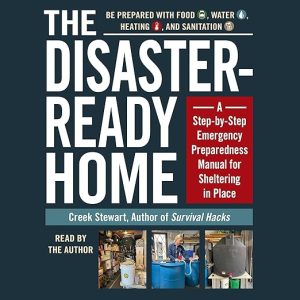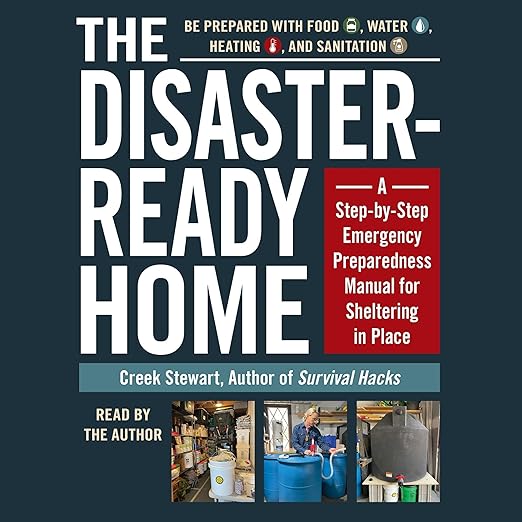
Creek Stewart wants your pantry organized before the power goes out, and this audiobook makes that case in four hours and thirty-eight minutes without once raising its voice. My verdict up front: the argument survives the change of format intact, and a good part of the instructions does not. Whether that is a problem depends entirely on whether you want to understand preparedness or to build something this weekend.
Four Areas, and the Skill of Rotating Stock
Four areas organize everything: food, water, heat and sanitation. That is the whole architecture, and its discipline is what makes the book work. Somebody who owns and has read a couple dozen titles on this subject calls this one the best written and best organized of the lot, and singles out the same four headings as the reason. Most preparedness writing sprawls across security, bug-out bags, firearms and gear lists. Stewart stays home, literally, and asks what a house needs to keep four functions running when the outside world stops supplying them.
Nothing here is speculative. The pantry chapter scales to whichever timeframe you pick, from two weeks through three months to a full year, and it spends as much attention on choosing food that matches your actual diet and budget as on quantities. Then comes the part almost nobody writes about: rotating that supply through your ordinary cooking so it gets eaten rather than discarded. A stockpile you never touch is a purchase, not a plan, and Stewart treats the distinction as the central skill.
Water and sanitation get the same treatment. Long-term storage, renewable sources, boiling when the kitchen has no power, and then the question that separates serious guides from aspirational ones: what happens to waste when the taps stop. Heat and light round it out. The book is unglamorous by design, and at this length it never pads, which is a compliment I do not get to pay many practical titles.
Stewart Reads Quantities Aloud and Names the Parts
Stewart reads it himself, and on a manual that matters more than it would on a memoir. The job the file hands him is peculiar: quantities, container sizes, shelf lives and ordered assembly steps have to arrive as continuous speech, with no page to scan back to and no bullet to anchor a number. The one advantage of a self-read manual is that the person defending each recommendation is the person who made it, and a listener can hear where the emphasis falls. Start with the sanitation chapter rather than the opening, since that is where the material is least visual and the audio is strongest.
Another entry gets at the thing most guides miss entirely. It comes from somebody who describes getting stumped by what to buy, by the names of materials, connectors and fasteners, and by which tool the job actually needs, and who reports that when Stewart says step by step he means it. That is the real barrier for a beginner. Not motivation, not knowledge, but the fact that a hardware store is unnavigable if you cannot name the part. Stewart names the parts.
Under Five Hours, from Prophecy to Plumbing
Brevity is the other quiet virtue. Preparedness books tend to arrive at intimidating lengths, and intimidation is precisely the wrong response to induce in somebody deciding whether to start. Under five hours is short enough that a listener can hear the whole system once, understand how the four categories interlock, and then go back to the section that applies. As an orientation to the field it is close to ideal.
Tone deserves credit too, because preparedness is a genre that sells on dread. The publisher's copy reaches for it, opening on daily headlines dominated by disease and disaster, and the book itself declines the invitation entirely. Nobody is told the collapse is coming. The reader is asked what happens if the power stays off for a week, which is a question that has already answered itself in most parts of the country, and then walked through the four things a house stops doing when it does. That shift from prophecy to plumbing is why this survives listening while a lot of its shelf-mates do not.
Missing Photos, and a Rating Count That Confuses
Photographs are the problem. The publisher's own copy promises detailed lists, photographs and complete instructions, and one five-star entry names them as the reason it worked, praising pictures of high quality that show you exactly what you need to see, particularly for a visual learner. None of that is in a recording. The listing makes no mention of a companion PDF either, so a buyer choosing audio is deliberately purchasing the half of the book that cannot show a fitting, a layout or a finished catchment setup.
The counter beneath the score is the other thing to notice. It reads one rating, and the score above it reads 4.7. A single voter chooses a whole star, one through five, and 4.7 is not among the options, so whatever produced that figure was not that one person's click. Five people have signed dated write-ups underneath, which is a different quantity again. None of this makes the book worse. It makes the number on the page useless as a shortcut, and the write-ups are where the actual information lives.
Preparing to Never Need the Store at All
If your household has never thought past a flashlight and a case of bottled water, this is the right starting point, and it is also the right one for people whose circumstances rule out improvising later. One four-star entry, from somebody describing themselves as elderly and disabled and prepping for about six years, makes the case better than the marketing does: the point of a plan is not to be faster than your neighbors at the store, it is not to need the store. That reframing is worth the price by itself.
Look elsewhere if you want tactical or security content, because Stewart is writing about a house rather than a confrontation, and give it a pass if you learn by building rather than by listening. Anybody who intends to construct the rain catchment system or the composting setup will need the diagrams, and the diagrams are not here. Borrow the printed edition from a library, keep this recording for the reasoning, and you will have the whole book for the price of half of it.
Does the audiobook include the photographs and lists the print edition is built around?
No. The visual apparatus the print edition advertises has no equivalent in a recording, and the listing says nothing about a companion PDF. Anyone planning to follow a build, identify a fitting or copy a layout should assume the visual half is missing and keep a printed copy within reach.
How far does the emergency pantry advice actually go?
It scales to whatever horizon you pick, with a fortnight, a season and a whole year all treated as legitimate targets, and it covers choosing food that suits your diet and your budget. The rotation system, which keeps stored food moving through ordinary meals so nothing is wasted, is the part that separates this from a shopping list.
Is this audiobook still useful if you already have supplies put away?
Yes, as an audit. The four categories arrive in a fixed order, food, water, heat and sanitation, which makes it easy to listen for the one you have neglected rather than for advice you already follow. Sanitation is the section most people will find genuinely new.
Can you follow the step-by-step instructions without the printed book in front of you?
Partly. The reasoning behind each recommendation carries perfectly well in speech, and the four-part structure is easy to hold in your head. Assembly sequences involving particular containers, fittings and tools are another matter, and those are exactly the passages where a listener will want to stop and look something up.