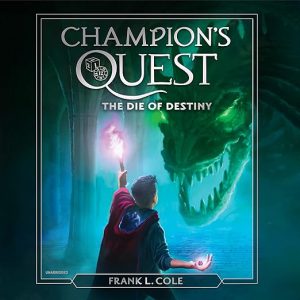
At a Glance
- Read by: A single reader, Kirby Heyborne, covering four children, a shopkeeper and a bestiary of monsters without support.
- At its heart: Tabletop role-playing made real, foster care and belonging, anxiety and panic, cooperation under pressure
- Vibe: Brisk quest adventure with a genuinely tender center
- Short version: A smart middle-grade fantasy that treats an anxious hero as a person rather than a problem to be cured.
Hob and Bogie's Curiosity Shoppe stocks no consoles, no headsets and nothing with a screen. What fills the windows instead are board games, miniature warriors and wizards and monsters, dragon models, and dice with more sides than most children know exist. Frank L. Cole opens this audiobook by making that shop irresistible to two boys walking past it, and the ordinary logic of a middle-grade adventure would have them buy something and go home. Instead they play a game called Champion's Quest, walk out the front door, and find that West Virginia has been replaced.
The Review
Tabletop gaming is the right reference point, and one reader reaches for exactly that in a headline, naming D&D and Magic the Gathering. This is a tabletop fantasy translated into a novel rather than a video-game portal story wearing tabletop clothes, and the difference shows in how the world behaves. Characters have assigned roles and statistics. Challenges yield treasure, weapons and experience. Monsters escalate in difficulty toward a final encounter. Cole keeps the machinery visible, which is a gift to any child who has rolled dice at a kitchen table and a decent primer for one who has not.
Where the book earns its keep is in refusing to make the game an escape from the real problems. Lucas is twelve, living in foster care he does not feel part of, and running away when the shop catches him. He also has panic attacks, stated plainly in the description rather than implied. Dropping a character with an anxiety disorder into a world of trolls and minotaurs could easily have been a device for curing him through bravery. What Cole does instead is treat the panic as a real constraint the party has to work around, which is a considerably more useful thing for an anxious young listener to hear.
Cole assembles four leads out of genuinely different problems rather than different hair colors. Lucas is fiercely independent and afraid; Jasmine, his classmate, struggles to make friends; Miles, his foster brother, is book-smart and wide-eyed; the fourth, a permanently irritated teenager, has been sent to bring the boys home and gets dragged along instead. Each real-world weakness maps onto something the quest requires them to overcome together. It is a tidy structure, and tidy is the correct choice for the age group, since the pattern is legible enough for a young listener to spot and enjoy spotting.
Momentum is the quality readers keep returning to. One account calls the adventure fast paced and exciting, predicts it will appeal to a wide age group, and admits to struggling not to finish the whole thing in a single sitting. Quest structures suit listening particularly well because each challenge is a self-contained episode with a clear objective, so a child who drifts for a minute has not lost the thread of anything. The stakes reset and rise at regular intervals, which is close to ideal pacing for a long car journey or a series of bedtimes.
Kirby Heyborne carries the whole cast alone, and the range required is wider than the page count suggests: four children spanning twelve to sixteen, an elderly shopkeeper who could pass for a wizard, plus trolls, brutish minotaurs and a three-headed monster waiting at the end. Single-voice performance on an ensemble middle-grade fantasy lives or dies on keeping four young characters distinguishable when they talk over each other, which they do constantly in a party-based story. That is the specific thing worth listening for in the opening minutes of the preview.
Before You Commit to The Die of Destiny
Finding this book again is harder than it should be, because the record and the book disagree about its name. The listing calls it The Die of Destiny. The description calls it Champion's Quest: Die of Destiny, the series field says Champion's Quest, and readers writing about it use the longer form. A parent searching a library catalog or a bookstore system for one string may well miss the other, and anyone hunting for the sequels should search the series name rather than this title.
Runtime deserves a parent's attention too. Nine and a half hours runs long for middle grade, appreciably longer than the four to six hours the category typically runs, and it represents a real commitment for a nine-year-old rather than a weekend's listening. The upside is that Cole has room to develop four characters properly instead of sketching three of them. The tradeoff is that a child who bounces off the first hour has a great deal of book left, so the preview matters more here than on a shorter title.
One thing the written column cannot tell you is how this landed with readers who arrived without a connection to the author. Several accounts come from teachers and librarians already invested in Cole's work, including one who owns the entire catalog, reads it aloud to students, and reports that copies in the classroom library carry long waiting lists. That same reader received an advance copy ahead of publication. Enthusiasm from committed educators is meaningful, but it describes a book's reception inside an existing readership rather than outside it.
Who It's For
Children roughly eight to twelve who already like fantasy adventure are the core audience, and the tabletop framing gives them something most portal stories do not: a set of rules they can see working. Children drawn to the idea of being dropped inside a game will respond most directly, and one account catches the hook neatly: a boy with firm plans to leave whose plans go out the window the moment he stumbles into a curiosity shop. Reluctant readers are worth singling out too, since the episodic quest structure forgives divided attention. Families listening together get a shared story with genuine emotional content underneath the monsters, particularly around anxiety, foster care and the wish to belong somewhere.
Younger listeners and sensitive ones need a check first. Menacing creatures, real physical peril and a child protagonist in acute distress are all present, and the three-headed monster at the end is built to be frightening. Anyone hoping for a gentle bedtime story should look elsewhere in the category. Older teenagers will find the emotional beats spelled out more than they need, which is the correct choice for the intended reader and a limitation for anyone past it.
Good to Know
What age range is The Die of Destiny audiobook aimed at?
Middle grade, broadly eight to twelve. The protagonists run from twelve to sixteen, and the description names friendship, cooperation, perseverance and overcoming anxiety among its themes. Younger children are worth assessing individually, since the monsters and the physical peril are played straight rather than softened for the age group.
Do you need to know tabletop games to follow this audiobook?
Not at all. Cole explains the role-playing conceit through the characters learning it themselves, so the rules arrive naturally as the quest proceeds. Children who already play will recognize the structure and enjoy it more, but nothing about the plot depends on prior familiarity with dice or character sheets.
How long is the recording, and who reads it?
Nine hours and thirty-one minutes, narrated by Kirby Heyborne, who holds the only reading credit. That length sits well above the usual middle-grade average, giving Cole room for four distinct character arcs but also asking more sustained attention than a typical chapter book in the category.