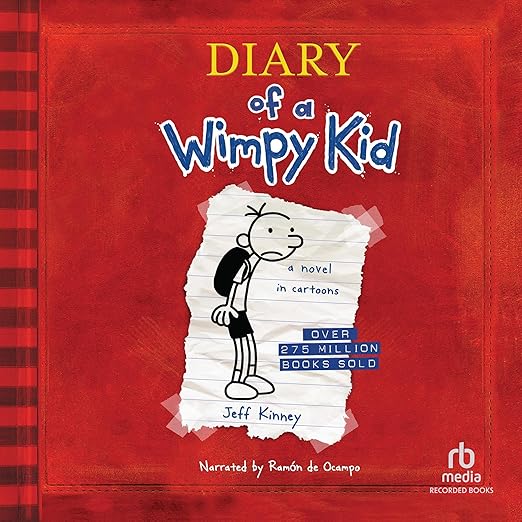
Greg Heffley's debut audiobook is still one of the most effective middle-grade listening experiences of the past two decades, and that assessment holds up when you examine exactly what Ramon De Ocampo does with Jeff Kinney's original voice. The Diary of a Wimpy Kid arrived in 2007 and created the template that dozens of illustrated diary-format novels have attempted to replicate since, almost none successfully. As an audiobook, it presents an interesting production challenge: the humor in the original text is built around the gap between Greg's self-image and objective reality, and that gap has to survive the transition from illustrated journal entries to pure audio without the visual joke reinforcement the illustrations provide on the page.
De Ocampo Plays Greg Absolutely Straight
De Ocampo navigates this challenge with a consistent choice: he plays Greg absolutely straight. Greg Heffley is not narrating his own humiliation knowingly; he genuinely believes himself to be a reasonably sophisticated observer of the world around him, and De Ocampo never winks at the listener over Greg's head. The result is that the comedy operates on exactly the terms Kinney designed: the listener sees through Greg while Greg does not see through himself, and the audio performance sustains that dramatic irony across the full hour and fifty-seven minutes of runtime without breaking it.
Greg's family situation, the bewildering younger brother Manny, the obnoxious older brother Rodrick, the well-meaning but fundamentally misaligned parents, is established quickly and efficiently. Kinney understands that middle-school social dynamics are a universal language, and De Ocampo renders Greg's observations about navigating that landscape with the exact register of a sixth grader who is convinced he understands more than he does.
A 'Manly Journal, Not Some Girly Diary'
The audiobook format reveals something about the original text that the illustrated version partly conceals: Kinney's prose rhythm is genuinely sharp. The joke constructions in the diary entries work at the sentence level, not just at the level of illustrated punchline, and De Ocampo's reading makes that visible in a way that skimming the page can obscure. The observation about Greg's 'manly journal, not some girly diary,' which is one of the book's foundational comic premises, lands with particular efficiency in audio because the delivery time and emphasis make the absurdity of the distinction clear in real time.
The first book in the series also benefits from being the origin point of a character who has now accumulated nine books of reputation. This audiobook presents Greg before listeners know where his particular brand of self-delusion leads, which makes his early misjudgments funnier in retrospect and more sympathetic in the moment. De Ocampo's performance honors both dimensions of that: Greg is funny because he is wrong, but he is also a recognizable eleven-year-old who is simply trying to navigate a world that does not operate the way he expects it to.
The runtime of under two hours makes this audiobook accessible in a single sitting for most listeners, which suits the episodic structure of the journal format. Individual entries can function as short-form entertainment without requiring sustained narrative momentum, but the cumulative arc of Greg's first year of middle school rewards listening all the way through.
The choice to render Greg's voice in first person throughout is worth examining as a production decision with specific audio implications. Greg is not a reliable narrator in the traditional literary sense, and Ramon De Ocampo's performance has to carry the dual register of Greg's self-perception and the listener's more accurate assessment simultaneously, in a single voice, without breaking either illusion. The technique is something like what skilled comedic actors call playing it straight: the performance accepts Greg's self-assessment at face value while delivering the material with timing that allows the humor to land at a second level the character himself does not register.
Kinney's decision to structure the book as a school-year diary rather than a continuous narrative is, in audio, a structural choice with real consequences for pacing. Each entry is self-contained enough to function as a unit but connected enough to accumulate into a portrait of a year. De Ocampo handles the transitions between entries with minimal fuss, trusting the date stamps to carry the temporal organization. The result is an audiobook that feels genuinely episodic, like listening to installments of a serial, which suits the format well and may be one reason the series has remained so popular as audio across successive installments.
No Single Climactic Moment, by Design
The audiobook does not replicate the visual gags from Kinney's illustrated journal format, including Greg's cartoon drawings and the visual layout of the page. Listeners who know the book in its print form will find some of the humor slightly compressed without those visual elements. This is an inherent limitation of the format rather than a production failure, and De Ocampo compensates through vocal performance wherever possible.
The episodic structure of the journal entries also means the audiobook does not build toward a single sustained climactic moment in the way that a conventional narrative novel would. Some listeners, particularly those accustomed to story-driven audiobooks with clear act structures, may find the loose accumulative format less satisfying than they expect. The emotional arc of Greg's first year is present but distributed across many small incidents rather than concentrated in a single dramatic sequence.
Parents should know the humor includes some mild competitiveness and social maneuvering that reflects genuine middle-school dynamics. Nothing crosses into territory that would concern most families, and the book's underlying observation that middle school is universal in its awkwardness is actually quite humanizing.
Essential Starting Point for the Whole Series
The original Diary of a Wimpy Kid audiobook is the essential starting point for any listener considering the series. Those who have seen the films or read later books should still begin here: De Ocampo's performance establishes the audio voice of Greg Heffley that carries through the series, and the origin context makes subsequent books significantly richer. Reluctant readers in the eight-to-twelve age range who find unillustrated prose audiobooks daunting will find De Ocampo's performance an unusually accessible entry point. Adults who read the original book as children will find the audio version resurfaces the humor with surprising freshness. Educators and parents looking for audiobooks that model journal-format narrative and voice-driven storytelling for young listeners will find this one instructive at the craft level as well as entertaining.