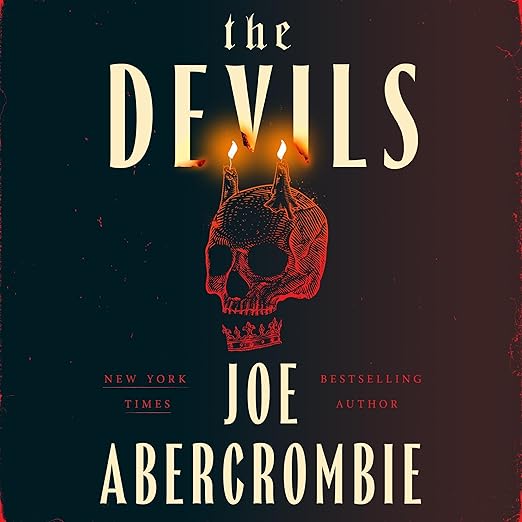
Quick Take
- Narration: Steven Pacey delivers an Earphones Award-winning performance that carries 25 hours of dense ensemble storytelling without losing a single character’s distinctiveness; his comedic timing matches Abercrombie’s darkly funny dialogue beat for beat.
- Themes: holy ends requiring unholy means, the comedy and tragedy of institutional religion, anti-heroism as genuine moral stance
- Mood: Raucous, violent, and frequently hilarious, with unexpected tenderness in the sapphic romance subplot
- Verdict: Abercrombie’s sharpest and funniest novel, elevated by Pacey’s career-best narration; the alt-medieval setting is a genuine departure that fans of the First Law world should approach without expectation of that world’s specific tone.
I finished The Devils at one in the morning on a weeknight, which is either a testament to its quality or a serious lapse in self-discipline. Having read all nine First Law novels, I came to this one half-expecting a familiar Abercrombie experience and got something both recognizable and substantially different. The same sharp dialogue, the same contempt for idealism, the same willingness to make you care about terrible people. But The Devils is also, genuinely and repeatedly, funny in ways that Abercrombie has not quite permitted himself before.
Brother Diaz arrives at the Sacred City expecting a commendation. He receives, instead, a flock of unrepentant murderers, a werewolf, a necromancer, a vampire, and a woman who declines to get involved, with a mission that requires all of them to do something quite righteous through quite unholy means. The premise is Pratchett-adjacent in its comic structure, which multiple reviewers noted, and the execution sustains that register without sacrificing the darker material that makes Abercrombie recognizably himself.
Our Take on The Devils
Steven Pacey narrated the First Law books and has long been the voice of that world for audiobook listeners. What makes his performance here particularly notable is how cleanly he navigates the tonal shift. The Devils requires comedic timing that the grimmer First Law material does not, and AudioFile’s Earphones Award and Booklist’s starred review both specifically call out his ability to deliver the dry humor with precision while keeping the tender moments in the sapphic romance subplot genuinely affecting. That is a considerable range to hold across twenty-five hours, and Pacey holds it.
Dan Roop’s thorough review, written as a longtime First Law reader, confirms that the alternate European setting is handled well and that the story stands entirely on its own outside the First Law world. The ten-year-old female Pope who dispatches Brother Diaz on his mission is one of the more memorable structural inventions in recent fantasy, and Abercrombie deploys her with a straight face that makes her somehow more credible than she has any right to be.
Why Listen to The Devils
The ensemble that Brother Diaz assembles is the novel’s primary pleasure. Joseph Finley’s detailed review captures the cast: a vampire, a werewolf, a necromancer, an invisible elf, a streetwise girl who may be the lost princess of Troy, and the woman who never sticks her neck out. Each of these characters has individual history, motivation, and speech patterns that Pacey differentiates with the kind of precision Tori’s review notes: it was very easy to not only identify each character from one another but care about them in their own little way.
The alt-medieval Europe setting, with its crusades against elves and its corrupted church hierarchy, is functional rather than deeply elaborated. Abercrombie uses it to run his themes, not to build a world for its own sake, which suits the picaresque structure of the story. The plot moves efficiently, and the twenty-five hour runtime earns its length through character accumulation rather than world description.
What to Watch For in The Devils
First Law readers who are looking for the brutal political complexity and long-game plotting of that world will find The Devils lighter in those respects. The novel is genuinely plot-driven in a more immediate way: a mission, a set of obstacles, a destination. The darkness is present, but it serves comedy as often as it serves tragedy. Tori’s review noted that it is a slow but good read, and that readers need to become invested in the characters’ personal motivations, otherwise the story runs the risk of feeling thin. That is the honest assessment: the momentum comes from character, and listeners who engage with the ensemble will be rewarded; those waiting for macro-political stakes may wait longer than feels comfortable.
Ralcon’s UK review described the book as very much Abercrombie and simultaneously not, which is perhaps the most precise single formulation of what The Devils accomplishes. It is a departure without being a betrayal, and it opens a new register rather than retreating into a familiar one.
Who Should Listen to The Devils
First Law readers who can set aside their attachment to that world’s specific tone will find this immensely entertaining. Readers new to Abercrombie who want to start with something lighter in register than The Blade Itself will find this an accessible and immediately enjoyable entry. Anyone drawn to Pratchett-style dark comedy with genuine stakes and violence will recognize what Abercrombie is doing here. The twenty-five hours and Pacey’s narration make this a particularly strong candidate for listeners who want to fully inhabit a single book over a week of commutes.
Frequently Asked Questions
Do I need to have read the First Law series to enjoy The Devils?
No. The Devils is set in a completely different world from the First Law and shares no characters or continuity with that series. It works as a standalone novel. First Law readers will bring familiarity with Abercrombie’s style, but new readers will find no gaps in comprehension.
How does the tone of The Devils compare to Abercrombie’s First Law books?
Significantly lighter and more comedic. The First Law series is known for its grimness, moral complexity, and long-game political plotting. The Devils retains Abercrombie’s sharp dialogue and anti-heroic instincts but foregrounds dark comedy and ensemble character dynamics in a way the First Law books do not. Multiple reviewers describe it as funnier than anything Abercrombie has written previously.
What is the sapphic romance subplot, and how prominent is it in the overall story?
One of the characters in Brother Diaz’s group is involved in a romantic relationship with another woman, and AudioFile specifically cited the tenderness of this storyline as one of Pacey’s performance highlights. It is a subplot rather than a primary narrative thread, but it is handled with enough care that it registers as a genuine emotional element rather than background texture.
Steven Pacey won an AudioFile Earphones Award for this narration. What specifically makes his performance stand out?
Both AudioFile and Booklist specifically call out his comedic timing for Abercrombie’s dry humor and his ability to differentiate a large ensemble cast so that each character remains individually recognizable across twenty-five hours. The range required, from broad physical comedy to quiet sapphic tenderness to violent action, is considerable, and the consensus among critics and reviewers is that Pacey delivers all of it without dropping the register.