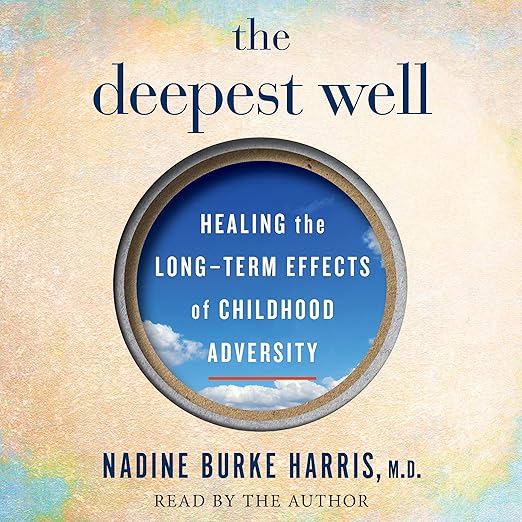
Before You Press Play
- Read by: Dr. Nadine Burke Harris narrating her own research memoir is a genuine asset, bringing clinical precision and personal warmth to material that could easily feel either cold or overwrought.
- At its heart: Adverse childhood experiences and lifelong health, systemic medical reform, the biology of trauma
- Vibe: Urgent and compassionate, moving between scientific rigor and deeply human storytelling
- Short version: One of the clearest and most humane explanations of childhood trauma's biology available for general listeners.
I had heard about The Deepest Well through the ACE research for years before I actually listened to it. The adverse childhood experiences study, the landmark Kaiser Permanente research that found a dose-response relationship between childhood adversity and adult health outcomes, appears in so many adjacent conversations, in trauma therapy, in public health, in developmental psychology, that it was starting to feel like background knowledge I thought I already understood. Dr. Nadine Burke Harris's book reminded me how much I had only understood abstractly.
Burke Harris is a pediatrician who founded the Center for Youth Wellness in San Francisco's Bayview Hunters Point neighborhood, one of the city's most economically stressed communities. Her book moves between three registers: the scientific research on ACEs and their physiological mechanisms, the stories of her patients and their families, and her own journey from medical training to what she calls a breakthrough understanding of what childhood stress does to the body. All three registers are present throughout, and the transitions between them are handled with unusual skill.
Is The Deepest Well Worth Your Time?
The science at the core of The Deepest Well is the finding that adverse childhood experiences, including abuse, neglect, parental substance dependence, and exposure to mental illness, change neural systems in ways that persist into adulthood and contribute to a wide range of physical health outcomes. Burke Harris is careful to distinguish this from the common-sense observation that difficult childhoods have lasting effects. The specific biological mechanism she traces involves the stress response system, cortisol and adrenaline and the disruption of normal development when these systems are activated repeatedly during critical developmental windows. The difference between understanding this in general terms and understanding the specific biology is the difference between sympathy and genuine comprehension.
One reviewer described the book as demystifying the connection between adversity and ill health. That is precise. Burke Harris does not ask you to take the link on faith or moral intuition. She explains, with clinical specificity and accessible language, how the body implements the effects of repeated stress activation. The result is that readers and listeners who have been trying to understand their own health histories through this lens find a more complete explanation than most clinical encounters have provided them.
The Best Parts of The Deepest Well
Burke Harris is deliberate about locating her practice in a specific place with specific social conditions. The Bayview Hunters Point context is not incidental to her research conclusions. It is where she encountered the pattern, in the concentration of complex health presentations among children growing up in sustained adversity, that sent her looking for the framework the ACE research eventually provided. The community stories she tells are handled with the combination of scientific distance and genuine care that marks the best physician writing, in the tradition of Paul Farmer's Mountains Beyond Mountains or Atul Gawande's clinical essays.
A reviewer who noted that she realized through the book how many of her own friends with high ACE scores had health outcomes that now made sense in this framework was describing the book's most common reported effect: it provides a retrospective explanation for patterns you may have observed but not understood. Whether those patterns are in your own history, in the patients you treat, or in the communities you work with, the book extends the explanatory power of the ACE framework beyond clinical research into lived comprehension.
Before You Commit to The Deepest Well
Like Brene Brown's audio course, The Deepest Well is a case where the author narrating her own material adds something that a professional reader could not replicate. Burke Harris's voice carries the clinical authority of a physician presenting findings while simultaneously conveying the human investment of someone who has watched these patterns play out in real children's lives. One reviewer described her as bringing so much voice in writing, which translates directly to the audio experience. The writing is already the voice; the narration makes that audible.
The ten-hour runtime reflects the scope of the argument. Burke Harris moves from the ACE research history through the biology of stress response through specific clinical intervention approaches to a discussion of what systemic change in healthcare would look like if ACE screening were routine. Each section builds on the previous one, and the book earns its length by deepening the argument rather than extending it through repetition.
Should You Listen to The Deepest Well?
Two-thirds of us, according to Burke Harris's research, have experienced at least one adverse childhood event. The book is not only for people who identify as trauma survivors. It is for anyone who works with children, who cares about public health, who wants to understand why certain health disparities are persistent across populations, or who is simply curious about the biological mechanisms that connect early experience and lifelong outcome. A reviewer called it a must-read for everyone who cares about children, the current health crisis, and real-world solutions. At 4.7 across only four reviews the sample is small, but the response is consistent. This is the kind of book that changes how you see things, which is the highest standard any nonfiction can reach.
A Few Questions About The Deepest Well
Is The Deepest Well primarily for healthcare professionals, or is it accessible to general readers?
It is genuinely accessible to general readers. Burke Harris explains biological mechanisms in plain language and structures the science around patient stories that ground the research in human terms. Reviewers with no clinical background have described it as one of the most comprehensible explanations of trauma biology they have encountered.
Does the book offer practical interventions, or is it primarily diagnostic?
It does both. Burke Harris describes the clinical intervention approach developed at the Center for Youth Wellness, which includes ACE screening as a routine part of pediatric care and a multimodal response that addresses the biological stress response through sleep, exercise, nutrition, mental health support, and caregiver wellbeing. The final sections deal explicitly with what healthcare policy reform would look like at scale.
How does Burke Harris's own pediatric practice in Bayview Hunters Point shape the book's perspective?
The Bayview Hunters Point context is central rather than incidental. Working in one of San Francisco's highest-poverty neighborhoods gave Burke Harris concentrated exposure to the health patterns the ACE research explains, and the community stories throughout the book reflect that specific setting. The book makes the case that systems-level medical reform is necessary precisely because individual clinical excellence cannot compensate for structural conditions.