Quick Take
- Narration: Priya Ayyar gives both Nehal and Giorgina distinct, fully inhabited voices, navigating the tonal contrast between their worlds with real skill.
- Themes: women’s rights and political agency, forbidden magic, friendship across class lines
- Mood: Propulsive and politically charged, with a slow-burn romantic undercurrent
- Verdict: A debut fantasy that earns its ambitions on both the political and the personal level, even if the ending arrives too abruptly.
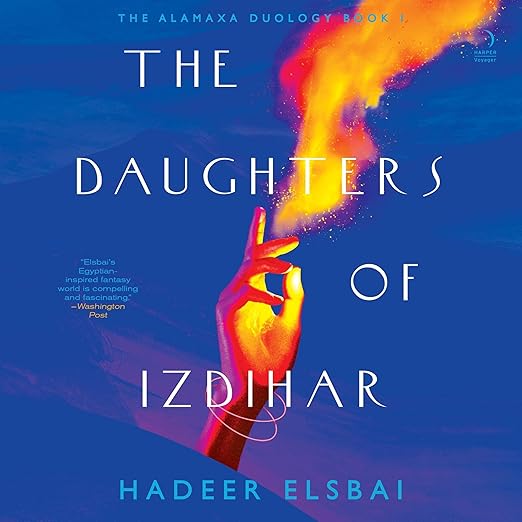
I started The Daughters of Izdihar on a Saturday morning and finished it well after midnight, which tells you most of what you need to know about the pacing. Hadeer Elsbai’s debut novel is one of those books that makes you aware of how rarely secondary world fantasy actually centers political organizing as a genuine plot engine rather than window dressing. The Daughters of Izdihar does not just gesture at a women’s rights movement. It puts you inside it, with all the argument, sacrifice, and moral complexity that implies.
The setup draws on modern Egyptian history for its texture while building its own wholly original world. Nehal is a waterweaver from an aristocratic family crushed by her father’s gambling debts, married against her will to the merchant Nico. Giorgina is a bookshop worker with a secret and uncontrollable earthweaving ability, who finds her community and purpose through the Daughters of Izdihar, a radical women’s organization led by the strategically brilliant Malak Mamdouh. Nico is in love with Giorgina. Nehal and Giorgina begin as strangers in an uncomfortable triangle and slowly become something far more interesting to each other.
Our Take on The Daughters of Izdihar
What Elsbai gets exactly right is the relationship between private struggle and public movement. Nehal wants to join the first all-female military regiment and use her waterweaving abilities on a battlefield. Giorgina wants, at minimum, the right to exist in public without fear. These are different scales of ambition, and the novel respects both without flattening either character into the other’s story. One reviewer quoted the book’s thesis directly: a country cannot be free if its women are not. That line lands because the novel earns it across thirteen hours of narrative, not just in a single rhetorical moment.
The magic system is functional and clearly imagined. Weavers manipulate specific elements, water, earth, and others implied but not yet fully explored in this first volume. The formal Weaving Academy that Nehal desperately wants to attend is controlled by forces that would rather keep women’s power untrained and unrecognized. The parallel between access to magical education and access to political rights is not subtle, but it does not need to be. Elsbai builds the world so that the metaphor is structural rather than decorative.
Why Listen to The Daughters of Izdihar
Priya Ayyar’s narration is one of the genuine pleasures of this audiobook. She distinguishes Nehal’s spoiled, impulsive urgency from Giorgina’s quieter, more internally conflicted voice without resorting to caricature. The secondary cast, Malak’s controlled authority, Nico’s distant ache, Marwan’s complexity, all register as distinct presences rather than supporting functions. At thirteen hours, the book never feels padded because Ayyar keeps the emotional stakes alive even in the slower political exposition scenes.
The Egyptian cultural inspiration gives the world a texture that sets it apart from the predominantly European-derived fantasy landscape. Elsbai renders it with specificity rather than exoticism, and Ayyar’s narration honors that specificity in the pronunciation and emotional coloring of names and places. This is the kind of debut that suggests a writer who has a clear sense of the world she is building and the patience to build it properly.
What to Watch For in The Daughters of Izdihar
The ending is the book’s most significant problem, and multiple reviewers noted it independently. One described it as choppy and abrupt, having completely forgotten this was not a standalone novel. That surprise is a structuring failure: the first book of a duology should generate momentum toward a sequel while still providing some form of resolution in its own right. The Daughters of Izdihar stops rather than concludes, and listeners who arrive without knowing it is the first volume of The Alamaxa Duology will feel the loss of that landing.
There is also a criticism worth acknowledging from a reviewer who found the feminist politics heavy-handed in places. Elsbai’s vision of women’s solidarity is genuine and consistently argued, but a few scenes do prioritize message delivery over character complexity. Nehal and Giorgina’s emotional decision-making is sometimes reactive in ways that serve the plot’s needs more than their own established personalities. Malak, interestingly, escapes this critique almost entirely and is arguably the most fully realized character in the book.
Who Should Listen to The Daughters of Izdihar
This audiobook is well suited to listeners who want their fantasy to do political and social work alongside its magic and romance. If you came to N.K. Jemisin’s Broken Earth trilogy or Tasha Suri’s Burning Kingdoms for the intersection of systemic oppression and speculative world-building, this belongs in the same conversation. Listeners who prefer their fantasy primarily as escapism may find the political scaffolding demanding. Go in knowing the ending is deliberately unresolved, and commit to the duology from the start.
Frequently Asked Questions
Is The Daughters of Izdihar a standalone audiobook or do I need to listen to the sequel?
It is the first book in The Alamaxa Duology, and the ending is deliberately open. Multiple reviewers were surprised to find it ends abruptly. You will want to have the sequel ready before you finish, particularly if cliffhanger endings frustrate you.
How explicit is the romantic content between Nehal and Giorgina?
The romantic development between the two protagonists is slow-burn and emotionally focused in this first volume. The book does not contain explicit content in the audiobook edition. The emotional and political relationship takes precedence over physical romance.
Does Priya Ayyar’s narration handle the Arabic-inflected names and terms well?
Yes. Ayyar’s narration navigates the Egyptian-inspired proper nouns and place names with care and consistency. The pronunciation choices feel intentional rather than approximated, which matters for a world building on a specific cultural tradition.
Is the magic system well explained for listeners new to elemental fantasy?
The elemental weaving system is introduced gradually and clearly. You do not need prior familiarity with this type of magic. The Weaving Academy, the different elemental types, and the social restrictions on weavers are all explained through character experience rather than exposition dumps.