Plummer's Dry Precision Matches the WSJ Reporting
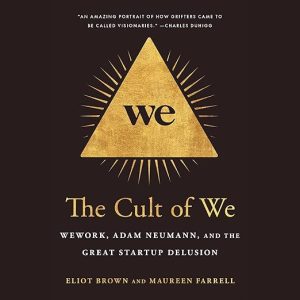
Reporting on the collapse of WeWork while the wreckage is still warm is one kind of journalism. Writing the definitive account of how a desk-rental company briefly convinced the world it was worth more than JPMorgan is something else entirely, and The Cult of We manages to be both at once. Thérèse Plummer narrates this audiobook with the dry precision the material calls for, giving Wall Street Journal reporters Eliot Brown and Maureen Farrell's account of Adam Neumann's rise and catastrophic fall the pace of a financial thriller and the rigor of a documented investigation. At over thirteen hours, it is a substantial commitment, but the story it reconstructs is one of the stranger corporate implosions in recent business history.
Brown and Farrell were the journalists whose reporting at the WSJ actually rocked WeWork while it was still operational, which gives them an unusual vantage point. They are not reconstructing events from a remove; they were inside the story as it happened, and the book benefits from that proximity in the specificity of its detail and the confidence of its sourcing. Plummer's narration conveys that authority without letting it calcify into self-congratulation.
SoftBank's Vision Fund Became WeWork's Oxygen Supply
The central question the book spends its runtime answering is not simply how Neumann built WeWork to a $47 billion paper valuation but why so many sophisticated people believed in it. Brown and Farrell are particularly good on SoftBank's Masayoshi Son, whose Vision Fund became WeWork's primary oxygen supply, and on the specific cultural moment in Silicon Valley when 'tech company' became a magic phrase that could transform any business model into something investors were willing to fund at extraordinary multiples. The mechanism by which Neumann's six-foot-five charisma and quasi-messianic language turned skeptical bankers into true believers is the book's most valuable contribution to the business literature of the period.
Plummer's performance handles both the analytical and narrative registers of the book without losing the thread. The audiobook moves between boardroom conversations, investor meetings, and scenes from Neumann's private jet with marijuana-clouded air and a revolving cast of power brokers, and back to the structural financial analysis that explains why the music kept playing so long. Plummer maintains consistent tone through all of it, which is the kind of invisible craft that makes a thirteen-hour production feel shorter than it is.
Reviewers without finance backgrounds describe the book as accessible, with 'key financial concepts and cons' explained without condescension. That accessibility is partly Plummer's contribution: her pacing gives listeners time to absorb financial mechanism before the narrative accelerates again.
The book's financial journalism lineage is visible in how it handles sourcing. Brown and Farrell name their sources specifically where other authors might rely on anonymous informants or composite characters, which gives The Cult of We a documentary solidity that most business narrative nonfiction lacks. That specific sourcing means the details that seem most outrageous, Neumann's private jet, the marijuana, the colonize-Mars ambition, the first-trillionaire self-description, are documented rather than reconstructed. Plummer's narration treats these details with the same matter-of-fact authority as the financial data, which is the correct register: incredulity served better by understatement than by editorial emphasis.
Plummer Resists Mockery Even in Absurdist Scenes
The book's WSJ origins mean it operates within a specific conception of what the WeWork story means: primarily a story of investor credulity, governance failure, and the excesses of a particular era of Silicon Valley valuation culture. The human cost to WeWork employees, many of whom received equity that became worthless and faced sudden layoffs, receives less sustained attention than the investor dynamics. Listeners interested in the labor and workplace dimension of the collapse will find it present but not centered.
The book was published in 2021, before WeCrashed, the Apple TV+ dramatization, which changed how many people understand the story. Listeners who have seen the dramatization first may find some of the book's revelations less surprising than they would have been on original publication, but the documented detail and sourced specificity of the journalistic account adds texture that dramatization necessarily compresses.
Plummer's approach to the absurdist passages in the book is one of the quieter performance achievements of this production. When the details are objectively almost farcical, specifically Neumann's speculation that a WeWork could host a Middle East peace accord, his private jet with marijuana smoke, his ambition to become the world's first trillionaire, Plummer maintains the same dry register she brings to the financial analysis. She does not tip into mockery, which would undercut the book's argument that these delusions were taken seriously by serious people. The comedy in The Cult of We comes from the facts themselves rather than from editorial emphasis, and Plummer understands that distinction.
Theranos and Enron Readers Will Recognize the Pattern
Business and finance listeners who want the sourced, documented account of how WeWork became what it did will find the audiobook the most rigorous available treatment of the subject. Listeners fascinated by the psychology of charismatic leadership and how it operates on sophisticated institutional audiences will find Brown and Farrell's access to the actual decision-makers particularly illuminating. Readers of comparable business collapse narratives, including accounts of Theranos, Enron, or the 2008 financial crisis, will find The Cult of We occupies that same territory. Those who watched WeCrashed and want the facts behind the dramatization will find the audiobook a useful complement. Listeners who need practical investment guidance or current market analysis should look elsewhere; this is history and journalism, not prescription.
The Short Version
- Performance: Thérèse Plummer narrates with dry authority, balancing the financial analysis and the almost satirical excesses of Neumann's court without letting either register overwhelm the other.
- What it covers: startup excess and investor credulity, charismatic leadership and institutional failure, Silicon Valley valuation culture
- Feel: Investigative and drily incredulous, with the dark comedy of watching smart people believe impossible things
- Our call: The definitive journalistic account of the WeWork collapse, narrated with the right register of disbelief, and essential listening for anyone who watched the valuation era in real time.
Questions Listeners Ask
Do I need a finance background to follow this audiobook?
No specialist knowledge required. Reviewers without finance backgrounds consistently describe the book as accessible and the financial concepts as well-explained. Brown and Farrell write for a general business-curious audience, and Plummer's pacing gives listeners time to absorb mechanism before the narrative accelerates.
How does the audiobook differ from the WeCrashed dramatization?
The book is the sourced journalistic account with documented detail, named sources, and specific financial mechanisms that dramatization necessarily compresses or fictionalizes for narrative purposes. Listeners who saw WeCrashed first will find the audiobook adds specificity and documented texture to events they know in outline.