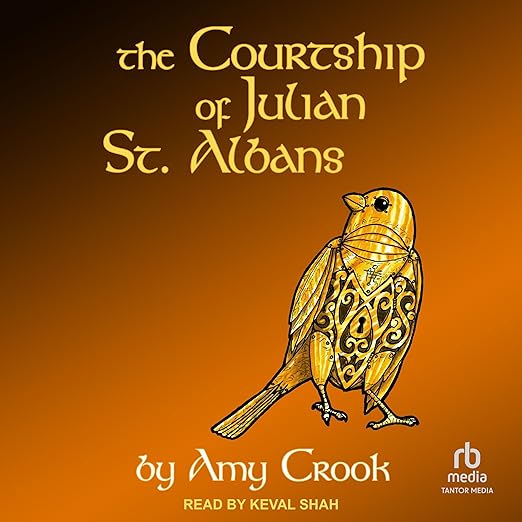
Quick Take
- Narration: Keval Shah handles the large cast with clear differentiation and brings exactly the right combination of wit and restraint to Alex Benedict’s sarcastic, guarded voice.
- Themes: Grief as entry point into connection, the performance of identity under scrutiny, magical detection as social navigation
- Mood: Warm and witty with a genuine mystery underneath, closer to a very good drawing-room comedy than a thriller
- Verdict: A richly realized debut world with an MM romance that builds slowly enough to feel genuinely earned, one of the more satisfying alternate-world fantasy audiobooks in recent memory.
I started The Courtship of Julian St. Albans late on a Friday night with the loose intention of listening for an hour before sleep. I was still listening at two in the morning. That’s not because the book is a propulsive thriller, it isn’t, and it doesn’t pretend to be. It’s because Amy Crook creates a world with enough detail and warmth that leaving it felt like a genuine cost.
The premise is elegant in the way the best genre mashups are: Alex Benedict is a magical consultant who works homicide investigations with the Agency’s top detective, and Julian St. Albans is the grieving heir whose fiancé has been murdered by magical means. When Alex is brought in to investigate, his family connections get him positioned inside Julian’s courtship, a formal Regency-inflected process in which suitors compete for Julian’s hand, where he can observe suspects while nominally pursuing the case. The cover gives him access. The access gives Crook a setting: a closed-circle investigation inside a world of elaborate social ritual, where the detective has personal stakes he won’t initially acknowledge.
Our Take on The Courtship of Julian St. Albans
The alternate England Crook constructs is the book’s most sustained achievement. It has Regency-era manners and Victorian fashion alongside fully modern conveniences and a magic system that functions as professional specialty, tuning forks that allow practitioners to perceive magical frequencies, charms that are as commonplace as smartphones, a society where same-sex marriage and queer identity are unremarkable. One reviewer described it as a world with “curries and total openness to gay marriage, a non-Christian religion with Guardians.” That openness is not incidental, Crook integrates it into the world’s texture rather than making it a point of difference, which is a more sophisticated move than it might seem.
The mystery itself is genuinely puzzling. I thought I had the solution halfway through and was wrong, which is exactly the correct relationship between a mystery and its reader. The magical-means element, the requirement to trace threads of magic rather than physical evidence, allows Crook to vary the detective process in interesting ways while keeping the investigation grounded in procedural logic rather than handwaving.
Why Listen to The Courtship of Julian St. Albans
Keval Shah’s narration deserves particular attention. The novel has a large cast, suitors, household staff, detective colleagues, Julian’s extended family, and the investigators, and Shah differentiates them clearly through voice and register. His Alex is exactly right: the “remorseless use of flirting to peeve those around him” that one reviewer highlighted is rendered with the precise level of ironic distance the character requires. The warmth underneath Alex’s deliberate abrasiveness is what makes the slow-burn romance work, and Shah calibrates the emotional reveal with care.
The romance itself is patient by the standards of the genre. This is not a book where the relationship resolves quickly. The courtship structure, Julian receiving multiple suitors while Alex investigates, keeps the emotional distance functional as long as the plot requires it, and the payoff is proportional to how long the investment takes. The included short fiction at the end of this edition (Untrue Love and Finer Points) extends the world usefully for listeners who don’t want to immediately let go of these characters.
What to Watch For in The Courtship of Julian St. Albans
At eighteen-plus hours, this is a long audiobook, and it is paced like a long audiobook. Listeners who want efficient plotting will find the world-building and social-scene chapters occasionally languorous. The food descriptions that one reviewer mentioned with semi-envious appreciation are detailed to a degree that either delights or slows the experience depending on your tolerance for sensory detail.
The book was originally published as a series of shorter works, which the Tantor Media edition compiles. Some readers familiar with the source material note that the stitching between sections is occasionally perceptible. First-time listeners arriving through the audiobook are unlikely to notice or care.
Who Should Listen to The Courtship of Julian St. Albans
Highly recommended for listeners who enjoy MM romance in alternate-history or secondary-world settings, detective fiction with strong character work, and cozy fantasy that earns its warmth through specificity rather than formula. Those who want fast-paced thriller energy should look elsewhere, this is a book that rewards patience. The eighteen-hour commitment is substantial, but the world Crook builds is one of the more original you’ll find in contemporary genre fiction.
Frequently Asked Questions
Is The Courtship of Julian St. Albans the first book in the Consulting Magic series, and can it be read as a standalone?
It is the first book and functions as a complete story with a satisfying resolution. The included short fiction (Untrue Love and Finer Points) extends the world but is supplementary. The overarching series continues in subsequent volumes, but this entry doesn’t leave the central mystery unresolved.
How explicit is the MM romance content in this audiobook?
The romance is slow-burn and on the tasteful end of the spectrum. The courtship structure keeps physical relationship development deliberately measured, and reviewers consistently describe the book as suitable for readers who prefer emotional tension over explicit content. The worldbuilding and mystery are the primary focus.
Does Keval Shah’s narration effectively differentiate the large cast of suitors and supporting characters?
Yes, this is one of the narration’s clear strengths. The cast of suitors, household staff, detectives, and extended family members is substantial, and Shah gives each a distinct voice and register without resorting to caricature. Listeners following the mystery will be able to track who is speaking without regularly needing to rewind.
Is the magic system in The Courtship of Julian St. Albans complex enough to require careful attention, or is it secondary to the mystery plot?
The magic is functional and clearly explained rather than systematically elaborate. Alex’s ability to perceive magical frequencies with a tuning fork provides the primary investigative mechanism, and Crook integrates it into the detection process naturally. Listeners who don’t enjoy learning fantasy magic systems from scratch will find this accessible.