Key Details
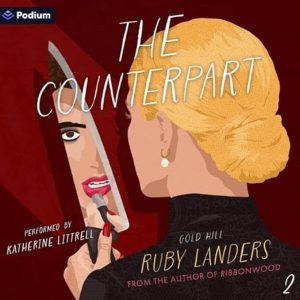
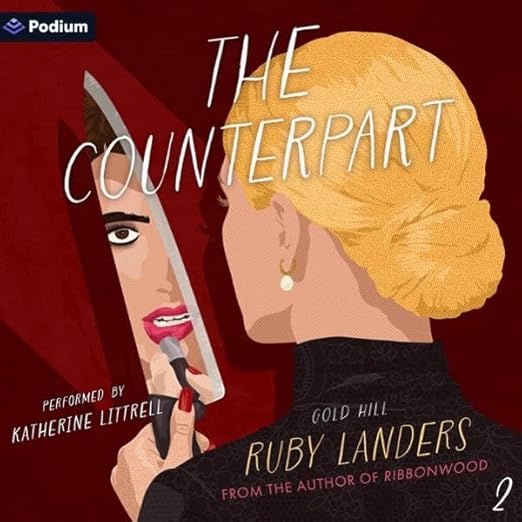
- Read by: Katherine Littrell handles both protagonists with clear vocal distinction; she navigates the tonal shifts between crime thriller tension and romantic heat without losing either register.
- At its heart: Identity and performance, sapphic desire under pressure, crime as power
- Vibe: Propulsive and spicy, with a genuinely suspenseful crime plot underneath the romance
- Short version: Ruby Landers delivers what her fans expect and then raises the stakes significantly with a mafia plot that earns the full eleven hours.
I am not typically drawn to crime romance hybrids, but a reader I trust told me that Ruby Landers does something unusual in this genre: she lets the crime plot be a real crime plot rather than decorative backdrop for the love story. I decided to test that claim on a long train journey from Paris, and by the time the train pulled into the station I had finished four hours of The Counterpart and was annoyed that I had to stop. The claim holds.
This is the second book in Landers's Gold Hill series, following Only Hope, and it works on its own terms even if you have not read the first, though the world and characters will feel richer with that context. The setup is built on a particular kind of story architecture: two women whose lives are intertwined in ways neither has fully understood, brought into direct contact by circumstances neither controls. Eloise Silver is an actor in her mid-thirties whose biggest career credit is an Australian soap opera and a string of ice-cream commercials until the mob boss's wife she once played on television turns out to be a real person who has just led a bloody coup to take over Melbourne's largest crime syndicate.
Eloise's Desperation Grounds a Parody-Adjacent Premise
The premise sounds like the beginning of a parody, but Landers earns it through character work that is more specific than the genre requires. Eloise's desperation for a big break is not played as comedy or as mere motivation. It is the grounding condition of her life, the thing that makes the risk of getting close to Estella Grant feel genuinely rational rather than simply reckless. Estella, meanwhile, is drawn with the kind of complexity that prevents the crime boss from becoming a straightforward fantasy figure. She is dangerous, calculated, and charismatic, and the book takes seriously the question of what it actually costs her to be what she has become.
One reviewer describes the motivations, experiences, and dynamics of the characters as masterful. That is a strong word, but the characterization here is genuinely stronger than what the mafia romance subgenre typically produces. Another reviewer notes twists and turns until the very end, with dialogue that rarely felt clunky and the right balance of plot, explicit content, and character development. The balance question is the hard one in this kind of hybrid, and Landers manages it better here than in the first Gold Hill book, by most accounts.
Littrell's Distinct Voices Make Eleven Hours Fly
The narration handles the book's dual perspective with genuine skill. Littrell gives Eloise and Estella sufficiently different vocal textures that the point-of-view shifts are navigable without chapter headings to orient you, which matters in a book with this much momentum. She is also one of those narrators who can play heat without making it feel performative, which is essential in a novel where the explicit content is integral to the dynamic between the characters rather than intermission from it. The eleven-hour runtime moves faster than that number suggests, which is usually a reliable indicator that the narration is doing its job.
Landers is a GCLS award-winning author, which situates her within a tradition of sapphic fiction that prizes craft alongside commercial entertainment. That pedigree shows in the prose, which does not always take the most obvious structural choice, and in the ending, which reviewers describe as satisfying without being predictable. The Gold Hill series sits in a specific intersection of lesbian fiction, crime thriller, and contemporary romance that has a passionate and somewhat underserved audience, and The Counterpart is as strong an entry point as any in the genre.
Explicit but Never Gratuitous, and Accessible as a Standalone
The book contains explicit sexual content, and Landers flags a content warnings list on her website. Listeners who are looking for sapphic romance without that level of explicitness will find the heat level high, though never gratuitous in the sense that it overwhelms the narrative. For listeners who enjoy the intersection of genuine suspense and explicit romance, the balance Landers strikes is the book's specific achievement: neither element is sacrificed for the other. The crime plot is consequential, the relationship is emotional, and the combination is what makes the full eleven hours feel justified rather than padded.
As book two of the Gold Hill series, this follows Only Hope, but reviewers who came to The Counterpart without reading the first book generally describe it as accessible as a standalone. The emotional stakes are constructed in a way that does not require prior reading to land, though starting with Only Hope will enrich investment in Estella's arc.
Crime Readers Who Want a Real Love Story Too
This is for readers who want sapphic romance with real narrative substance behind the relationship, listeners who enjoy crime fiction and are open to a central love story as part of the genre rather than a departure from it, and anyone who has been disappointed by mafia romance that treats the criminal world as pure fantasy backdrop. It is not for readers who want low heat levels or prefer their crime fiction without romantic subplots. It is especially recommended for existing Ruby Landers readers who found the Gold Hill series promising but want to see what she does when she pushes the craft harder.