The Short Version
- Performance: A W Dickson delivers the fast-paced military action with energy and consistent characterization, a solid match for C.G. Cooper's crisp, propulsive prose.
- What it covers: Vigilante justice and the limits of law, loyalty and military brotherhood, threats to American political institutions
- Feel: Fast, propulsive, and unapologetically pulpy, three books designed to be consumed in rapid succession
- Our call: Solid, fast-moving military thriller fiction that delivers exactly what it promises, not literary complexity but reliable genre entertainment at its most efficient.
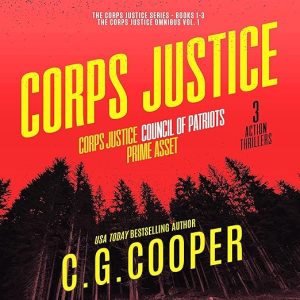
There is a specific type of audiobook I reach for when I have been doing intensive, demanding listening for weeks and my brain needs something that just moves. The Corps Justice Series: Books 1-3 is that kind of listen. C.G. Cooper writes military thrillers with the lean efficiency of someone who has read a lot of genre fiction and understood what works: a compelling protagonist, antagonists with clear motivations, action sequences that don't overstay their welcome, and a forward momentum that makes stopping genuinely difficult.
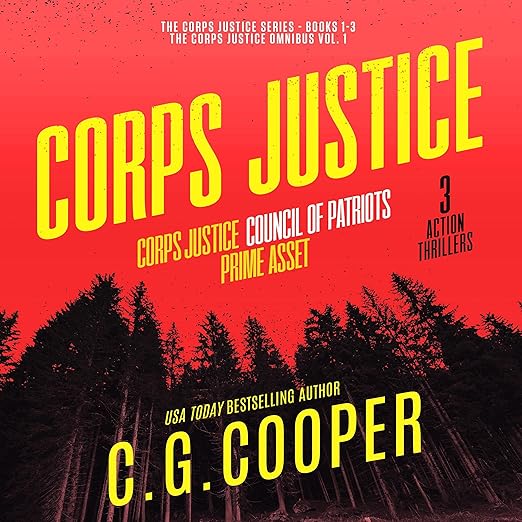
The box set collects the first three entries in the Corps Justice series. Book one, Corps Justice, introduces former Marine Cal Stokes, a Navy Cross recipient who returns from war expecting peace and instead finds himself drawn into a fight that forces him to operate outside the law. Book two, Council of Patriots, sends Cal and his team from SSI to Las Vegas to prevent an infiltration of the Democratic National Convention by an invisible enemy with inside political connections. Book three, Prime Asset, pivots to a personal threat: Cal's friend Neil Patel disappears in Jackson Hole, Wyoming, and the SSI team pursues the trail into a final confrontation with returning enemies.
A Closer Look at The Corps Justice Series: Books 1-3
Cooper writes with the instincts of someone who knows his audience well. The prose is clean and purposeful, one reviewer described it as "fast paced and crisp", and the action sequences have a kinetic quality that translates particularly well to audio. A W Dickson's narration supports this; he reads with energy and maintains consistent characterization across a large cast without becoming confusing or overwrought.
The Tom Clancy comparison that one reviewer raises, offering the caveat that Cooper is "not Clancey level storytelling", is fair and also the right frame for managing expectations. Clancy at his best was doing something with geopolitical texture and technical detail that elevated the military thriller to a different plane. Cooper is working at a more efficient, less architecturally ambitious scale. His Cal Stokes is a capable, morally committed protagonist rather than a fully drawn psychological study, and the supporting cast functions more as an ensemble of competences than as characters with complex inner lives. None of this is a failure on Cooper's terms; it is a genre commitment.
What Makes The Corps Justice Series: Books 1-3 Worth Hearing
The value proposition of the box set format is immediately apparent: seventeen hours of continuous story across three volumes, with characters and stakes that carry and deepen from book to book. The investment in Cal Stokes and SSI that the first novel requires pays dividends in the second and third entries, where returning characters and evolving relationships carry real weight. Cooper is building toward a longer series, and the first three entries establish a foundation that is solid enough to support the ambition.
One reviewer who came to the series as a female reader specifically noted finding it accessible and enjoyable, noting that it avoids the hyper-masculine insularity that can make some military fiction feel exclusive. Cooper keeps the focus on stakes and mission rather than on gender dynamics, which widens the potential audience.
Things to Know Before Starting The Corps Justice Series: Books 1-3
The series' politics are worth flagging for listeners with strong sensitivities in either direction. Cooper's world is one where private military contractors operate in service of genuine patriotism, where American institutions are worth defending, and where the threats to those institutions come from both foreign adversaries and domestic political operators. This is not an ideologically neutral universe. The Council of Patriots book, specifically, involves a conspiracy centered on the Democratic National Convention that some readers will find the framing of politically loaded. Cooper is not writing polemic, but he is writing from a clear perspective.
The three books also vary in ambition. Corps Justice is the most origin-story focused; Council of Patriots is the most politically complex; Prime Asset is the most personal. Taken together, they demonstrate Cooper's range within his chosen lane, and they leave a listener ready for more.
Who C. G. Cooper Is Writing For
Military thriller readers who want reliable, fast-moving genre fiction will be well served. Fans of the genre who have already exhausted Brad Thor, Vince Flynn, and Daniel Silva's output and are looking for something in the same key will find this a natural fit. Literary fiction readers expecting psychological depth or moral ambiguity will be disappointed. The box set format is the right entry point, buying individual volumes first and assessing pacing is not necessary when the first book makes the series' terms this clear.