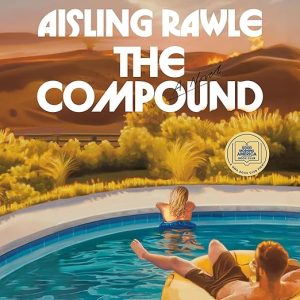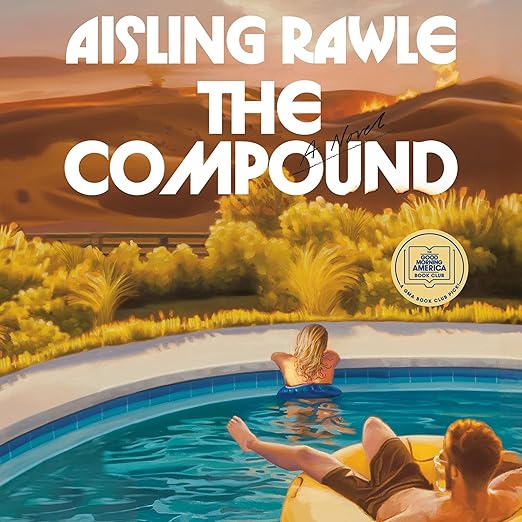
What kind of book gets compared to a guilty-pleasure binge-watch and a literary classic in the same promotional blurb? That tension in the marketing for The Compound by Aisling Rawle is not accidental. It reflects something genuinely split in the novel itself: the story operates on the surface like a reality television show, propulsive and slightly shameless and engineered for maximum forward momentum, while underneath it runs a colder, more deliberate critique of exactly the kind of entertainment it is mimicking. Picking up this audiobook, narrated by Lucy Boynton, means signing up for a ten-hour listening experience that keeps you company for a week and occupies your thinking long after it ends.
Lily wakes up in a remote desert compound alongside nineteen other contestants competing on a massively popular reality show. The rules are straightforward: outlast everyone else and stay in the Compound longest. Rewards include champagne and lipstick. Communal necessities like food, appliances, and an actual front door require winning challenges. The world outside is falling apart, but Lily has no desire to leave. That premise does two things simultaneously. It gives the novel its page-turning forward momentum. And it quietly raises uncomfortable questions about why anyone would choose a controlled competition over an uncertain but real world outside.
Rawle is doing something more precise here than the packaging suggests. The New York Times Book Review called it smart and provocative and so damn addictive, and all three of those adjectives are accurate but they need to be understood together rather than separately. The smartness and the provocation are not offered alongside the addictive quality; they are delivered through it. The novel is metacritical in the sense that it implicates its own audience in the same consumerist appetites it critiques through Lily. The fact that you cannot stop listening is part of the argument being made about you as a cultural participant, not just as a reader.
Reviewer AWL hit on this when describing the book as the reality TV version of a book, easy to read and fun, while noting that the message about materialism and consumerism is well done, albeit obvious. That obviousness deserves examination. The visibility of the critique may be entirely intentional: a deliberate choice to make the satirical mechanism legible rather than buried, in the same way that reality television makes its own contrivances partially visible while insisting the emotions and outcomes are genuine. The show within the novel and the novel itself are playing the same game at the same time.
What Makes The Compound: A GMA Book Club Pick Worth Hearing
Lucy Boynton's narration is one of the strongest reasons to choose the audiobook format for this particular novel. Lily's voice needs to sound simultaneously authentic and performed, since she is always aware of the cameras even when the prose presents her as unguarded. Boynton navigates that double register throughout the full runtime, giving the character a surface warmth that never fully obscures the calculation operating underneath it. The long audiobook format gives the layers of Lily's character time to accumulate in the way they need to for the ending to land with its intended weight.
Reviewer amanda berrey noted being completely hooked by watching how different personalities approached the same situations and caring deeply about who ended up surviving, which identifies the book's second great strength: the ensemble dynamics. The compound's contestants are not archetypes arranged for thematic contrast but genuine characters with competing survival strategies, and the collision and occasional alliance of those strategies drives the middle section with real momentum that sustains the runtime without flagging.
Things to Know Before Starting The Compound: A GMA Book Club Pick
Reviewer Asheley articulated the most common listener disappointment clearly: this is not, despite some meaningful nods in that direction, a full dystopian novel or a climate fiction text in any developed sense. The world outside the compound is present as pressure, implication, and periodic revelation rather than a fully built speculative backdrop. If you arrive hoping for the atmospheric infrastructure of the best dystopian fiction, the book will feel underbuilt in that dimension. What it actually is, a social satire about reality television, desire, and the performance of authenticity under observation, is a different and entirely valid thing. Knowing that distinction upfront changes how you position yourself to receive it and will save considerable frustration.
The ending raises the stakes in ways that some readers have found genuinely disturbing and others have found somewhat underresolved. Oprah Daily called it every bit as addictive as your favorite guilty pleasure binge-watch, and that comparison holds structurally, including in how it handles resolution: satisfying on the immediate surface, more unsettled and unsettling if you let it settle for a day or two afterward.
Who Aisling Rawle Is Writing For
This audiobook works for listeners who enjoy literary fiction that moves like genre entertainment, for fans of sharp social satire delivered through an addictive rather than distanced frame, and for anyone who has ever felt uncomfortable about how much they enjoy watching strangers compete under manufactured pressure. Listeners committed to rigorous SF worldbuilding or fully realized dystopian settings should significantly adjust their expectations before starting. The GMA Book Club selection reflects the book's mainstream literary ambitions rather than its speculative ones, and the audience for whom those ambitions land will find this a very satisfying ten hours of listening.
At a Glance
- Narrator: Lucy Boynton brings exactly the right blend of surface charm and barely-concealed unease to Lily's perspective, making the reality-show performance feel genuinely layered across the full ten hours.
- Subjects: Reality television as social control, consumerism and desire, the performance of authenticity under observation
- Tone: Propulsive and slightly suffocating, like a binge-watch you cannot stop even as it unsettles you
- Bottom line: An addictive debut with a sharper satirical edge than its premise suggests, though listeners who arrive expecting full dystopian worldbuilding will find the book more interested in character and social commentary than speculative infrastructure.
How does Lucy Boynton's narration enhance the audiobook experience for this particular story?
Boynton brings a quality that suits Lily's double consciousness as a contestant who is always performing for cameras while simultaneously trying to survive. The surface charm and the barely-visible calculation underneath are both present in her performance, and that layered quality makes the novel's central tension feel immediate and embodied rather than theoretical across the full ten-hour audiobook runtime.
What does the rating spread for this audiobook tell prospective listeners about whether to try it?
The three-star responses came primarily from listeners who arrived expecting more dystopian infrastructure and less focus on interpersonal contestant dynamics. The four and five-star responses came from listeners who appreciated the character work and the social satire for what it actually is. If speculative worldbuilding is your primary draw, approach with caution. If character-driven tension with satirical stakes is your preference, the audiobook consistently delivers that.