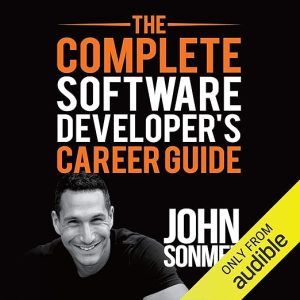
At a Glance
- Narrator: Sonmez self-narrates with the practiced directness of someone who has delivered this advice to real developers many times; the twenty-hour runtime stays listenable throughout.
- Subjects: career navigation, technical soft skills, self-directed learning
- Tone: Practical and direct, occasionally blunt
- Bottom line: A genuinely comprehensive career manual for software developers that covers what formal education consistently leaves out.
At what point does technical skill stop being the deciding factor in a software career? John Sonmez answers that question within the first thirty minutes of this audiobook, and the answer is earlier than most developers expect. Sonmez built his audience through his Simple Programmer platform, coaching developers on the parts of the career that no one explicitly teaches: how to negotiate, how to market yourself, how to learn without drowning, and how to make the contractor-versus-employee decision without defaulting to whichever option feels safer.
I worked through this one during a stretch of long evening walks, which turned out to be the right context for it. This is not a book you read for aesthetic pleasure; it is a book you listen to while you are walking and nodding and occasionally stopping to write something down. At twenty hours and four minutes, it is genuinely comprehensive, and the self-narration by Sonmez keeps the pace conversational in a way that suits the material.
First, the Big Picture
Sonmez narrates his own work, and this is absolutely the right choice. His YouTube and podcast background means he speaks directly to a listener rather than reading at one. The cadence is informal without being casual; he is clearly a person who has said these things before to real developers in real career crises, and that familiarity with the audience comes through. For a book of this length, narrator energy matters enormously, and Sonmez sustains it across twenty hours without running thin.
The coverage is unusually complete. The book addresses choosing a programming language, navigating the CS degree question, understanding coding bootcamps (including which ones are scams), handling micromanager bosses, building work experience before you have a job, dressing for interviews at companies that say 'casual,' and negotiating hourly rates. One reviewer called it 'the missing manual you've been looking for in a software career,' and the comprehensiveness justifies that claim without the marketing noise usually attached to it.
The specific sections on the chicken-and-egg experience problem are worth the runtime on their own. Every developer faces the same wall: every job posting requires three to five years of experience, but getting that experience requires having a job. Sonmez proposes concrete workarounds, not vague advice about networking or personal branding, and those workarounds are the kind of thing that feels obvious in retrospect but that no one tells you when you are staring at an application form at midnight.
The contractor-versus-salaried chapter is similarly practical. Sonmez breaks down not just the financial arithmetic but the personality factors: which developers thrive in the uncertainty of contracting and which find that uncertainty corrosive. That kind of self-assessment framework is genuinely rare in career literature, where the advice tends to be universal when the optimal path is nearly always individual.
Sonmez's section on interview preparation is worth isolating for particular attention. The advice here is not generic confidence coaching; it is specific, tactical, and grounded in the mechanics of how technical hiring processes actually work. The guidance on whiteboard interviews, on how to signal competence under observation without appearing to be performing competence, and on navigating the specific social dynamics of a technical interview is the kind of practical specificity that turns a general career book into something you can use within forty-eight hours. Listeners who are actively job-hunting should consider replaying these sections rather than treating them as background information.
Weak Spots in The Complete Software Developer's Career Guide
The book was written with a US market in mind, and some of the specifics around coding bootcamps, salary negotiation norms, and job market dynamics do not translate cleanly to non-American contexts. International listeners will need to filter for relevant principles and discount the local specifics. That is a real limitation for a book this long, and worth knowing before you invest twenty hours.
Sonmez's perspective is also that of a developer who succeeded on a particular trajectory, and his bias toward solo self-improvement and personal branding runs through the book consistently. That ethos will resonate with certain readers and feel incomplete to others who work in team cultures or large enterprise environments where individual brand-building is less central. Neither is wrong, but the book's worldview is specific enough to notice.
The book's chapter on learning new technologies efficiently is among its most transferable contributions. Sonmez's framework for just-in-time learning, acquiring skills at the point of need rather than accumulating knowledge speculatively, runs counter to how most developers are trained to think about professional development. The instinct to learn comprehensively before applying is hard to break, and Sonmez makes a rigorous case for why it costs more than it saves in both time and motivation. Hearing him make this argument in audio rather than reading it creates a different effect: his own delivery demonstrates what confident, focused communication about complex topics actually sounds like in practice.
Is This One for You?
Early-career developers within the first three years of their professional life will get the most from this audiobook, especially those who are self-taught or from non-traditional educational backgrounds. Mid-career developers facing a transition, whether from employed to contracting or from junior to senior, will find the negotiation and positioning chapters directly useful. Experienced developers in stable positions may find the early chapters redundant, but the sections on teaching and personal brand building remain relevant regardless of career stage. Non-US listeners should approach with calibrated expectations for regional relevance.