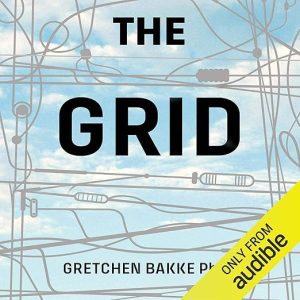
Cultural anthropology applied to electrical infrastructure sounds like a category error, and the first hour of this audiobook goes to proving it is not. Gretchen Bakke's argument is that the grid carrying power to American homes is an accident of history and culture rather than an inevitable piece of engineering, and that the thing is now so rickety a strong wind or a hot day can bring it to a halt. Eleven hours later you will not look at a transmission line the same way, which is an odd promise to make about a book that is fundamentally about wires.
First, the Big Picture
One number on this page cannot mean what it says. The average reads 4.2 and the ratings counter beneath it reads one. A tenth of a star is not a figure a single vote can produce, because one voter can only land on a whole number, and you need at least five votes before an average can arrive at 4.2 at all. Meanwhile five long verdicts sit underneath, four of them awarding five stars and the fifth awarding four, which averages out at 4.8. Whatever the 4.2 is counting, it is not the people who took the trouble to write something.
Bakke's method is the appeal, and one entry, signed inside its own opening line the way a print review would be, describes it accurately: a very readable look at the history of electric power in the United States from Thomas Edison until now, written to help readers shape what comes next. She treats the grid as a cultural object, built in an era when monopoly, centralization and standardization counted as strengths, and now badly matched to a country that caters to local needs while new renewable sources keep coming online. Framed that way, electricity stops being a utility bill and turns into a story about American self-belief.
Emily Caudwell handles all eleven hours, and the assignment is a specific kind of hard. Infrastructure writing runs on acronyms, institutional names and quantities that a reader on the page can slow down for and a listener cannot. The copy promises humor and a bright eye, which helps, but the vocabulary still arrives thick and unannounced. Play a passage about the contemporary solutions rather than the opening history, because that is where the density peaks, and it will tell you inside ten minutes whether eleven hours of this is a commitment you can keep.
Smart meters, blackouts and distributed generation: a five-star entry from 2020 makes the case better than the jacket text does, describing how the grid was a revolution when it arrived in the late 1800s, then faded so far into the background that it became invisible, and how over the last twenty years it has crashed back into view alongside questions about resilience. That arc is exactly what the book exists to explain. It accounts for why a subject that spent most of a century as pure background is suddenly on the news every summer.
The payoff for a general listener is a working mental model. After eleven hours you understand why power flows the way it does, why a utility behaves the way it does, and why pushing variable generation through a system built for steady supply is a harder problem than the headlines suggest. Bakke is a cultural anthropologist rather than an engineer, and that turns out to be the right training for the job, because the book is interested in why people built this thing and why they cannot bring themselves to rebuild it.
Weak Spots in The Grid
Writing in August 2025, a four-star entry opens by calling it ten years after publication, which is off by a year against the date on this record, since this edition arrived in September 2016. The slip is trivial. What it points at is not. A book about an infrastructure in crisis, recorded in 2016, is now describing a system that has absorbed another decade of change, and the listener has to do that updating unaided while the narrative keeps presenting its examples as current.
Scope is the second thing to watch. This is a United States story from beginning to end, running from the founding era of monopoly and standardization onward, and the description never pretends otherwise. A listener elsewhere will find the diagnosis transferable and the specifics useless. The categories the record sits in, computers and technology alongside science and engineering, also oversell the technical content, because the book explains institutions and habits far more than it explains electrical engineering, and anyone shopping for the latter will be disappointed early.
Housekeeping is the last item. The publisher line reads Audible Studios for Bloomsbury, which is a production credit rather than a publisher, the release date sits in September 2016 with nothing to indicate when the text itself was finished, and the running time ends up being the one figure here that nobody could have got wrong. For a book whose entire subject is a system nobody maintains properly, a listing maintained this loosely has a certain symmetry going for it.
Is This One for You?
Students are the obvious fit, and one enthusiastic entry confirms it by describing the book as useful background for studies in renewable energy finance. That is exactly the right use for it. Bakke supplies the context a technical course leaves out, which is how the system acquired its shape and why it resists the changes engineers keep proposing. Anyone working in energy policy, at a utility, or on renewables development will find eleven hours here that make their own field's politics legible.
Stay away if you want engineering, if you need current figures, or if American institutional history sounds like a chore, because all three objections are fair and the book answers none of them. Everyone else gets an absorbing account of the least glamorous machine in the country, told by someone who finds it fascinating and can explain why. A decade on from this recording the diagnosis has aged considerably better than the examples, which is a better hit rate than most books about the future of anything manage.