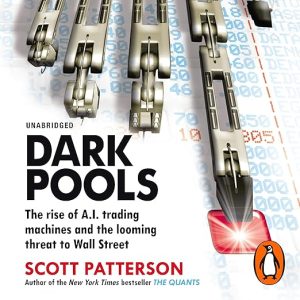
Jacket copy on this audiobook promises trading robots so self-directed that humans cannot predict what they will do next, plus a warning that artificial intelligence is nudging the world toward global meltdown. That is two short paragraphs of marketing, and it describes a more excitable book than the one Scott Patterson wrote. What eleven hours and thirty-six minutes actually contains is a history of how electronic trading got built, by whom, and at whose expense. The bots arrive late, and they turn out to be considerably less autonomous than the blurb wants you to expect.
A Closer Look at Dark Pools
Patterson's real subject is not the machine but the people who let it in. The description credits blisteringly intelligent computer programmers with the rise of the bots, and the account underneath runs through the venues those programmers built, the incumbents they displaced, and what took the place of the old arrangement once the displacing was finished. Told that way it becomes a story about incentives rather than about code, which is why it works perfectly well for a listener with no technical background. Nobody needs to understand an order-matching engine to follow who benefited and who paid.
Blaster bots and hunter-sniper cloaking devices are the phrases a July 2012 five-star reaches for, describing the book as a cross between War Games, The Matrix and Terminator, and singling out the misfit programmer behind a venue called Island as its nearest thing to a hero. That entry calls the whole thing a fun, intelligent weekend read. The vocabulary is the point: Patterson writes financial infrastructure as a thriller, and whether that registers as clarity or as hype depends largely on how much you already know about market plumbing.
Computer Science is where this listing has been filed, and the tag is less wrong than revealing. Somebody read a blurb about self-directed trading robots and artificial intelligence and shelved the book accordingly. What sits under that heading is financial journalism about markets, firms and regulation, with the software in a supporting role. A listener arriving from the technology category expecting an account of algorithm design will be disappointed, and a listener who wanted a Wall Street narrative will never find it filed under that heading at all.
What Makes Dark Pools Worth Hearing
Positioned between two better-known books is where a May 2014 four-star places this one, describing it as the follow-up to Patterson's earlier volume on quantitative trading and as the precursor to the high-frequency trading book Michael Lewis published afterward. That entry credits the narrative with tracking early electronic outfits taking on the exchanges and the entrenched market makers, and calls the walk through the birth of electronic trading well written and easily comprehended. As a placement in a reading order, it tells a buyer considerably more than the blurb does.
Chronology is what audio handles well here. The book moves forward in time through a sequence of firms and confrontations, and a linear structure is exactly what a listener can hold without a notebook open. Eleven hours and thirty-six minutes is long, and the length buys something specific: room for individual characters to become distinct before the systemic argument lands on top of them. Financial history that skips the people ends up as a lecture, and this one spends real time establishing who wanted what, which is why the later material carries weight.
Byron Wagner narrates, and the roster is the difficulty. Financial history of this kind arrives thick with firm names, venue names, acronyms, and a large cast of traders and programmers who appear, vanish, and return two hours later expecting to be recognized. A reader has to make those names stick on first hearing, because a listener cannot flick back to check who ran what. Eleven and a half hours gives the problem plenty of chances to bite. Listen to a stretch where several firms are introduced at once, since that is where an audio edition of a book like this either holds or quietly stops making sense.
Things to Know Before Starting Dark Pools
Precision is the thing this average cannot support. A 4.5 sits over exactly one rating, and a decimal place implies a base wide enough for fractions to arise in the first place, which one vote is not. One voter picks a whole star. Whatever produced that 4.5, it was not the population the counter describes, and no reading of the figure survives contact with the count sitting beside it. Work from the reader write-ups instead, of which five are visible and one is not in English.
Split verdicts are the most informative kind, and a June 2012 five-star supplies one. The book does two things, that entry argues: it walks through the historical events that produced the modern stock market, and it tries to explain what is happening inside market microstructure. On the first it succeeds and is genuinely enjoyable. On the second, by the same account, almost no information arrives, the analytic discussion is missing, and some of the comparisons and conclusions are simply wrong. Anybody buying this for technical understanding should weigh that carefully before committing.
Who It's For
Newcomers to market structure get the best deal here. The book explains how the current system came to exist, in narrative form, with people attached to every decision, and that is far more durable knowledge than an account of any particular strategy would be. Listeners who followed the high-frequency trading argument through journalism and want the origin story underneath it will find eleven and a half hours well spent, and the linear chronology makes the book easy to resume after a gap of several days.
Practitioners already working inside market structure should temper their expectations, since the copy sells a story about people and machines rather than an analysis of mechanisms. Anybody sold by the blurb's promise of autonomous machines steering the world toward meltdown will meet a calmer and more institutional book than advertised. What it delivers instead is the history explaining how the machines got the run of the place, which turns out to be more useful than the warning ever was.
Does this audiobook assume you already understand how markets work?
It does not. Patterson explains each mechanism as it becomes relevant and keeps the story anchored to people rather than to instruments. Some vocabulary around venues, order types and market makers arrives quickly, but the narrative supplies enough context to carry a listener who has never traded anything. Prior reading makes it faster, not possible.
Does the book really argue that artificial intelligence could cause a global meltdown?
The description frames it that way, calling this a timely warning about machines taking over as intelligence gradually shifts from people to programs. The book underneath is more measured, treating automation as the outcome of ordinary commercial incentives rather than as a runaway system. Read the blurb as positioning and the content as reporting.
Does the audiobook cover the people behind the systems, or only the technology?
People come first throughout. The copy credits the rise of the bots to a group of unusually capable programmers, and the book follows those figures, their firms and their rivalries as the spine of the story. The technology appears as something particular individuals chose to build for particular reasons, which is what makes eleven hours listenable.