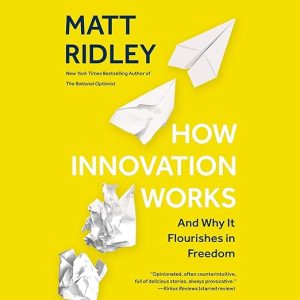
- Performance: Matt Ridley self-narrates with the confident, persuasive cadence of someone who has argued this thesis across hundreds of conversations, and it works.
- What it covers: Innovation versus invention, collective progress, freedom and economic development
- Feel: Intellectually propulsive and sweeping in scope
- Our call: A confident, wide-ranging argument for rethinking how progress works, best for listeners who enjoy big-picture intellectual history delivered with opinion.
Matt Ridley narrating his own book is one of those combinations that either works completely or collapses under the weight of an author too close to his own arguments to let a listener breathe. This audiobook lands firmly in the first category. Ridley's voice has a dry, persuasive confidence that suits the thesis he is advancing: that innovation is not the product of lone geniuses or top-down planning but a bottom-up, incremental, collaborative process that emerges from the human habit of exchange. He reads this audiobook as if he is making the case to someone he expects will push back, which keeps the listening experience intellectually alive across its twelve-and-a-half hour runtime.
I came to this one having spent a week in airports and transit hubs, which seemed like an appropriate context for a book that devotes serious attention to the history of powered flight, railways, and container shipping. Ridley moves through scores of innovation stories with the kind of enthusiasm that makes a genuinely long book feel propulsive rather than exhaustive. The range is extraordinary: fire, zero, vaccines, coffee, vaping, blockchain, wheeled suitcases, mosquito nets, and artificial intelligence all appear, not as items in a list but as case studies in how the same underlying process operates across wildly different domains.
Ridley's central argument is that innovation is crucially different from invention. Invention is the generation of an idea; innovation is the turning of inventions into things of practical and affordable use to people. That distinction drives everything that follows. The steam engine did not emerge from a single brilliant mind in a single eureka moment; it evolved over generations through the accumulated contributions of dozens of people, each building on what came before. The same is true of jet engines, search engines, fertilizer, and corrugated iron. This is not a modest thesis. Ridley is arguing against a dominant cultural narrative about creativity and progress, and he makes the case with enough specific historical evidence to at least force the reader to engage with it seriously.
He also argues that innovation slows when it is over-regulated, over-planned, and over-attributed to institutional direction, and that this carries policy implications for how governments approach everything from pharmaceutical development to energy production. These sections are the ones most likely to generate reader disagreement, and Ridley does not pretend they are neutral. The author's prior work, including The Rational Optimist, established him as a thinker with strong views about markets and freedom. Those views surface here, and listeners who find them congenial will find the book more persuasive than those who do not.
What Makes How Innovation Works Worth Hearing
Reviewer Eric Grover quotes Ridley directly: 'Innovation is the child of freedom and the parent of prosperity.' That line captures both the book's thesis and its register: it is readable and deliberately quotable. Grover calls it 'engaging and thoroughly enjoyable' and notes that Ridley 'illustrates with dozens of vivid examples.' Another reviewer, Happy, takes the enthusiasm further, suggesting that every leader, teacher, and influencer read this book alongside The Rational Optimist and The Evolution of Everything. That level of recommendation reflects how well Ridley's ideas translate to readers already sympathetic to his worldview.
The self-narration is a genuine asset here. Ridley knows which phrases to lean on, which examples to let breathe, and where the argument picks up speed. He reads with the cadence of someone who has given the keynote talk version of this material and knows where the audience tends to respond. That oral quality in the prose itself, combined with an author who delivers it with evident conviction, makes for an audiobook experience that feels more like a long, well-researched conversation than a lecture.
Things to Know Before Starting How Innovation Works
The book covers an enormous amount of ground, and listeners who want deep treatment of any single case study may find the breadth comes at the cost of depth. Each innovation story is told at the level of revealing the underlying pattern rather than exhausting the history, which is the right choice for a book with this scope but may frustrate listeners who want more on, say, the development of vaccines or the history of computing. Ridley points toward further reading rather than providing it.
The political and economic arguments embedded in the later chapters are not incidental to the book's thesis but are, in fact, part of it. Listeners who approach the material as purely descriptive history may be surprised by how normative the conclusion sections become. That is a feature for some readers and a liability for others; knowing it in advance helps set expectations.
One of the more counterintuitive arguments in the book is that innovation often happens despite institutional support rather than because of it. Ridley documents cases where patent systems slowed progress, where government investment in planned research produced less than parallel private experimentation, where the expectation of credit and attribution created bottlenecks in the collaborative processes that drive real advancement. These arguments are not universally accepted among economists and historians of technology, and listeners who engage with the book critically will find plenty to push back on. But they are made with enough specific historical grounding to require engagement rather than dismissal.
The final section's argument that the world may be entering an innovation famine, that the conditions which produced the extraordinary progress of the twentieth century are not guaranteed to persist, is the most sobering element in an otherwise optimistic book. Ridley derives this concern not from pessimism about human nature but from observation of regulatory and institutional trends, which gives it the same empirical texture as the rest of the argument rather than the feel of a political sermon bolted onto a history book.
Who Matt Ridley Is Writing For
This audiobook rewards listeners with an appetite for big-picture intellectual history, a tolerance for sweeping argument, and an interest in how human progress actually happens at the level of mechanisms rather than mythology. Business readers, policy thinkers, and general readers with an interest in economic history will find it worth the investment. Listeners who prefer their nonfiction tightly focused on a single subject, or who are likely to find Ridley's policy views distracting, may prefer his earlier, less polemical work. The self-narration is a clear reason to choose the audio format specifically.
Before You Listen
Does Matt Ridley narrating his own audiobook add to or detract from the experience?
It adds considerably. Ridley reads with the rhythm of someone who has given the keynote version of this material, and he knows where the arguments pick up speed. The self-narration gives the audiobook a conversational directness that a third-party narrator would struggle to replicate.
Is this audiobook a companion to The Rational Optimist or can it stand alone?
How Innovation Works stands entirely on its own. Ridley builds on his optimism framework but develops a distinct thesis about the mechanics of innovation. Readers of The Rational Optimist will find familiar ideas and new extensions of them; newcomers to Ridley's work will not feel lost.
At 12.5 hours, does the audiobook sustain engagement across its full runtime?
The breadth of case studies keeps it from becoming repetitive. Ridley moves quickly through individual examples, so the listening experience feels more like a series of connected observations than a marathon of a single argument. The self-narration sustains energy across the full runtime.