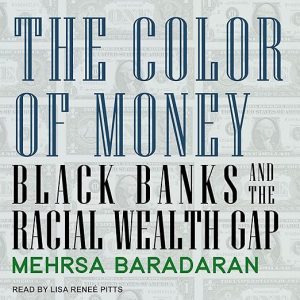
Before You Press Play
- Narrator: Lisa Reneé Pitts brings measured authority to Baradaran's dense historical and legal argument, sustaining intellectual gravity across a 15-hour audiobook without losing the emotional weight of what the evidence shows.
- Subjects: The racial wealth gap and its structural causes, the catch-22 of Black banking, the limits of community self-help as policy
- Tone: Rigorously documented and quietly devastating
- Bottom line: Anyone who wants to understand why the racial wealth gap persists beyond individual circumstance will find Baradaran's structural argument the most thoroughly evidenced account currently available in audio.
Black Banks as Solution and Casualty
Mehrsa Baradaran's The Color of Money makes an argument that should reshape how any serious reader thinks about the racial wealth gap in America, and it does so through evidence assembled with the precision you would expect from a banking law professor at the University of California, Irvine. This audiobook runs 15 hours and 10 minutes, narrated by Lisa Reneé Pitts, and earned a 4.8 rating across its small but emphatic reviewer pool. Reviewers have called it an epic expose and described the experience of listening as shockingly enlightening in a way that the sanitized policy language of conventional economic history rarely achieves. One reviewer described every stroke of the pen as dripping with painfully ugly but enlightening information, which is accurate as a description of what Baradaran is willing to put on the record.
The central argument is not complicated but it is devastating in its implications. When the Emancipation Proclamation was signed in 1863, Black Americans owned less than one percent of the nation's total wealth. More than 150 years later, that number has barely moved. Baradaran's contribution is to explain why, not through individual choices or cultural factors, but through the structural mechanics of banking, credit, and capital formation in a segregated economy. The book focuses on Black banks as both the proposed solution to this problem and its most instructive casualty in the long history of American racial economic policy.
The Catch-22 Baradaran Finds in Black Banking
The catch-22 that Baradaran identifies is the intellectual heart of the book. Black banks, the institutions most needed to help communities escape the poverty caused by discrimination and segregation, were themselves systematically destroyed by that same poverty. They could not circulate capital effectively because their depositor base was impoverished, and they could not solve the impoverishment because they lacked the capital to lend at scale. Rather than generating independent wealth, they often redirected what little Black capital existed toward white banking institutions, leaving Black communities with structurally less than they would have had without the banking infrastructure that was supposed to help them accumulate it.
This argument directly challenges the political narrative of Black banking and community self-help as the solution to racial economic inequality. Baradaran's most important contribution may be her demonstration that this narrative has functioned as a politically convenient decoy, a way of framing the problem as one requiring community effort and entrepreneurial aspiration rather than structural reform or direct racial redress. One reviewer cited the extensive source material, noting that the research spans nearly 70 pages of citations in the print edition, and described the legal and historical analysis as both rigorous and uncomfortable. The audiobook format allows Pitts's narration to carry the listener through material that in print might prompt frequent pauses to process the implications of what has been documented.
Pitts's Measured Delivery Carries the Evidence
Lisa Reneé Pitts's narration is precisely calibrated for this material. She brings measured, authoritative delivery to Baradaran's dense legal and historical analysis without sacrificing the emotional register that the human stakes require. At 15 hours, the narration must sustain intellectual gravity across an enormous amount of documented argument, and Pitts manages it through tonal consistency that conveys the weight of the evidence without melodrama or performative outrage. The restraint is appropriate. The evidence is devastating enough without embellishment, and Pitts understands that. Reviewers have consistently described the listening experience as engrossing, which at this length and density of argument is a genuine performance achievement.
Single-Topic Sessions for a Book That Builds
The book is dense with historical and economic documentation. Baradaran moves through the history of Reconstruction, the Freedman's Savings Bank disaster, the rise and structured collapse of Black Wall Street, the New Deal's exclusionary practices, the War on Poverty, and the evolution of banking law in ways that require sustained attention. This is not a book to listen to while multitasking. The argument builds across chapters, and losing the thread makes the later structural analysis less coherent. Single-topic sessions with replay of key passages will repay the effort for listeners who take this seriously.
The book's conclusions are deliberately challenging. Baradaran does not end with an optimistic policy prescription that makes the weight of the documented injustice feel comfortably resolvable through incremental reform. Her closing argument is that only bolder, more realistic views of banking's relationship to Black communities will end the cycle of poverty and promote Black wealth accumulation. That is not a call to comfortable incrementalism. Listeners who approach this audiobook hoping for reassurance that current policies are moving in the right direction will not find it, and that intellectual honesty is part of what gives the book its lasting analytical value.
A 15-Hour Commitment Worth Making
This audiobook belongs in the listening library of anyone seriously engaged with American economic history, racial inequality, or banking policy. It is equally valuable for readers approaching the topic with no prior knowledge, as the historical foundation is laid carefully and fully, and for those who already know the broad outlines of the racial wealth gap and want the structural mechanics explained with legal and economic rigor. Listeners who prefer lighter nonfiction or who are not prepared for a 15-hour sustained argument should calibrate expectations accordingly. For those willing to commit the time, this audiobook represents one of the most important and most thoroughly documented works on race and economics currently available in the format.