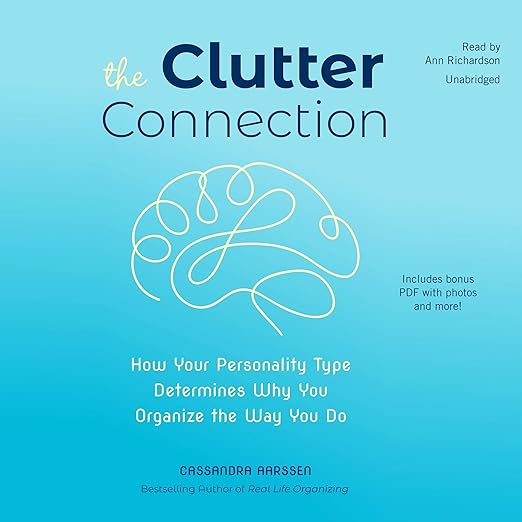
Four brain types, a self-assessment and a set of real-life solutions matched to each: that is the architecture of this audiobook, and it is also why the file pairs five hours and thirty-eight minutes with a PDF. Cassandra Aarssen's premise is a good one, and the sentence carrying it sits on the record inside quotation marks: you're not messy, you just organize differently. What that promises is a system built around the listener instead of around a photograph of somebody else's pantry.
Aarssen's argument is that organizing is not one size fits all, and that conventional advice fails because of a mismatch between method and person. The copy names the four Clutterbug styles as the framework and the 3P's, productivity, procrastination and perfectionism, as the diagnostic, then promises to connect motivation and happiness to the shape of a space. It is a typology book, which means its value depends entirely on whether you recognize yourself in one of the four. Get that right and everything downstream follows. Get it wrong and the storage advice is somebody else's all over again.
In November 2021 somebody who had already worked through the famous tidying method gave this five stars and explained why the earlier book failed them: it offered no organizational ideas for their style, and purging alone never solved anything, because the stuff comes back. That is the clearest statement available of the gap this book is trying to fill. Aarssen is not competing on decluttering technique at all. The claim is that technique sits downstream of temperament, which is a genuinely different proposition, and it is why this book still holds an audience.
Why Listen to The Clutter Connection
Organizing books are among the hardest things to move into audio, and this record half concedes it by shipping the PDF alongside the file. Ann Richardson takes the reading rather than Aarssen, which is the interesting choice here. A typology depends on four styles staying distinct in a listener's head across the whole runtime, with no chart to glance at and no headings to see, so the entire burden of differentiation falls on how the four are introduced and how consistently they are named afterward. Spend three minutes on a stretch where the four types are being told apart, because that is the one part of this file whose difficulty is structural rather than stylistic.
That self-assessment is the hinge, and a July 2021 five-star describes using it. After watching a couple of the author's videos and deciding to try the book, that reader came out as a Butterfly, a style type needing visual abundance with organizational simplicity, and the entry is cut off exactly as it reaches what the book suggested about being able to see your own things. Two things follow. The diagnostic works as a diagnostic, which is not nothing. And a listener will want the PDF open while taking it, because a self-assessment delivered by voice is close to the least natural thing an audio edition can be asked to do.
What to Watch For in The Clutter Connection
Arithmetic is where this page falls apart. The badge reads 4.7 and the counter beneath it registers exactly one rating. A displayed 4.7 is forty-seven tenths, and a tenth of a star is a resolution that only appears once the base is wide enough for tenths to exist; at a rating count of one, the only figures available are whole numbers. Put the other way round, an average of 4.7 needs a base that divides into ten, and one does not. Meanwhile five people have written assessments underneath it, four of them at length. Two different populations are being reported inside a single box.
Partial reads are worth flagging on a book of this kind, and an April 2019 four-star says so openly: that entry had not got through the whole thing yet, but the beginning had already delivered real insight into an organizing style, and the reader turned out to be a combination of two of the four. That is a fair report and a useful warning at the same time. A typology that lets you land between categories is more honest than one that does not, and harder to act on, which is why the book has to spend time on integrating several styles into one space.
Handles are the other tell. Two of the five entries file under storefront defaults rather than names, and one of those two names a rival format's store outright, which is a small piece of evidence about what this column has been grading. Reading, not listening, is the verb three of the five reach for. None of that discredits a word they say. It does mean a buyer weighing the audio specifically is working from responses about a text. The series field says Clutterbug and the number beside it is empty, so the record cannot place this in its own sequence either.
Who Should Listen to The Clutter Connection
Households where two people organize differently are the natural buyers, since the whole argument is that the difference is temperamental rather than moral. Anyone who has been called messy and felt the judgment land will find the framing worth the price on its own, and the blurb says outright that the book exists to smash the stereotype that some people are naturally messy. Parents get use out of it for the same reason. So does anybody who has bought an organizing system, followed it exactly, and watched the house revert inside a month.
Deep-clean checklists are not what this supplies, and neither are room-by-room instructions. The book operates at the level of why rather than how, and a listener wanting a sequence to follow on Saturday morning will find the diagnosis more generous than the prescription. The same applies if you will not open the PDF, because a typology with a self-assessment at its center is a book asking for a page. Curiosity about the premise is answered inside one sitting, which makes this an unusually low-risk purchase for anybody the premise describes.