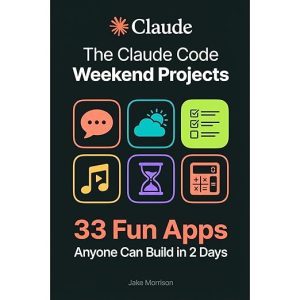
Weekend project books occupy a peculiar space in technical publishing: they promise enough structure to get started and enough ambition to feel like the work matters. The Claude Code Weekend Projects by Jake Morrison positions itself in this niche with specific clarity, thirty-three complete applications, each designed to ship in forty-eight hours, using a defined stack of modern web tools. As an audiobook narrated through Virtual Voice, the listening experience carries the usual limitations of AI-generated narration applied to technical content, but the substance Morrison has assembled is more practical than the format might suggest for a developer-focused title.
Morrison's central framework is the 2-Day Build: Day 1 handles core functionality, Day 2 handles polish and deployment. That constraint is the book's most useful contribution. Scope creep kills weekend projects. By imposing a hard deadline with a specific daily objective, Morrison gives the framework enough structure to function as an actual discipline rather than a vague aspiration. The thirty-three projects, which range from an AI Writing Assistant Chrome Extension to a Real-Time Chat Application to a Habit Tracker with streak gamification, are organized around this structure and designed to be followed, not just browsed.
Next.js and Supabase Replace Tutorial Defaults
Morrison's fourteen years of traditional development experience are visible in the technical choices throughout. The stack he recommends, Next.js 14, Supabase, Tailwind CSS, Vercel, reflects real production decisions rather than tutorial defaults. These are tools that professionals actually use at scale, and building weekend projects with them means the skills transfer directly to commercial work. The book is explicit about this: it is not training you to build demos, it is training you to ship software that could generate income, with Stripe integration and monetization guidance included for several projects.
The AI-assisted workflow component is the most timely part of the book and the most time-sensitive. Morrison provides specific prompts for Claude Code integration, 'copy-paste prompts that generate clean, production-ready code' is the explicit promise, and while the approach is sound, the specific tool behavior he describes will continue to evolve. The book's methodology for human-AI collaboration in development is more durable than any specific prompt syntax, and that collaborative workflow framing is worth internalizing even as individual details shift.
Virtual Voice Stumbles on Code and File Paths
Virtual Voice narration is the obvious limitation of this audiobook for a developer audience. Technical titles present a specific challenge for AI narration: code syntax, file paths, and command-line instructions read awkwardly when rendered phonetically, and the inflection that a human narrator would bring to distinguish between explanation and instruction is absent. Morrison's prose is clear enough that the narration mostly manages, but listeners planning to implement projects from the audiobook will genuinely benefit from having the text or notes alongside, this is not a book that survives on audio alone for technical implementation purposes.
The book is designed for listeners already comfortable with web development. Morrison assumes familiarity with JavaScript, React fundamentals, and deployment basics. The AI-assisted workflow is positioned as an accelerant for existing skills, not a replacement for foundational knowledge. The framing of the target reader, 'experienced developers wanting to 10x output,' 'technical founders,' 'side project entrepreneurs', is accurate. Beginners who attempt these projects without prior web development experience will struggle regardless of AI assistance.
Pricing and Launch Tactics Beyond the Code
The book's relationship to the tools it describes is its most significant structural fragility. Next.js updates frequently. Supabase's API surface changes. Claude Code's behavior as a coding assistant evolves across model updates. Morrison is building on a foundation that will look meaningfully different within twelve to eighteen months of any given reader's first encounter with the book. The 2-Day Framework and the project selection logic are the durable parts. The specific implementation details should be treated as starting points requiring verification rather than authoritative instructions.
This particular listing carries no ratings yet, leaving no community consensus at all to calibrate expectations against. The book reads as a genuine practitioner's work rather than a hurried AI-market-capitalizing title, Morrison's specific project choices reflect real developer experience with what ships reliably and what generates interest. The invoice generator, the URL shortener with analytics, the social media cross-poster, these are not trivial examples but recognizable patterns from freelance and small-product development contexts.
Morrison's approach to monetization deserves specific attention because it is rarer than it should be in developer project books. Most weekend-project resources treat deployment as the endpoint. Morrison treats it as the beginning of a separate discipline, how to price what you built, how to set up Stripe, how to acquire initial users through launch platforms, and how to distinguish between a project that earned its weekend and one that can grow into something more. The inclusion of actual pricing strategy and launch tactics alongside the technical implementation is what separates this from tutorial content that assumes the work is done when the app compiles. For developers who have shipped technically sound projects that went nowhere, that commercial framing is exactly the supplementary knowledge the technical training pipeline tends to omit.
Solid Web Fundamentals Before Attempting These Projects
Developers with solid web fundamentals who want to build a portfolio of shipped projects will get genuine value here, particularly from the 2-Day Framework and the monetization guidance. Technical founders needing to validate ideas quickly before committing engineering resources will find the rapid-deployment methodology directly applicable. Beginners looking for an entry point to web development should build foundational skills first and return to this once they can follow the stack choices. Listeners who need to implement projects as they listen will find the Virtual Voice narration of technical content a genuine friction point and should ensure they have the text alongside.
- Narration: Virtual Voice narration is functional for the conceptual material but creates real friction with technical content, text alongside is recommended for implementation.
- Themes: AI-assisted rapid development, weekend shipping discipline, monetization of side projects
- Mood: Energetic and builder-focused, with a pragmatic edge
- Verdict: A practical developer audiobook for intermediate-to-advanced builders who want a proven framework for shipping AI-assisted web applications in 48-hour windows.
Common Questions
Does this audiobook work as a standalone resource or does it require the text alongside to implement the projects?
For implementation purposes, having the text alongside is strongly recommended. Virtual Voice narration of technical content, prompts, file structures, API patterns, does not replace written reference material. As a methodology and inspiration resource, the audiobook works on its own; for actual weekend builds, you will want the text.
What level of web development experience does this audiobook assume?
Intermediate to advanced. Morrison assumes familiarity with JavaScript, basic React patterns, and deployment fundamentals. The AI-assisted workflow is designed to accelerate existing skills, not replace foundational knowledge. Complete beginners will struggle with the project complexity regardless of the AI tooling described.
How quickly will the specific tool advice in this audiobook become outdated?
The 2-Day Framework and project selection methodology are durable. Specific Next.js versions, Supabase API patterns, and AI prompt syntax will evolve and should be verified against current documentation. Treat the implementation details as starting points rather than authoritative instructions.
Is this audiobook specifically about using Claude Code as a coding assistant, and does it require access to that tool?
The book is built around AI-assisted development workflows using Claude Code from Cursor as the primary tool, and the specific prompts are designed for that environment. The underlying methodology, scoped 48-hour builds, modern stack choices, monetization-ready architecture, applies more broadly, but the AI workflow guidance is specific to that toolset.