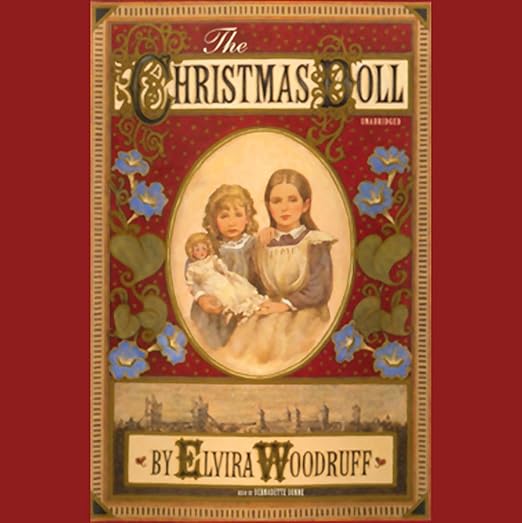
Lucy Wolcott and her younger sister Glory have nothing in a London workhouse except each other and the stories Lucy tells. Elvira Woodruff's The Christmas Doll is an audiobook that earns its warmth by taking the girls' poverty seriously before allowing them any relief. Lucy invents narratives about a family she barely remembers and a lost doll named Morning Glory who will return to them someday. These are not idle fantasies but survival strategies, the way children build interior architecture when the exterior world offers nothing solid to hold. When a fever sweeps the workhouse and the sisters flee into the cold streets of London, those stories and that doll become the pivot around which the novel's resolution turns. Bernadette Dunn narrates across three hours and seven minutes with the kind of warm precision this material requires.
Dunn understands that the sentimental trap in Victorian-set children's fiction is easy to fall into and that Woodruff's prose avoids it by keeping the details of the girls' situation concrete and unglamorized. Her rendering of Lucy's voice captures the exhausted resourcefulness of a child who has been responsible for her younger sister for longer than any child should need to be. The period texture of the setting, the muffin man's cries at dawn, the lamplighter at dusk, the cold river where the girls search through the muck for anything of value, is rendered with the sensory vividness that historical fiction demands and that audio narration can deliver with particular immediacy. The workhouse itself, where the girls labor from dawn to dusk stitching blankets and sacks, is established not as backdrop but as a social reality that the novel refuses to soften into period charm.
How The Christmas Doll Holds Up
Woodruff's choice to center the sisters' relationship rather than the doll itself as the book's emotional core is what prevents the story from slipping into the whimsy that can make Victorian-set children's novels feel distant and decorative. Morning Glory is a plot device, an object of hope and a catalyst for the novel's third act, but what matters is what the doll represents to Glory and what Lucy has sacrificed to maintain that particular hope. The narrative investment in the sisters' bond across months of genuine hardship is what makes the resolution meaningful rather than merely pleasant. A retired schoolteacher who used this as a classroom read-aloud for sixth graders for years noted that even the boys in her class consistently engaged with the story, which speaks to Woodruff's skill at writing resilience and mutual loyalty rather than sentiment and rescue as the book's primary emotional register.
The doll Morning Glory is itself a carefully constructed narrative device. From the moment Lucy promises that the doll is destined to return, the reader understands this promise as both comfort and burden, the kind of story a sibling tells to keep a younger child's spirit intact even as the promise weighs on the teller. When Lucy finds an old discarded doll by the river and Glory claims it as the long-lost Morning Glory, the scene arrives with an emotional charge that Woodruff has been building since the book's opening paragraphs. Dunn's narration of that moment earns the reader's investment because she has held the tension carefully throughout without releasing it prematurely.
Why The Christmas Doll Works as an Audiobook
This audiobook works particularly well as a shared family listen, reflecting its origins as a read-aloud text in classroom and home settings. A parent who read this to three daughters aged six through twelve reported that all of them loved it and begged for more each night, and that age range is meaningful: Woodruff has calibrated the material so that older children can appreciate the historical and social dimensions while younger listeners connect with the emotional stakes of the sisters' survival. The themes of poverty and illness are present but handled with a narrative gravity that respects young listeners without presenting the material as trauma. Dunn's pacing makes the shared-listen experience particularly natural, leaving room for the moments of quiet that this kind of story needs to land properly. The audiobook is also well suited to the weeks around Christmas for obvious reasons, though the themes of sisterhood and the sustaining power of storytelling are not seasonal in any limiting sense.
Weak Spots in The Christmas Doll
Parents of very young children should note that the workhouse setting, the fever, and the girls' period on the streets of London involve genuine hardship that may require contextualizing for listeners under seven. The historical realities of Victorian child labor and poverty are not softened into abstraction, which is a deliberate authorial choice and the right one for the story's emotional authenticity, but it does mean the book works better for slightly older children than its holiday category label might initially suggest. The resolution depends on a degree of narrative coincidence characteristic of the Christmas story tradition and requires the willing suspension of strict realism that most family holiday literature asks for. Woodruff prepares the ground sufficiently that the payoff feels emotionally consistent rather than contrived, but the coincidence is real and younger readers may take it on different terms than older ones.
Should You Listen to The Christmas Doll?
This audiobook is ideal for family listening in the weeks around Christmas, particularly for families with children between roughly seven and twelve who are ready for historical fiction that does not sanitize difficult realities. It works as a bedtime series listen, a holiday journey companion, or a shared experience for parents and children who want a story with genuine emotional weight. Educators looking for an audiobook that pairs with units on Victorian England, poverty, or resilience in children's literature will find it productive on multiple levels. Adult listeners who enjoy historical children's fiction for its own sake will find Woodruff's prose and Dunn's narration rewarding well beyond the seasonal frame in which the book is most often recommended.
- Performance: Bernadette Dunn captures the period texture of Victorian London and the emotional intelligence of both Lucy and Glory without pushing the sentiment into melodrama.
- What it covers: Sisterly love as survival, the power of storytelling as shelter, poverty and grace in Victorian England
- Feel: Tender and atmospheric, with a careful balance between genuine hardship and earned warmth
- Our call: Elvira Woodruff's The Christmas Doll is among the more accomplished children's holiday audiobooks, earning its emotional resolution rather than simply declaring it.