Quick Take
- Narration: Natalie Naudus is precisely the right choice for Jordan Baker, she reads with a detached, sensory quality that mirrors the novel’s dreamlike, unreliable narration.
- Themes: Racial outsiderhood inside white privilege, queer desire and self-discovery, the magic lurking beneath Jazz Age excess
- Mood: Lush and disquieting, gorgeous on the surface, deeply unsettled underneath
- Verdict: A literary retelling that earns its source material by genuinely transforming it, but readers who want comfort or resolution from their Gatsby retellings should approach with caution.
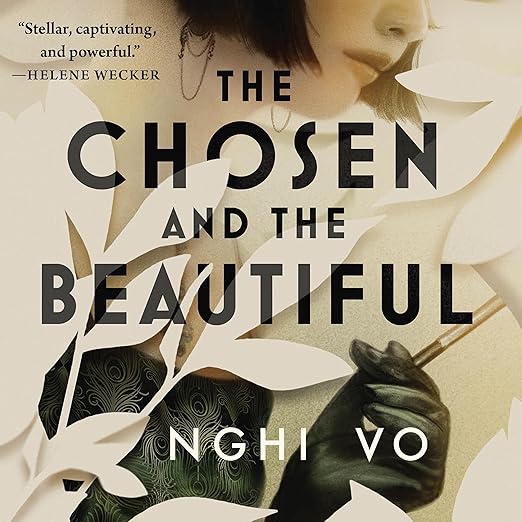
I finished The Chosen and the Beautiful on a Sunday evening after sitting with it for most of the day. It is not a book that rushes anywhere. It moves the way a Jazz Age party moves: with apparent ease and considerable alcohol, with beauty on the surface and something darker underneath, with the knowledge that it will end badly present in every room. Nghi Vo has written a retelling of The Great Gatsby that functions as a genuine literary intervention rather than a fan exercise, and Natalie Naudus’s narration understands exactly what kind of performance that intervention requires.
Jordan Baker, in Fitzgerald’s original, is a minor figure: elegant, dishonest, self-contained. She is useful to the novel as a contrast to Daisy’s sentimentality, but she exists in a thin narrative band. Vo gives her a history, a body, a culture, and a magic practice. Jordan here is Vietnamese, brought to the United States as an infant by her missionary adoptive mother, raised in the most rarefied circles of 1920s American society, and perpetually treated as an exotic attraction by the same peers who invite her to their parties. She has money, education, a killer golf handicap, and she is queer. She can also burn the cut paper heart out of a man.
What Paper Magic Does That Fitzgerald’s Text Cannot
The decision to introduce a literal magic system grounded in paper and fire is Vo’s most significant departure from Fitzgerald, and it is the right one. In the original novel, the Jazz Age’s excess is figured as a kind of magic, seductive and corrupting in equal measure. Vo makes that metaphor material. Jordan’s paper magic is Vietnamese in origin, tied to her cultural identity in ways she is only beginning to understand, and it operates in a world where infernal pacts exist alongside stock portfolios and where lost ghosts drift through the corridors of the same mansions where Gatsby throws his parties.
This layering of the supernatural into a historical setting is not new as a technique. What Vo does that is distinctive is refuse to use the magic as mere decoration. Jordan’s growing command of her abilities runs parallel to her growing understanding of what she is in this world and what she wants. One reviewer described the novel as compulsively readable even while feeling out of sorts, which captures the particular quality of Vo’s prose: it pulls you forward while keeping you slightly off-balance, which is precisely where an unreliable narrator’s story should keep its reader.
The Discomfort the Novel Is Building Toward
Several reviewers arrived at the same observation from different angles: the book is masterful but not enjoyable in a straightforward sense. It is admired rather than loved. Jordan is a narrator who fascinates rather than invites sympathy, and the Gatsby plot, however transformed, is still a tragedy. The queer romance between Jordan and Daisy, developed here with much more interiority than Fitzgerald permits, is not a story that ends in happiness. The world of the 1920s is not structured for their happiness, and Vo does not pretend otherwise.
That refusal of false comfort is one of the novel’s genuine strengths. It would have been easy to use the retelling format to deliver a more optimistic conclusion for characters Fitzgerald left tragic or diminished. Vo chooses not to, and the choice is thematically coherent. Jordan learns things about herself and her power that she cannot unlearn, and that knowledge costs her in ways the ending makes clear. The novel’s final chapters are quietly devastating.
Natalie Naudus and the Voice of Jordan Baker
An unreliable narrator read aloud is a particular challenge. The voice has to be seductive enough that the listener follows it, and detached enough that the distance between what Jordan says and what is actually happening remains perceptible. Naudus manages this balance with considerable skill. Her delivery is elegant and slightly removed, as if Jordan is narrating from a comfortable remove from her own experience. That quality suits both the period and the character.
Naudus also handles the prose’s lyrical register without over-performing it. Vo’s sentences are dense and often beautiful, and there is a risk in reading that kind of writing of tipping into something too ornate. Naudus keeps the pacing alive even in the most atmospheric passages, which is the right instinct for a novel that could otherwise sink under the weight of its own languor.
For Readers Who Know Fitzgerald and Those Who Do Not
The Chosen and the Beautiful works differently depending on familiarity with the source. Readers who know The Great Gatsby well will find layers of transformation and counterpoint that deepens the experience considerably. One reviewer rereread Fitzgerald immediately before Vo’s novel and found the exercise illuminating. Those who do not know the original will still find a coherent, complete literary fantasy, but some of the resonance in Jordan’s relationship with Daisy and Nick, and some of the commentary on white privilege and racial spectacle, will land with less precision.
This is not a book for everyone, and it knows it. Readers who come to it expecting resolution, romance, or the satisfaction of a corrected ending will find the experience disorienting. Readers who want a novel that inhabits its moral complexity without flinching, told through a narrator who is queer, Asian, and perpetually unassimilable in the world she navigates, will find exactly that.
Frequently Asked Questions
Do I need to have read The Great Gatsby to appreciate The Chosen and the Beautiful?
Prior familiarity helps significantly. Vo’s novel is in constant dialogue with Fitzgerald’s text, and understanding Jordan Baker’s original function in that story makes the transformation Vo performs more resonant. The novel stands alone as a story, but readers who rereread or already know Gatsby will get considerably more from it.
How much of the original Gatsby plot is retained versus transformed in Vo’s version?
The broad outline of Gatsby’s parties, his doomed pursuit of Daisy, and the novel’s tragic conclusion remain intact. What changes substantially is Jordan’s interiority, her Vietnamese heritage and paper magic practice, the explicitly queer dimensions of her relationships, and the infernal bargains and supernatural elements that Vo layers into the historical setting.
Is Natalie Naudus’s narration well-suited to first-person literary fiction of this kind?
Yes. Naudus excels at maintaining the double register the novel requires: elegant and seductive on the surface, with a perceptible distance underneath. She handles Vo’s lyrical prose without making it feel self-indulgent, and her delivery of Jordan’s more unreliable observations lands with appropriate ambiguity.
The synopsis describes Jordan as queer, how central is that to the novel’s plot?
Central, but not in the way of a conventional romance arc. Jordan’s queerness is expressed primarily through her relationship with Daisy, which Vo develops with much more emotional complexity than Fitzgerald permits. It is part of what makes Jordan an outsider even within the privilege she inhabits, and Vo integrates it into the novel’s larger argument about who gets to belong in these spaces.