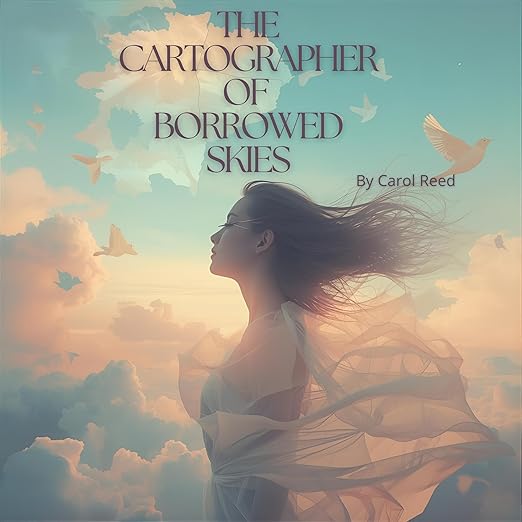
Can a sky hold grief? Can a map hum with loss? Carol Reed's The Cartographer of Borrowed Skies opens in a world where both are possible, and this audiobook uses an AI voice replica of Louise Cooksey to deliver that premise. The combination adds its own layer of strangeness to a narrative already saturated with questions about memory, loss, and the technology of preservation. The story follows Maya Ishikawa, a woman who hears what others cannot: the secret songs of the sky, encoded in weather patterns that other people simply feel and move through without listening.
Where This One Lands
The magical realism framework Reed deploys here is ambitious. Weather that remembers. Maps that encode grief. A fellowship called The Kairograph whose mission is to mend the torn fabric between climate and memory. These are striking conceits, and Reed develops them with genuine consistency. The rules of this world are not arbitrary, and the sky-map that Maya must repair functions as both literal plot object and emotional metaphor without the two registers canceling each other out or becoming incoherent.
The AI voice replica narration is worth addressing directly. The production uses Louise Cooksey's voice replica, and the performance has the clarity and pacing of a capable narrator, but listeners attuned to the slight textural quality of AI-generated voice will notice it. For some, this creates an odd resonance with a narrative that is fundamentally about what happens when order is imposed on the chaos of memory. The Archivist who erases stories by replacing them with grids is not a comfortable antagonist to listen to through a technology that itself operates by processing and reconstructing pattern. Whether this is productive irony or simply an awkward production choice depends on how much weight you give to the medium's relationship to the message.
The comparisons to Erin Morgenstern, Madeline Miller, and Haruki Murakami that appear in the synopsis are aspirational rather than strictly accurate. Reed's prose sensibility shares Morgenstern's interest in atmosphere and strangeness, Miller's investment in mythological structure, and Murakami's comfort with the untranslated dream-logic of the real. But those are large predecessors, and Cartographer of Borrowed Skies is a shorter, quieter work. At two hours and thirty-nine minutes, it is closer in length to a novella than a novel, and it does not fully develop the emotional depth those comparisons imply.
Why The Cartographer of Borrowed Skies Works as an Audiobook
The geographical scope is one of the most distinctive pleasures of this story. Maya's journey moves from the heat-sung alleys of Marrakech to the frozen silence of Lapland, from the domed architecture of Istanbul to the tiled dreams of Lisbon. Reed treats each location as a specific climate-and-memory environment rather than a generic backdrop, and the relationship between landscape and feeling is the book's core philosophical claim. It is most convincing when Reed is anchored to a specific place rather than moving between them in summary.
Rashid, the scholar who listens to storms, and Ayoub, the boy who believes itineraries are prophecies, are the traveling companions who give Maya's journey human texture. They function as different relationships to the same mystery: Rashid brings the analytical frame, Ayoub the intuitive one, and Maya moves between them as someone whose ability to hear the sky gives her access that neither purely rational nor purely instinctive thinking provides. The dynamic is sketched rather than fully developed at novella length, but it is effective in its proportions given the constraints.
The climate philosophy dimension, the idea that weather and memory are coupled systems whose severance has consequences for what a place can be, gives the book a thematic seriousness that distinguishes it from purely atmospheric fantasy. The Archivist as antagonist works precisely because his impulse toward order and categorization is recognizable, even sympathetic in some lights. He is not wrong that grids make sense of chaos; he is wrong that sense-making is worth the cost of erasure.
What Gives Us Pause
The short runtime is both an asset and a limitation. At under three hours, the story moves with the efficiency of a novella, but some of the emotional architecture feels compressed. Maya's decision about what kind of world should remain: one that obeys, or one that remembers, arrives at a point where the listener has not quite spent enough time with the consequences of each option to feel the weight of the choice fully. Reed trusts the accumulated imagery to do the work, which is the right instinct but requires the imagery to land with more precision than it always manages across such a brief runtime.
The AI narration, as noted, is audible to attentive listeners. It is not distracting in the way that early text-to-speech narration was. The voice is expressive and the pacing is natural, but the quality is slightly different from a human narrator, particularly in the emotional peak moments where performance matters most. Listeners who prefer human narration should factor this into their decision before purchasing.
Who Should Listen to The Cartographer of Borrowed Skies
Readers who love atmosphere-forward magical realism and are comfortable with a story that prioritizes mood and philosophical resonance over conventional plot mechanics will find this audiobook rewarding. If you have enjoyed Erin Morgenstern's Night Circus or similar works that build immersive worlds with an internal emotional logic, Reed's approach will feel familiar in the best sense. Those who need strong character development and emotional payoff proportional to the investment will find the novella length frustrating rather than satisfying. The AI narration is worth knowing about in advance; it is a production choice that works adequately but is not invisible.
Is the narrator for The Cartographer of Borrowed Skies audiobook a human voice or an AI?
The production uses Louise Cooksey's voice replica, which is an AI-generated voice modeled on a human narrator. The performance is competent and expressive, but listeners sensitive to AI narration will notice the difference from a human performance, particularly in emotionally intense moments.
Does this audiobook have a clear narrative resolution, or does it end ambiguously?
The story moves toward resolution of its central conflict, but Reed's approach is lyrical rather than plotted. Listeners who need a clear, definitive ending may find the conclusion more open than they prefer, while those comfortable with atmospheric resolution will find it satisfying.