- Narration: Virtual Voice AI narration - clear and even-paced, well-suited to meditative content, but lacks the emotional tonal variation that a human narrator would bring to generational turns
- Themes: Multigenerational female lineage, craft as memory, material culture, the object that outlasts its maker
- Mood: Quiet, meditative, elegiac without being sentimental
- Verdict: A remarkably economical 29-minute narrative about five women and one crocheted cape - the craft specificity is its greatest strength, the AI narration its main caveat
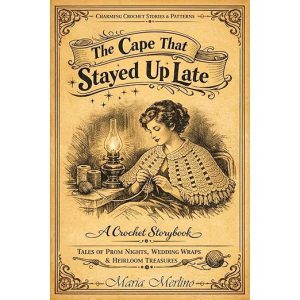
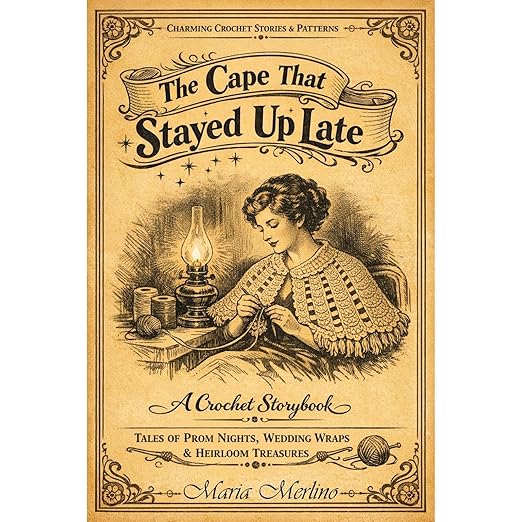
Imagine a cedar box passed from mother to daughter across five generations, each woman opening it in a different decade, finding the same crocheted cape and a layer of history she did not expect. That is the emotional architecture of The Cape That Stayed Up Late, and Maria Merlino builds it with a structural precision that is remarkable for a work of only 29 minutes. This audiobook is narrated by a Virtual Voice - an AI-generated narrator - which is worth noting upfront for listeners who are sensitive to synthetic speech. The performance is clear and even-paced, suited to meditative listening, but lacks the tonal variation a human narrator might bring to the generational turns in the story.
The opening is the strongest argument for what Merlino is attempting. In 1912, Claire crochets a twelve-panel cape for her first dance - a specific, tactile act of making that grounds everything that follows in the physical reality of craft. The cape is not a symbol imposed on the story from outside; it is an object with a documented history of hands. Every woman who inherits it adds something: a color, ribbon edging, shell edging, fringe. By the time the cape passes through five generations, it is a palimpsest of female attention, each layer readable by someone who knows what to look for.
At 29 minutes, this is one of the shortest audiobooks I have covered in this space, and it uses its runtime with unusual economy. Merlino does not attempt to fully render five lives; she gives each woman a moment of contact with the cape that establishes character, relationship to the past, and forward momentum without requiring the depth of a short story per generation. The cumulative effect depends on that restraint. By the final passage, the cape has acquired enough history that its physical description carries emotional weight without the text having to explain why.
The inclusion of a modern crochet pattern for the cape itself is an unusual and genuinely interesting editorial choice. It turns the audiobook into something more than a short story: a listener who wants to make the cape can do so, connecting their own hands to the making that begins the narrative in 1912. The pattern instructions, read in AI narration, are not the most practical listening experience for someone actively crocheting, but their presence in the text acknowledges something important about the relationship between craft tradition and storytelling that Merlino has built the whole work around.
Twelve-Panel Construction Speaks to Fellow Crocheters
The argument for audio over print with this particular text is less obvious than with longer works, but it holds. The AI narration's evenness - what might in other contexts feel like a limitation - suits the meditative quality of a story about objects that outlast the people who made them. The voice does not impose emotional interpretation on moments the listener might experience differently; it delivers the text cleanly and lets the accumulation of detail do the work.
For crochet and fiber arts communities, this audiobook offers something unusual: a narrative that treats handcraft as the central category of human meaning-making rather than a background detail. The specificity of the twelve-panel construction, the sequence of additions by each woman, and the final pattern are the kind of craft-specific detail that resonates differently with people who know what those construction choices mean. A crocheter listening to Claire's original construction will understand something about her choices that a non-crafter might miss.
The 29-minute runtime also makes this a strong option for listeners who want a complete narrative experience without a major time investment. It is short enough to listen to in a single sitting during a break, long enough to arrive at a genuine emotional conclusion. The generational structure compresses time in a way that makes the brevity feel proportionate to the scope rather than inadequate to it.
AI Narration Misses the Gentle Tonal Shifts
The AI narration is the most significant caveat for this audiobook. Virtual Voice technology has improved considerably, but it lacks the emotional register shifts that a skilled human narrator brings to material like this - the gentle change in tone when a character opens a cedar box and finds her mother's history inside, the slight lengthening on a word that the author wants to carry weight. Listeners who are sensitive to synthetic voice quality will notice the flatness more in a narrative this emotionally precise than in, say, a reference or how-to recording.
The extreme brevity means some of the five women are more sketched than rendered. The emotional logic of the generational transfer is clear, but not every woman receives equal development. Listeners who want fully realized characters at each generational turn will find the format limiting by design. This is a work that relies on the reader's imaginative participation to complete what the brevity cannot.
The crochet pattern, while a lovely conceptual addition, is not particularly accessible in audio form for someone who wants to actually make the cape. The pattern instructions are better engaged with in print or PDF form where visual reference is possible. The audiobook version works as a listen-through of the complete text, pattern included, but the practical utility of the pattern in audio form is limited.
Crocheters and Non-Crocheters Both Have Reasons to Listen
Fiber arts enthusiasts - crochet makers, knitters, textile history readers, anyone who understands what it means to work something into existence with your hands - will find this audiobook resonant in ways that go beyond its brief runtime. Merlino treats making as a form of love and memory rather than decoration, and that framing will be immediately recognizable to anyone for whom craft carries that weight.
Listeners interested in multigenerational women's stories told through objects and material culture will find The Cape That Stayed Up Late a satisfying, if brief, example of the form. It shares something with works like 'The Signature of All Things' or 'The Red Tent' in its interest in female lineage and the objects that transmit it, scaled down to a format that can be completed in half an hour.
Gift recommendations in the fiber arts space are notoriously difficult because the overlap between 'things a crocheter has not already acquired' and 'things a non-crocheter can identify' is small. This audiobook sits in that overlap: specific enough to be meaningful to someone who crochets, accessible enough to give to someone who does not crochet but loves the person who does. The 29-minute runtime makes it a genuine gift rather than an obligation.
Listeners who are open to AI narration, or who are specifically interested in how Virtual Voice technology performs on this type of emotionally textured literary material, will find it a useful data point. The AI narration handles the text competently; it does not damage the story, but it does not elevate it the way a skilled human narrator might. For a story this carefully built, that is a trade-off worth knowing about before you listen.