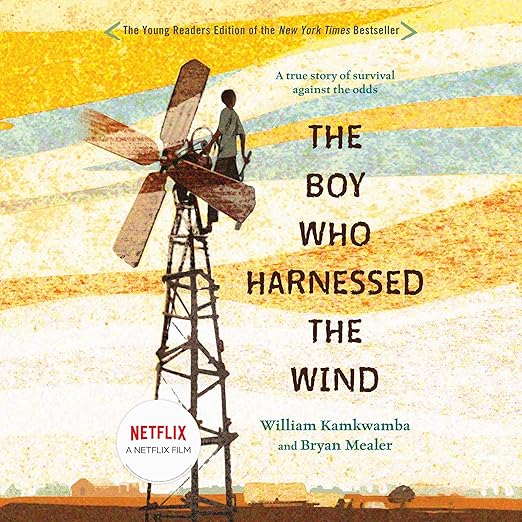
William Kamkwamba was fourteen years old when a famine stripped his family's crops in rural Malawi, and his solution was to build a windmill from scrap metal and bicycle parts using diagrams from a library book. The Boy Who Harnessed the Wind, the young readers' adaptation narrated by Korey Jackson across six-and-a-half hours, is the audiobook account of exactly how that happened: not as an inspirational abstraction but as a specific sequence of steps, failures, observations, and stubborn refusals to accept the boundary between what was possible and what the people around him believed was possible. It is one of the more extraordinary nonfiction audiobooks available for young listeners.
William Kamkwamba wrote the original memoir with Bryan Mealer, and this adaptation retells the complete story recalibrated for a younger audience. The adaptation is not a simplification so much as a reorientation: the famine and its physical stakes are present and honest, but the lens stays on William's experience of the problem as something he could affect rather than merely endure. The audiobook has a Netflix film adaptation with Chiwetel Ejiofor, and families who discovered the story there will find the audio version a richer, more internally detailed account of what the film necessarily compressed.
The audiobook's central achievement is its refusal to present the windmill as an act of inspiration or genius. Kamkwamba describes it as a sequence of steps, each following from the previous, built on information he found in a library copy of a book called Using Energy whose diagrams he could follow even when the English text exceeded his reading level. This is exactly the kind of granularity that separates a meaningful memoir from a motivational poster version of itself. The windmill worked because of physics and persistence, and the audiobook makes both of those things specific rather than symbolic.
The famine sections are handled with honesty that will affect young listeners without traumatizing them. Kamkwamba describes what going hungry actually feels like: the specific physical weakness, the disruption of normal social routines, the way food scarcity changes your relationship to time and energy and possibility. One reviewer noted the book contains so many life lessons, which is accurate but undersells what those lessons are actually grounded in. This is not a story about believing in yourself in a comfortable sense. It is a story about applying available knowledge to an urgent problem with limited resources and community skepticism on all sides.
The community's initial response to the windmill project is one of the audiobook's most nuanced passages. William's neighbors and family members initially thought he had lost his mind. Their reaction is not presented as ignorance or cruelty; it is presented as a reasonable response to watching someone divert scarce time and energy during a famine toward something that had never been attempted in the village. The book's patience with their skepticism, and its account of how that skepticism converted to support when the windmill worked, is one of its most honest achievements.
Why It Works in Audio
Korey Jackson's narration is particularly well suited to the memoir's combination of documentary honesty and genuine wonder. He does not over-sentimentalize the poverty or the crisis, which is a real trap for narrators approaching material about African rural poverty, where the tendency toward either pity or uplift can overwhelm the specific humanity of the story. Jackson keeps both the hardship and the ingenuity proportionate throughout, which means the emotional impact when the windmill begins to generate electricity arrives with full force rather than as the conclusion of a manipulative build.
The audiobook is also valuable as a science and engineering account. Kamkwamba's descriptions of how he sourced components, how he understood the physics of wind energy from diagrams rather than formal instruction, and how he debugged a system that had never been built in his village are as clear and interesting as anything in popular science writing for young readers. Jackson's delivery of the technical passages is precise without being dry, which sustains engagement through sections that might otherwise lose the audiobook's core middle-grade audience.
Before You Commit to The Boy Who Harnessed the Wind
The passages about William's time at the village library deserve particular attention. He describes reading books whose language he could not fully follow, working from diagrams and context to construct understanding that formal instruction would have made easier but not necessarily more lasting. This is a quiet argument about how learning actually happens under constraint, and it lands without being didactic. For young listeners who struggle with or feel excluded from formal educational settings, this dimension of the story carries real resonance.
Also watch for how the audiobook handles the relationship between William and his father. The father's trajectory from skepticism to pride, documented in specific moments rather than a clean arc, is one of the most emotionally substantial threads in the memoir. Jackson's delivery of those scenes finds the right restraint to let the feeling accumulate without overpressing it.
Who Will Get the Most From It
Young listeners from around nine years upward will find the audiobook accessible and genuinely engaging, working as adventure, memoir, and a concrete account of physics and persistence in roughly equal measure. Parents looking for children's nonfiction that handles African poverty and resilience without stereotyping or condescension will find this one of the most trustworthy titles in its genre. The audiobook also rewards adult listening in a way that few children's nonfiction titles manage.
Very young children under eight may find the famine sections difficult and the technical windmill passages less immediately engaging. Listeners who prefer fictional adventure will find the nonfiction format less immediately propulsive than a novel, though the real events carry their own momentum. For the audience it is designed for, this is one of the more substantive and honest children's nonfiction audiobooks currently available.
- Performance: Korey Jackson brings warmth and clarity to William Kamkwamba's story, finding the right tone between wonder and gravity without over-dramatizing either.
- What it covers: ingenuity under scarcity, the relationship between knowledge and power, perseverance without external validation
- Feel: Inspiring without sentimentality, grounded in the real conditions of a specific place and crisis
- Our call: William Kamkwamba's story is one of the most extraordinary real accounts of young problem-solving in children's nonfiction, and Korey Jackson's narration does full justice to both its lightness and its weight.
Common Questions
Is The Boy Who Harnessed the Wind audiobook the young readers' edition or the adult memoir?
This is the young readers' edition, adapted for middle-grade audiences from the original adult memoir written with Bryan Mealer. It is complete in its own right and retells the full story, but the framing and some contextual depth from the adult version has been adjusted for younger readers.
How does Korey Jackson's narration handle the emotional weight of the famine sections in this audiobook?
Jackson maintains a measured, grounded tone through the famine material that honors its gravity without making it sensationalistic. The weight comes from the facts rather than the delivery, and that restraint serves the memoir's own refusal to exploit its circumstances for easy emotional effect.
Is the Boy Who Harnessed the Wind audiobook suitable for classroom use or educational listening?
Yes, and it has been used in educational settings for its combination of memoir, STEM themes, and its honest depiction of Malawian rural life and climate-related food insecurity. The young readers' adaptation is specifically designed to be accessible for classroom age ranges, and the audiobook format makes it practical for individual or group learning contexts.
Does the audiobook include the photographs and epilogue mentioned in the book description?
The audiobook format does not include the photographs or illustrations from the print edition. The epilogue material bringing William's story up to date is incorporated into the audio narrative. Families wanting the visual components alongside the story may want to pair the audiobook with the illustrated print edition.