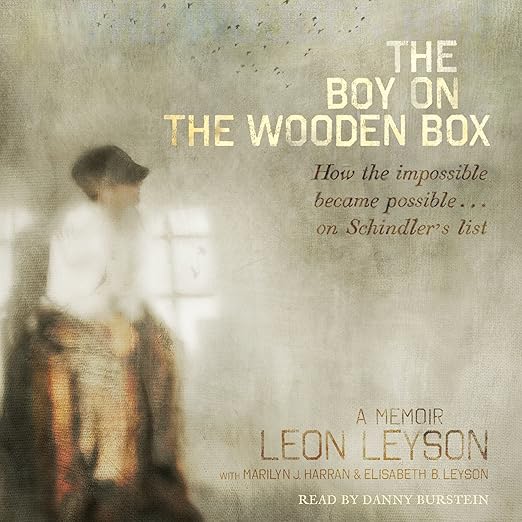
Leon Leyson was ten years old when the Nazis invaded Poland. His memoir, The Boy on the Wooden Box, is the only firsthand account published by one of the youngest children to survive the Holocaust on Oskar Schindler's list, and Danny Burstein narrates this audiobook with a steadiness that matches the book's own defining quality: its dignity. In 4 hours and 14 minutes, Burstein reads a story that could easily overwhelm and instead remains, as the subtitle promises, a legacy of hope told without rancor and without the retrospective performance of suffering that can make Holocaust memoir feel inaccessible to younger readers.
What Leon Leyson Delivers
Leyson's title comes from a concrete physical detail: he was small enough that he had to stand on a wooden box to reach the machinery in Oskar Schindler's factory, the factory that kept him alive. That title image captures the memoir's scale and point of view precisely. This is not a comprehensive history of Schindler's list or Polish Jewry during the Holocaust. It is the story told from the height of a child who could not reach the machines without assistance, covering his childhood in the Polish town of Narewka, the Nazi invasion, his family's forced relocation to the Krakow ghetto, the sadism of Amon Goeth at the Plaszow concentration camp outside Krakow, and Schindler's decision to add the Leyson family to his workers' list.
Reviewer Celia provides the essential statistical context: 88% of Polish Jews were murdered during the Holocaust, making Leyson's survival not a typical outcome but an extraordinary convergence of luck, perseverance, and the intervention of a specific individual. The book is positioned alongside The Boy in the Striped Pajamas and The Book Thief as an entry point for younger readers into Holocaust history, and Leyson's first-person immediacy gives it something those fictional accounts cannot offer: actual lived experience rather than authorial imagination. Burstein's narration serves that distinction consistently. He reads Leyson's prose with the tone of direct testimony, not dramatization. The effect is an audiobook that feels like hearing a person tell their own story even though Leyson, who died in 2013 shortly after completing the memoir, is not reading it himself.
What Leon Leyson Gets Right
Reviewer P. Blevins identifies this as a memoir that stands as testament to the will of those who survived and the bravery, generosity, and humanity of those who chose to help. That dual focus, on the survivor and on the person who chose to act at great personal cost, is what gives the audiobook its particular educational value beyond any summary of historical facts. Schindler is not a saint in Leyson's account. He is a complicated, opportunistic businessman who made a series of choices that cost him everything he had spent the war accumulating, and Leyson writes about his benefactor with clear-eyed gratitude that contains no hagiography.
The audiobook's length, just over four hours, makes it practical for classroom use or family listening across a few sessions. Burstein's narration does not simplify for a younger audience or talk down to it; he reads the text as written, which is Leyson's own clear, unpretentious prose rather than a pedagogically adapted version. The accessibility comes from Leyson's original choices as a writer, not from a narrator softening the material. Reviewer Jenny H. notes reading it during a family bereavement and finding that it sharpened her attention to her own family's stories and the generational transmission of experience, which speaks to the memoir's capacity to resonate beyond its specific historical context. The audiobook works equally as an educational resource and as a personal reading experience for adults who come to it independently of any classroom assignment. Leyson wrote the only memoir published by a former Schindler's list child; the specificity of that position in history gives the short production a documentary weight that longer, more elaborately narrated Holocaust accounts sometimes dilute rather than concentrate.
Where Leon Leyson Loses Some Ground
The audiobook does not protect younger listeners from the realities of the Holocaust. Leyson writes about Plaszow and Amon Goeth's sadism with the directness of someone describing events he witnessed as a child. None of it is gratuitous, but it is honest, and parents listening with children under ten should be prepared to engage with those sections rather than assuming the audiobook will manage the difficulty on their behalf. The memoir's perspective, a child's point of view encountering incomprehensible events, captures an innocence confronting systematic evil in a way that is harder to process than adult retrospective accounts.
The memoir is also deliberately narrow in scope. It is not a comprehensive account of Schindler's list, the factory's operations, or the other survivors Leyson shared that experience with. Listeners who want that broader historical picture will need to supplement it with other sources. What the audiobook offers is something narrower and, in its way, more powerful: the point of view of one small boy who had to stand on a wooden box to reach the machinery that kept him alive, and who tells that story without bitterness or performance, simply as the truth of what happened to him.
Should You Listen to The Boy on the Wooden Box?
This audiobook is appropriate for middle school students and older, and functions well alongside fiction like The Boy in the Striped Pajamas for readers ready for actual historical testimony. Adults who have not encountered Leyson's account will find it among the most direct and least performatively anguished Holocaust memoirs available in audio. Not recommended for children under nine or ten given the historical content, but Burstein's measured reading is careful enough that the material is handled with more restraint than most.
Before You Listen
Is The Boy on the Wooden Box audiobook appropriate for middle school students?
Yes. It is widely used in middle school and high school classrooms and is specifically positioned for those age groups. The historical content is presented honestly without gratuitous detail. Parents of younger or more sensitive children should listen alongside them, particularly for the Plaszow sections.
How does The Boy on the Wooden Box audiobook compare to fictional Holocaust narratives like The Boy in the Striped Pajamas?
The defining difference is that Leyson's account is firsthand testimony rather than fiction. The audiobook carries the specific weight of lived experience, including the wooden box detail of the title, that fiction cannot replicate. It functions well alongside those novels as an introduction to actual historical record.
At just over four hours, is this audiobook long enough to fully develop Leyson's story?
Yes. Leyson covers his childhood in Poland, the ghetto, Plaszow, and his survival through Schindler's factory with sufficient detail to give the full arc its weight. The short runtime reflects Leyson's disciplined, direct prose rather than any deficit in the story he tells.