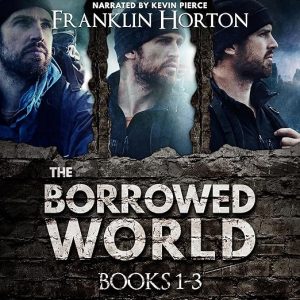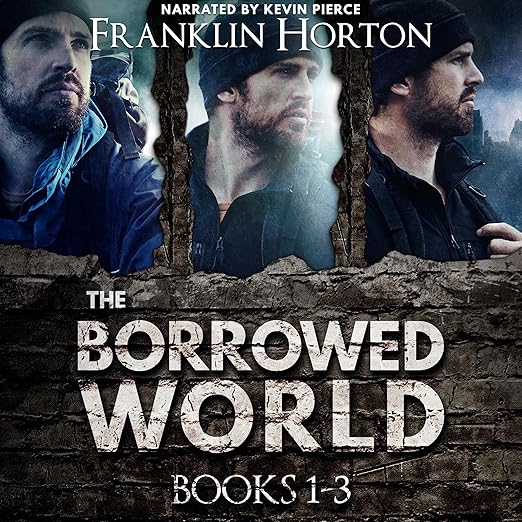
I started the first Borrowed World book on a long drive through November rain and finished the third well past midnight on a weekend when I had no particular reason to stop. Franklin Horton's series has a quality documented by enough reviewers that it reads as a genuine property of the work rather than marketing language: it is difficult to stop once started. The box set collects The Borrowed World, Ashes of the Unspeakable, and Legion of Despair, which is roughly 25 hours of survival fiction built on a deceptively simple premise. What would happen to a regular, prepared-but-not-elite American when the infrastructure collapsed while he was hundreds of miles from home?
Jim Powell is a business traveler who preps. Not in the bunker-and-assault-rifle-stockpile sense that dominates much of the genre, but in the practical, working-knowledge sense of someone who has thought carefully about what might go wrong and has taken modest steps against it. When ISIS operatives trigger a coordinated infrastructure attack, Jim is stranded far from his family with his preparations about to face their first real test. What Horton understands, and what separates this series from its peers, is that training for collapse and experiencing collapse are fundamentally different things.
Reviewer after reviewer in the series' extensive review record notes the same quality: the characters feel like actual people rather than prepper-fantasy archetypes. Jim is not a former Delta Force operator with a photographic memory and infinite physical endurance. He gets tired. He makes mistakes under stress. He encounters other survivors who are as frightened and unprepared as he feared they would be, and the moral questions that arise from those encounters are handled with more nuance than most of the genre manages. One reviewer specifically praised that unlike many post-apocalyptic heroes who are super lucky and prepared, Jim's human frailties make his successes feel genuinely earned rather than inevitable.
The ISIS-trigger premise is politically loaded in ways the series does not fully interrogate, which is worth noting for listeners sensitive to that framing. Horton is more interested in the logistics of survival than the geopolitics of causation, so the specific threat origin becomes less prominent as the books progress and the collapse becomes the reality Jim is navigating rather than an event he is reacting to. By book three, the cause is almost irrelevant; only the conditions remain, and those conditions Horton renders with considerable specificity.
The Best Parts of The Borrowed World Box Set, Volume One: Books 1-3
Pierce has extensive experience in thriller and action fiction, and he brings the same workmanlike solidity to Jim that the character himself projects. This is not glamorous narration: Pierce does not impose cinematic uplift on scenes that Horton has deliberately kept mundane. When Jim is exhausted and hungry and calculating the probability of making it another mile, Pierce sounds like a tired man doing math, not a performer narrating a heroic journey. That calibration matters enormously in survival fiction where the gap between performance and reality would break the tone immediately.
Before You Commit to The Borrowed World Box Set, Volume One: Books 1-3
The arc tracks Jim's gradual recalibration of what he is willing to do to protect his family and group. The first book establishes his baseline, a man who has prepared but retained civilian ethics. By the third book, those ethics are under genuine pressure from scenarios that cannot be resolved without violence or the credible threat of it. Horton does not celebrate this evolution, which is what keeps it honest. The how-to prepper information woven through the narrative is practical enough that reviewer John Prangenberg specifically noted the book's instructional value, which is either a recommendation or a caveat depending on your priorities as a listener.
Should You Listen to The Borrowed World Box Set, Volume One: Books 1-3?
Prepper fiction enthusiasts who want grounded, character-based survival drama rather than action-movie pacing will find this among the best the genre offers. Listeners interested in disaster preparedness who want the information delivered through narrative will also find value here. This is not for listeners seeking fast-paced thriller energy: Horton's pace is deliberate and his focus is on the texture of collapse rather than its spectacle. The 25-hour box set format rewards commitment and patience.
Questions Listeners Ask
Does Kevin Pierce narrate the later books in the Borrowed World series beyond this box set?
Pierce narrates the full Borrowed World series, which provides meaningful continuity for long-term listeners. His consistent characterization of Jim across the extended series is one of the listening experience's reliable pleasures.
How realistic is Horton's ISIS attack and grid collapse scenario compared to other EMP-fiction premises?
Horton's attack scenario is plausible at the level of thriller fiction without attempting the technical precision of a policy paper. The collapse mechanics are internally consistent, and the series' focus quickly shifts from the cause to the lived experience of the aftermath, where the details are researched and convincing.