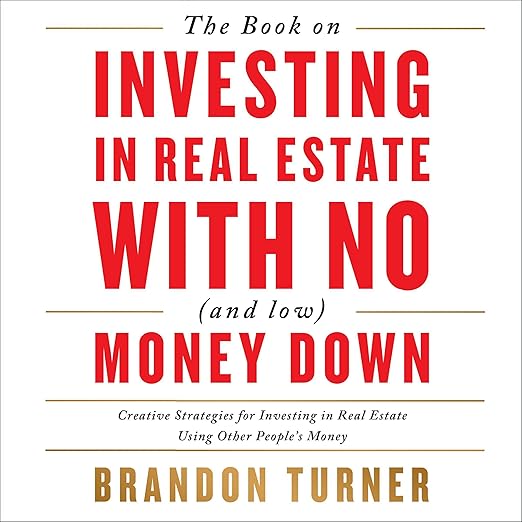
Brandon Turner narrating his own book on creative real estate financing is an unusual production choice that turns out to be an asset. Turner co-hosted The BiggerPockets Podcast for years and that experience shows in the audio delivery: he knows how to explain financial concepts at conversational pace, and he brings the same informal confidence to the narration that presumably made him effective on the show. The Book on Investing In Real Estate with No (and Low) Money Down does not pretend that the techniques it describes are risk-free or universally applicable. That honesty about the ugly side of creative investing, which Turner includes explicitly alongside the strategies themselves, separates this audiobook from the more credulous end of the real estate advice genre.
Our Take on The Book on Investing In Real Estate with No
Turner's central argument is that the balance in your checking account is not the binding constraint most aspiring investors treat it as. The book is structured around multiple financing methods that sidestep or delay the need for significant personal capital, ranging from attracting private money lenders to wholesaling and flipping strategies that generate returns before significant personal exposure. Each method is explained with pros, cons, and realistic context about where it works and where it does not. One reviewer noted that Turner 'really offers a TRUE guide to creative investing strategies that make sense in today's economic climate,' and that practical emphasis on what actually functions in current market conditions is the book's main differentiator from more theoretical alternatives.
The self-narration gives the material a different texture than a professional narrator would. Turner occasionally digresses into personal anecdotes and commentary that go slightly beyond the text, which works because his experience is genuine and the anecdotes illuminate the principles rather than merely padding the runtime. For the 5.5-hour length, the pacing feels appropriate: the material develops each strategy fully without extending past the point of diminishing returns on any single topic. Listeners who have engaged with BiggerPockets content in any format will recognize Turner's voice and approach immediately.
Why Listen to The Book on Investing In Real Estate with No
The book's range is one of its strengths. Rather than advocating a single strategy and building an entire system around it, Turner lays out multiple approaches and frames them as tools to be selected based on individual circumstances, market conditions, and risk tolerance. The section on attracting private money lenders is particularly useful because it addresses a category of financing that most introductory real estate books handle superficially if at all. Turner explains how to present deals compellingly to potential investors, what terms are reasonable to propose, and how to structure relationships that work for both parties.
The treatment of wholesaling is similarly specific. Rather than presenting it as a quick-profit shortcut, Turner explains the operational requirements, the legal landscape in different jurisdictions, and the relational infrastructure needed to make it sustainable. The mindset section, which Turner includes early and explicitly, frames the rest of the content: creative investing requires a creative mind, and the techniques that follow only function for listeners who have genuinely updated their assumptions about what financing can look like. The audio version benefits from Turner's conversational delivery of these conceptual sections, which can feel dry in text form but work better when voiced by someone who clearly believes what he is saying.
What to Watch For in The Book on Investing In Real Estate with No
Turner is upfront that not all strategies work in all markets. The book addresses a range of financing situations, but listeners in high-cost-of-entry markets should pay particular attention to the sections on market applicability rather than assuming every technique translates directly to their local conditions. One reviewer from the Southern California market noted that the strategies make sense given today's economic realities in that specific context, which suggests the content holds up in competitive environments, but each listener should interrogate the local application carefully.
The sections on mix-and-match strategy combinations are worth particular attention. Turner's argument is that the most effective creative investors do not commit to a single approach but learn to read situations and apply different financing methods accordingly. That flexibility orientation runs through the audiobook's structure as well as its content, and it is one of the reasons the book avoids the formulaic feel of much of the real estate advice category. The revised and updated edition, which this version represents, addresses current market conditions with more precision than earlier versions could.
Who Should Listen to The Book on Investing In Real Estate with No
Aspiring real estate investors who feel that a lack of capital is an absolute barrier to entry will find this audiobook the most directly relevant resource available on that specific problem. Listeners who have read general introductions to real estate investing and want to go deeper on financing mechanics will find Turner's level of specificity more satisfying than most of the category. Anyone already invested in the BiggerPockets ecosystem will recognize the framework and find the audio version a useful complement to the written materials. Experienced investors looking for novel strategies may find the content covers ground they already know, though the self-narration adds personal context that text alone does not provide. This audiobook is most valuable for people who have identified real estate investing as a serious goal and are trying to understand how to begin without substantial liquid capital.
Frequently Asked Questions
Does Brandon Turner narrating his own audiobook affect the listening experience positively or negatively?
Positively for most listeners. Turner brings podcasting experience to the delivery that keeps the pace conversational and the tone credible. He occasionally goes slightly off-text, but those moments add context rather than creating confusion.
Are the strategies in this audiobook still applicable to current real estate markets?
The revised and updated edition addresses current conditions, and reviewers in competitive markets have confirmed the content remains applicable. That said, local market specifics always vary, and listeners should cross-reference strategies against conditions in their target market.
Does the audiobook cover both residential and commercial real estate investing?
The primary focus is residential real estate, with detailed coverage of strategies like wholesaling, flipping, and buy-and-hold rentals. Commercial real estate is referenced but not the book's central subject.