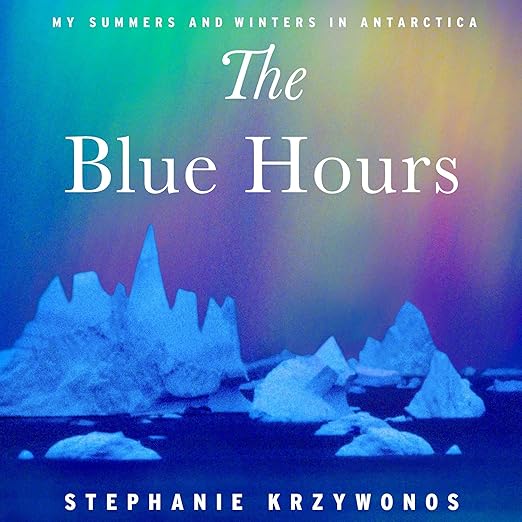
Antarctica has a way of exposing the question at the center of a life. Not in a vague philosophical sense, but in the specific and merciless way that extreme isolation removes every layer of distraction until you are left with only yourself and whatever you were running toward or away from. Stephanie Krzywonos's memoir The Blue Hours poses that particular kind of question as an audiobook experience: can grief be survived not by processing it in therapy or routine, but by placing yourself somewhere so remote and inhuman that the ordinary scaffolding of mourning simply cannot follow? This book arrives for listeners willing to sit with a narrator who does not always find clean answers, and that honesty is the book's defining quality.
Where This One Lands
The Blue Hours covers seven seasons Krzywonos spent in Antarctica: six polar summers and one winter. That winter is the centerpiece of the book. When the sun disappears for more than four months, the experience of the continent becomes something qualitatively different from the long summer days when supply ships arrive and the population of McMurdo or Palmer swells. Krzywonos is not a scientist or an explorer in the Shackleton sense. She goes as an ordinary worker, the kind of person who fixes things or serves food or manages logistics, and that position gives her access to a version of Antarctica that the glamorous expedition narrative tends to ignore. The contrast between her modest role and the scale of the continent she inhabits becomes one of the book's quiet structural devices.
The book's subtitle frames this as a story about pushing past the boundaries of the known world, and that is accurate on the literal level. But what Krzywonos is really pursuing is something more intimate: a reckoning with her best friend's death and with her own capacity to exist in the absence of someone who had been central to her life. Antarctica becomes both refuge and amplifier. The penguins and glaciers and whiteout storms are vividly rendered, but they are never mere scenery. They are the external correlatives to an internal landscape that Krzywonos renders with precision and care.
The structural complexity of The Blue Hours is one of its genuine strengths. Krzywonos weaves memoir with history, science, and what she calls criticism, meaning an honest reckoning with Antarctica's complicated past: the colonial mapping projects, the environmental questions about who belongs on the continent as it warms, and the often-invisible human labor force that keeps the research stations running. The passages in old explorers' huts, where she finds traces of previous expeditions and encounters what she describes as the presence of ghosts, are among the most effective in the book.
The writing itself is lyrical without tipping into self-indulgence. Krzywonos finds precise language for experiences that resist precision: the specific quality of darkness during the polar winter, the way auroras nourish rather than merely impress, the strange temporality of living without a regular sunrise. Readers who have responded to other Antarctic memoirs like Sara Wheeler's Terra Incognita will find familiar emotional territory here, handled with individual distinctiveness. The audiobook format suits this material well because the rhythm of Krzywonos's prose benefits from being received in real time rather than skimmed.
What to Watch For in The Blue Hours
The book's scope is ambitious enough that it occasionally strains under its own weight. The historical passages and the scientific context are well-researched and often illuminating, but the transitions between Krzywonos's personal narrative and the broader Antarctic history can feel abrupt. Some listeners will want the memoir to stay in its own lane rather than pivoting to environmental advocacy or colonial critique mid-chapter. Others will find those pivots exactly what elevates the book above standard grief memoir. The central grief narrative, the loss of her best friend and her years of carrying it while surrounded by ice, is handled with a restraint that is admirable but occasionally frustrating.
The book's literary ambition is evident in the way Krzywonos handles time. A polar winter that stretches over four sunless months does strange things to a person's sense of sequence and duration, and she renders that distortion with specificity rather than abstracting it into metaphor. The practical details of Antarctic winter life, the schedules, the confined spaces, the ways that community forms and strains under extreme conditions, are woven into the larger emotional narrative without being allowed to overshadow it. Krzywonos trusts her reader to hold multiple registers at once: the scientific, the personal, the political. What makes The Blue Hours distinctive in the Antarctic memoir genre is precisely that Krzywonos never presents the continent as a solution. She went looking for something large enough to hold her grief, and Antarctica delivered on that scale, but the grief came back with her when she left, as grief tends to do. That honesty is the book's most valuable quality.
Recommended For
This audiobook is for listeners drawn to memoir that does not simplify its subject. If you have ever been drawn to extreme geography as a way of understanding extreme interiority, Krzywonos writes from that exact impulse. Fans of polar literature and nature writing will appreciate the precision of her observation. Anyone who has navigated grief that resisted conventional timelines will find something true in her account of the winter. Listeners who prefer memoir with a cleaner narrative arc or a more resolved emotional resolution may find the book demands more patience than they want to give a seven-hour listening experience. The book is for readers who can sit with an ending that opens rather than closes.
Questions Listeners Ask
Is this audiobook a traditional adventure memoir or something more personal?
It is primarily a grief memoir set in Antarctica. Krzywonos went to the continent after her best friend's death and the book traces what seven seasons in one of the world's most extreme environments revealed about loss, belonging, and survival. The adventure elements are present but secondary.
Does this audiobook require familiarity with Antarctic history to follow?
No prior knowledge is required. Krzywonos provides enough historical and scientific context within the text that listeners unfamiliar with Antarctic exploration will be able to follow the references. Readers of classic polar literature will find additional resonance in those passages.