Quick Take
- Narration: Rick Bragg reads his own work, and that slow Southern drawl is inseparable from what the book is doing. This is one of those cases where the self-narration is not just appropriate but necessary.
- Themes: Southern food culture as family inheritance, generational memory, the dignity of country cooking
- Mood: Warmly nostalgic with genuine humor and occasional heartbreak
- Verdict: A food memoir and family history that earns its nineteen hours by doing something no recipe book could do.
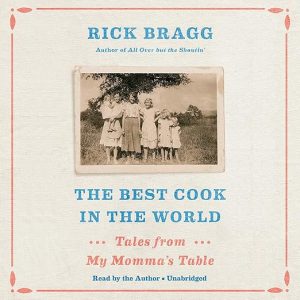
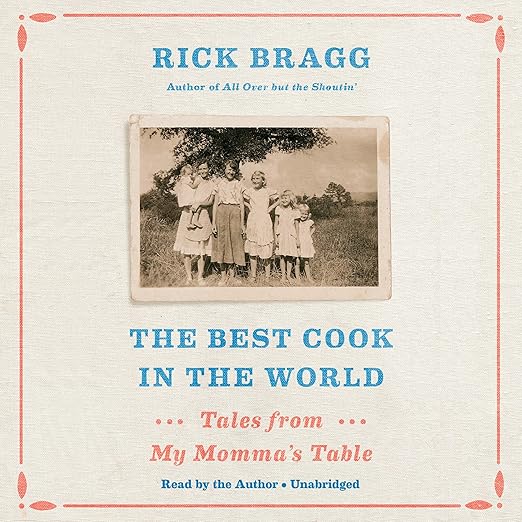
I listened to about forty minutes of this one while making dinner, and then I had to stop because I was getting distracted trying to picture Margaret Bragg in her kitchen, measuring in tads and smidgens and making corn pudding from memory. Rick Bragg reading his own words about his mother is not a background activity. It demands attention, and it rewards the attention you give it.
The Best Cook in the World is formally a food memoir with recipes embedded in the stories. In practice, it is something closer to an act of preservation: Bragg gathering up the oral history of a multigenerational Southern family before it disperses entirely, holding it in place with the one currency that family trusted, which is food. Margaret Bragg does not own a cookbook. She measures in intuition and long habit. Her corn bread takes fifteen to twenty minutes, depending on the mysteries of your oven. Bragg is here to translate all of that into something that can last.
Our Take on The Best Cook in the World
Bragg’s prose in this book is among the best of his career, which is saying something for the author of All Over but the Shoutin’. He has the Pulitzer-winning journalist’s eye for the specific detail that unlocks a larger truth, and he deploys it with the warmth of someone writing about people he loves. One reviewer described the experience as sitting in a room while he interviewed his mother, and that is an apt metaphor for how the audio works. Bragg does not narrate his book so much as inhabit it. His mother’s recipes become occasions for stories that reach back to before the Civil War, passed down skillet by skillet through generations. The flatbed truck as farm-to-table delivery system is one of those lines that lands differently when you hear it in Bragg’s voice than when you read it on a page.
The humor is real and unsentimental in the best sense. Bragg makes the reader laugh and then turns the scene suddenly tender, which is the rhythm of the book from beginning to end. Several reviewers mentioned becoming emotional, and I understand why. This is not a book that manufactures feeling. It earns it by putting you in a room with specific people and letting their lives do the work.
Why Listen to This Over Reading It
This is one of the clearest cases I can make for audio as the superior format for a book. Bragg’s narration is the book. His cadence, the drawl that one reviewer heard on the Garden and Gun podcast and immediately went looking for the audiobook, the way he makes certain words do double duty as local weather report and moral philosophy, is as much a part of the experience as the recipes. At nineteen hours, this is a long commitment, but the pacing is unhurried in a way that feels like spending time with someone rather than consuming content. I stretched it over four evenings and felt each one was a distinct pleasure.
What to Watch For in the Recipe Structure
The recipes are embedded in narratives rather than formatted as a conventional cookbook, which means listeners cannot easily reference them independently. If you want to actually cook Margaret Bragg’s pinto beans and hambone or her corn pudding, you will want access to the text version alongside the audio. As a record of a vanishing culinary tradition, the book is invaluable. As a practical cooking guide, it requires a bit of effort to extract the relevant instructions from the surrounding story. Most listeners will find that the story is why they came, and the recipes are a bonus rather than the point.
Who Should Listen to The Best Cook in the World
This is for anyone who grew up around Southern cooking and wants to have that world rendered in precise and loving language. It is also for anyone who has not, and who wants to understand what food-as-family-history means before it disappears entirely. Bragg does not sentimentalize poverty or hardship, but he treats the ingenuity and love that went into cooking with very little as worthy of the same respect as any haute cuisine tradition. Listeners who want a tidy, recipe-forward food memoir will find this too narrative-heavy. Everyone else should clear a few evenings.
Frequently Asked Questions
Is Rick Bragg’s self-narration distracting or does it add something the book could not otherwise have?
The self-narration is genuinely essential here. Multiple reviewers who heard Bragg speaking about the book in interviews sought out the audio specifically because his voice and cadence are inseparable from what the book is doing. It is one of the stronger arguments for an author narrating their own memoir.
Do the recipes actually work if you try to cook from them?
The recipes are embedded in narrative rather than formatted conventionally, and Margaret Bragg measures in terms like tads and smidgens. Listeners who want to actually replicate the dishes will need to listen carefully and possibly supplement with the printed edition. Bragg acknowledges the imprecision as a feature of his mother’s style.
Is this a standalone work or do you need to have read All Over but the Shoutin’ first?
It stands completely on its own. Some of the same family members appear across Bragg’s books, but The Best Cook in the World introduces the Bragg family and context fully enough that new readers can enter here without prior knowledge.
At nineteen hours, how does the pacing hold up across the full runtime?
The episodic structure of the book works in its favor for a long listen. Each story is self-contained enough that you can step away and return without losing narrative momentum. Reviewers consistently describe finishing it in multiple sittings without the book feeling padded or slow.