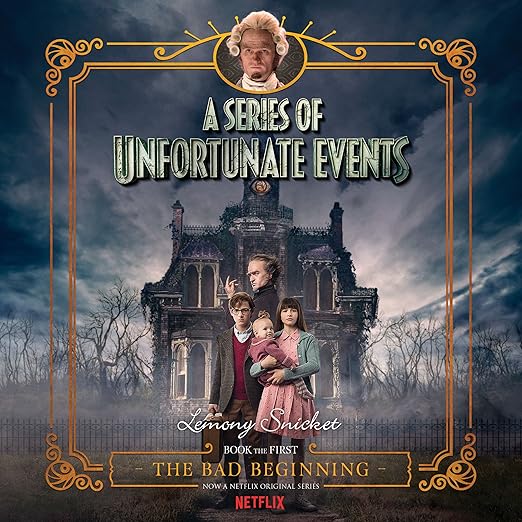
The description promises a team of talented readers and names exactly one of them. Tim Curry takes the billing, offered up as distinguished and disturbed inside a single clause, and this audiobook is sold explicitly on being a multi-voice recording. Whoever else stood in front of those microphones appears nowhere: not in the credit, not in the title, not in a single line of the copy. For a production whose entire pitch is the number of voices in it, that omission is a peculiar place to start.
Catastrophes and Irritations Get Equal Billing Here
Lemony Snicket's opening volume gets described here purely through its unpleasantness. That, of course, is the joke. The copy likens hearing it to a car alarm, bagpipe music, or a doorbell ringing in the middle of the night, then warns that this recording brings the book to such terrible life that nobody should really have to experience it. The ghastly details on offer are a tragic fire, a nefarious villain, itchy clothing, and cold porridge for breakfast. Two catastrophes and two minor irritations, given precisely equal billing: the proportion this whole series runs on.
Tim Curry is the name attached, and the copy leans its weight on that casting. A book written in a register of exhausted formal dread needs a voice capable of delivering the word ghastly as though it were a compliment. What the credit will not tell you is how the multi-voice element actually operates. Does a cast take the characters while Curry keeps the narration? Do the other readers surface only in dialogue? Nothing on this listing addresses it, and no reviewer has stepped in to fill the gap.
MJ James wrote the most interesting sentence in this column without appearing to notice. Reviewing in 2017, that reader observes that the main character of the story could be argued to be the narrator, since everything arrives through the voice of Lemony Snicket. On the page that is a neat structural point. On a multi-voice recording it becomes a production question, because if the narrator is the protagonist, then whoever carries the narration is playing the lead and the rest of the cast is support.
Reverse Psychology Makes the Strongest Argument Here
Two hours and twenty-nine minutes is close to the ideal length for this material. Long enough to count as an event, short enough to finish across one car journey or two bedtimes, and short enough that a child who bounces off the tone has lost almost nothing. The series is numbered and this is the first of them, so the recording works as an inexpensive audition for a very long shelf of sequels.
Reverse psychology makes the strongest argument for the recording, because the copy is already doing what the books do. Telling a reader they would be better off listening to something else is the comic posture of the entire series, and a child who finds that funny in a description will find it funny for two and a half hours. A child who prefers stories that encourage them will know inside ninety seconds that this is not going to happen.
Whitney's daughter is seven, reads above her level, needed something more challenging, and now looks forward to it every night before bed. Jessica, writing in 2014, argues that this series teaches children better values than Harry Potter does, precisely because it lacks the magic that lets problems be solved from outside the characters. Both of those come from adults watching one specific child, worth considerably more than a star rating on its own.
Nobody Here Mentions the Actual Recording
NOW A NETFLIX ORIGINAL SERIES leads the description. October 26, 2004 is the release date sitting on the record. Those two facts cannot describe the same moment. The jacket copy has evidently been refreshed at least once since the recording was made while the recording sat exactly where it was. Ordinary publishing housekeeping, and still worth knowing that the promotional banner above this description is a good deal younger than the audio beneath it. The review dates point the same way: three of the five entries here were filed in January 2026, within three weeks of one another, on a recording that has been available since 2004. Two of those three were filed on consecutive days, January 26 and January 27. Something sent people back to this listing twenty-one years after it appeared, and the description offers the likeliest reason.
Not one of the five people who wrote here mentions the recording. On most listings that would pass without comment; on this one it is remarkable, because the production is the only thing the description sells. Not the plot, not the characters, not the author, but the multi-voice recording and the reader fronting it. Five people sat down and typed something, and each of them landed on a subject other than the single feature the publisher chose to advertise. Two of the five run to fewer than twenty words apiece, one of those in Spanish, and neither is describing an audio edition at all.
A header sits above MJ James's review proper: five stars, Book Length 188 pages, Genre: Children, Children's Chapter, Middle School. A page count posted against a recording running two hours and twenty-nine minutes is the plainest evidence available that this column arrived from print. The record's own filing is stranger still, since alongside children's audiobooks it sits under relationships, parenting and personal development, a category no children's gothic comedy has ever belonged in.
Curry's Admirers Deserve More Voices Than Credited
The right household is one where a child already finds catastrophe funny, or is old enough to relish being warned off something. Confident young readers are the target, and the column sketches the range without meaning to: one reviewer's child at seven, and a genre header naming middle school. Adults who grew up on these books get a version they have not heard before, and the Humor tag is the single piece of filing on this page that lands exactly right.
Households that want a straight, warm reading should look elsewhere, since the design here is arch, mannered and deliberately off-putting, and a child who wants comforting at bedtime will not find it. The same applies to anyone hoping the credit will identify the rest of the cast, because it never does. Curry's admirers deserve to know that the recording they are buying holds more voices than the listing is prepared to admit.