Quick Take
- Narration: Ruth Urquhart delivers a warm, clear performance that handles the ensemble cast with consistency, she brings emotional range to Ruethwyn without over-dramatizing the more action-heavy sequences.
- Themes: recovery and adaptation after catastrophic loss, the limits of magical power as metaphor for disability, loyalty and rescue as driving motivation
- Mood: Action-driven fantasy with a quiet emotional core, accessible and propulsive
- Verdict: A solid opening to a series that knows what it wants to be, character-driven academy fantasy with real stakes and a protagonist whose limitations make her more compelling than her gifts.
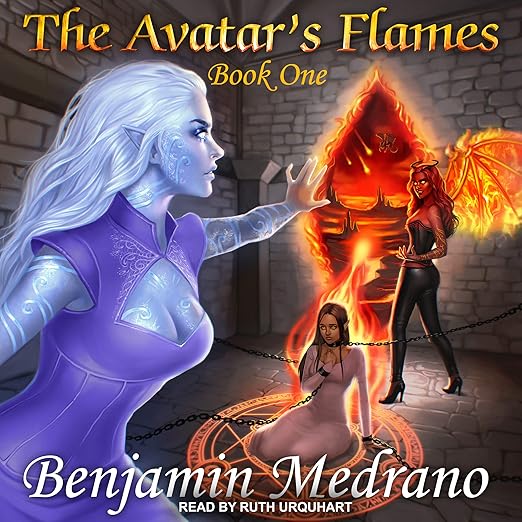
I came to The Avatar’s Flames through a recommendation thread on LGBTQ fantasy, and it sat in my queue for longer than it deserved. When I finally started it during a long drive on a rainy November afternoon, I was surprised by how quickly the setup establishes genuine emotional stakes. The dragon attack that opens Ruethwyn’s story doesn’t feel like a genre contrivance, it functions as a structural disaster that the entire subsequent narrative has to work around. She arrives at the academy missing an eye, an arm, and half her magical ability. That’s not a disadvantage to overcome before the real story begins. That is the story.
Benjamin Medrano’s Through the Fire series opens with this 2018 installment, narrated by Ruth Urquhart for Tantor Audio. The premise is high fantasy in a recognizable tradition, a magic academy, an ensemble of fellow students, a ticking-clock rescue mission, but the execution is distinguished by Medrano’s decision to build his protagonist’s competence around what she has rather than what she lost. Ruethwyn uses intelligence, cunning, and what remains of her abilities to navigate a situation that most fantasy protagonists would find insurmountable. That choice gives the book a texture that straight power-fantasy stories lack.
Our Take on The Avatar’s Flames
The LGBTQ framing here is present in the setup, Ruethwyn’s rescue mission is motivated by love for the young woman taken from her village, a love she was building up the courage to confess when everything was destroyed, but it functions as character motivation rather than as a category the book is primarily about. This is worth naming because listeners approaching it specifically for sapphic fantasy romance may find the love story is slower to develop than the action-adventure elements. The series is clearly setting up an emotional arc across multiple volumes, and this first installment prioritizes establishing the world, the academy, and Ruethwyn’s adaptive strategies over delivering on the romantic premise established in the opening chapters.
What Medrano does exceptionally well is populate the academy with a supporting cast that feels genuinely distinct. The dark elf who gives Ruethwyn her two-year deadline, the kitsune she rescues partway through, the fellow students who respond to her physical limitations with a range of reactions, none of these feel like placeholders. The world’s mythology, including the magic system built around the constraint of Ruethwyn’s curse, is cohesive without being exhaustively explained. Reviewer Adam B. notes this was “the first no” before trailing off in an apparent review character limit, a fitting accident, since the book is generally stronger on what it introduces than on how neatly it resolves everything in a single volume.
Why Listen to The Avatar’s Flames
Ruth Urquhart’s performance is clear-eyed about what the material needs. This is not a book that requires heavy emotional color-commentary from the narrator; it moves quickly and trusts listeners to do their own emotional work. Urquhart maintains that pace without flattening the character differentiation, which is the correct instinct. The sections where Ruethwyn assesses her own limitations with a kind of pragmatic honesty, cataloguing what she can no longer do and recalculating accordingly, come through with a steadiness that serves the character’s core quality well.
At just under eleven hours, it’s a comfortable single-series entry point. Reviewer Jen Bunny Bear describes it as having “nice flow and effortless progression,” which tracks with the listening experience. You are never confused about where you are in the story or what Ruethwyn is trying to accomplish at any given moment. That clarity is a genuine craft achievement in a genre where world-building often comes at the expense of narrative momentum.
What to Watch For in The Avatar’s Flames
The pacing shifts in the final third, where several plot threads converge, including the demon infestation that reviewer Joseph White mentions, in a way that feels slightly rushed relative to the more measured setup. First installments in series often sacrifice their endings to set up sequels, and this one is not entirely immune to that tendency. The central rescue mission that drives Ruethwyn forward remains unresolved by the close of this volume, which is the correct long-form structural choice but may frustrate listeners expecting a more complete arc.
The novel’s emotional climaxes are occasionally announced more than earned. Ruethwyn’s psychological state after the attack is described with enough clarity that it functions as the story’s emotional engine, but the quieter scenes where that trauma should register more subtly sometimes feel slightly underwritten compared to the action sequences. This is a common tension in action-driven fantasy, and Medrano handles it better than average without fully resolving it.
Who Should Listen to The Avatar’s Flames
Listeners who enjoy academy-setting fantasy with a protagonist who must work strategically around significant limitations, rather than one who discovers hidden power in time to solve each problem, will find this more satisfying than the average series opener. Those specifically looking for sapphic romance as the primary genre note should know this is a slow burn across a series rather than a focused romance in a single volume. Fans of Medrano’s other work in the Ancien Dreams series will recognize his interest in ensemble dynamics and characters whose circumstances are more complicated than their apparent destiny suggests.
Frequently Asked Questions
Does the LGBTQ content in The Avatar’s Flames feel central to the story or incidental?
It’s central to motivation without dominating the genre. Ruethwyn’s love for the girl taken from her village drives the entire plot, but the book is primarily fantasy adventure rather than romance. The sapphic element is established early and treated without fanfare, which readers generally respond to positively. Those expecting a romance-forward story may find the adventure elements take more page time than the relationship development.
Is Ruethwyn’s disability, missing an eye and arm, handled with any consistency and care?
This is one of the book’s stronger elements. Her injuries are not a temporary setback that magically resolves, they shape every strategy she employs throughout the book. She has to adapt her magical approach, her combat style, and her self-concept around what remains after the attack. Reviewer Adam B., who read an ARC, specifically calls out this as a distinguishing quality of the story.
Do you need to have read any of Benjamin Medrano’s other work before starting this series?
No. Through the Fire is a standalone series and The Avatar’s Flames functions as a complete introduction to its world, magic system, and characters. Familiarity with his Ancien Dreams series may add appreciation for his approach but is not required.
Is the central rescue mission resolved by the end of this first book?
Not fully. This is the first book in a series and the rescue of Ruethwyn’s beloved is the overarching long-term goal rather than a single-volume arc. The book has a satisfying internal story with the academy events and the demon infestation, but listeners should expect to continue into later books for the emotional resolution of the opening setup.