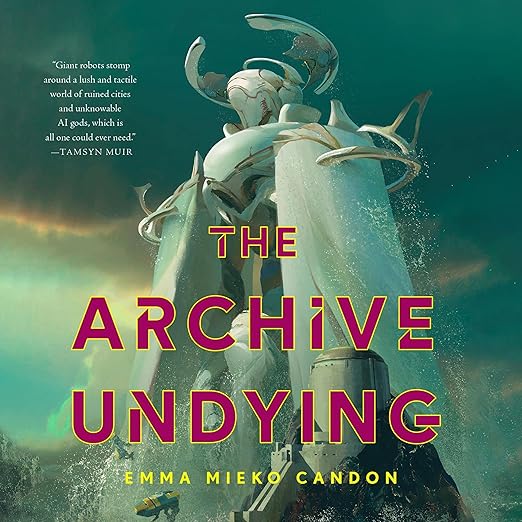
Quick Take
- Narration: Yung-I Chang navigates the novel’s dense, layered language with clarity, though the book’s demanding prose style means even attentive listeners may need to rewind.
- Themes: AI divinity and corruption, trauma and dissociation, the cost of love over the greater good
- Mood: Dense, disorienting, and achingly raw
- Verdict: A bold, polarizing debut that rewards committed listeners willing to wrestle with its complexity.
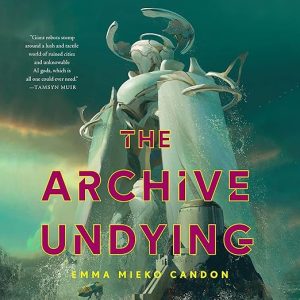
I was halfway through my morning commute when The Archive Undying first lost me, and I mean that in the most productive sense. Emma Mieko Candon’s prose does not ease you in. It deposits you directly into a world of AI gods, pilot-priests with corrupted bodies, and ghost cities where seventeen years of trauma have been pressed into a man who can neither die nor forget. I had to rewind twice in the first two chapters to get my bearings, and I am glad I did.
Yung-I Chang narrates, and his delivery suits the novel’s register: measured, weighted, with the particular quietness of someone recounting something they would rather not. Sunai, the protagonist, has been wandering since the god of Khuon Mo went mad and destroyed everything it loved before resurrecting him in its death throes. Chang makes Sunai sound exactly like that, like a man who has run so far from his past that he has forgotten how to stand still.
Our Take on The Archive Undying
Candon’s entry into mecha fiction is not a comfortable read, and it is not meant to be. The Downworld Sequence opens with a premise that blurs the boundaries between machine and deity, between faith and infrastructure, between a person and the god that made them. Sunai’s journey back into the world of gods and machines begins, almost comically, with a terrible decision, he wakes up in the bed of the one man he should not have slept with, and spirals from there into questions that have no clean answers. One reviewer described the book as a look at what it would mean for AI and humanity and sense of self all to blur into one another, and that framing captures the philosophical ambition here accurately. Candon is not writing a plot-first adventure. She is writing a meditation on corruption, devotion, and the terrible things we do in the name of love.
Why Listen to The Archive Undying
The audiobook format works particularly well for this novel because Chang’s pacing forces the listener to stay with the material rather than skimming ahead when the world-building becomes dense. And it does become dense. Readers who loved it pointed to the richness of the world-naming alone, terms like Reconcile Elegy, So-Beloved, Register Parse, as evidence of an imagination operating at full stretch. The novel’s emotional rawness, which reviewers called achingly beautiful, also benefits from an audio delivery that does not let you rush past the grief. At just over sixteen hours, it is a substantial commitment, but listeners who connect with it tend to find it genuinely transporting.
What to Watch For in The Archive Undying
This is one of the more polarizing audiobooks I have covered in this space, and the criticism deserves to be addressed plainly. Several readers found the prose too wordy for its plot, and the middle section in particular was described as a slog with too much repetitive rehashing of the same thematic territory. One listener who bought the hardcover eighteen months before the audiobook made multiple failed attempts to finish before the audio version finally worked for them. That is not a ringing endorsement of accessibility. If you are the kind of listener who needs narrative momentum to stay engaged, or who finds prose-first science fiction laborious, this is likely not the book for you. The plot does not operate on conventional thriller timing.
Who Should Listen to The Archive Undying
Readers who prize dense world-building, morally compromised protagonists, and science fiction that asks genuinely difficult questions about consciousness and devotion will find The Archive Undying rewarding. It is particularly well-suited to fans of literary science fiction and those who enjoyed the blurring of genre in works like Ann Leckie’s Ancillary series or Arkady Martine’s A Memory Called Empire. Listeners looking for straightforward mecha action or a fast-moving plot will likely bounce off this one. The 3.8 rating reflects the split honestly.
Frequently Asked Questions
Is The Archive Undying’s mecha content central to the story or more of a backdrop?
The giant robots, steered by pilot-priests with corrupted bodies, are woven into the world’s social and religious structure rather than serving as action set pieces. The mecha elements are more context than spectacle, which is part of what distinguishes this from more conventional mecha fiction.
Does The Archive Undying have LGBTQ+ romantic content, and how explicit is it?
Yes. Sunai’s queerness is central to his characterization, he copes with his trauma through drink, drugs, and men, and the wrong-bed inciting incident involves a same-sex relationship. The romantic content is not explicitly detailed but is integral to the story rather than incidental.
Is this a complete story or does it end on a cliffhanger for the Downworld Sequence?
The Archive Undying is the first volume in the Downworld Sequence and does not resolve all of its threads. It functions more as an opening movement than a self-contained narrative, which reviewers who loved it accepted as part of the experience.
How does Yung-I Chang handle the novel’s invented terminology and world-specific naming?
Consistently and without stumbling, from what listeners report. The naming conventions in the Downworld Sequence are elaborate, and Chang’s steady delivery helps anchor the listener rather than letting the terminology become disorienting.