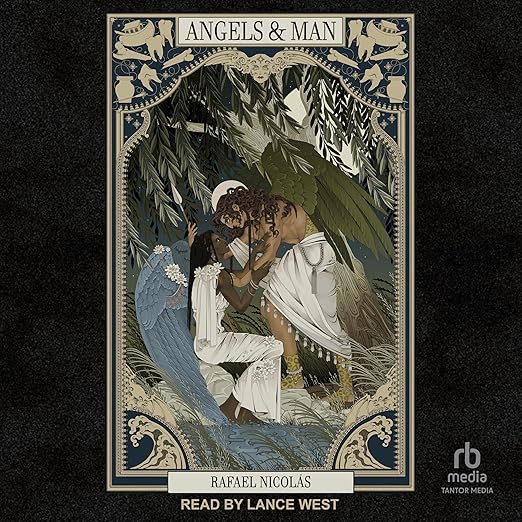
Heaven, as Rafael Nicolas imagines it in Angels & Man, is not a paradise but an aftermath. The celestial realm of this second book in the Angels series exists in the reconstructed ruins of what came before Satan's fall, rebuilt but oppressive in the specific way of places that police memory because the memory itself is dangerous. That atmospheric foundation, a Heaven that is paranoid rather than peaceful, is what Lance West establishes in the opening chapters of this audiobook, and it is what gives the subsequent mission of the Watcher angels to Earth its emotional weight. The angels who descend to teach humans about God's love do not arrive from a position of uncomplicated faith. They arrive from a Heaven they have different relationships to, and those differences between Azazel and Samyaza are the engine of what follows.
Our Take on Angels & Man
Nicolas is working with the Book of Enoch, an apocryphal text outside the canonical Bible that describes Watcher angels who descended to Earth and became entangled with humanity in ways that eventually required divine intervention on a catastrophic scale. One reviewer notes that they found themselves searching for information about these angels online while reading, which is a meaningful response to Nicolas's work: his scholarship surfaces in ways that make the mythology feel discovered rather than invented. The figures of Azazel and Samyaza are drawn directly from that tradition, and the psychological distinction Nicolas establishes between them is carefully maintained across nearly nineteen hours of narrative. Azazel is miserable in Heaven already; the divine order feels like a prison before any human contact is made. Samyaza is content but hungry for Heaven's former glory, and it is his ambition to restore divine favor that drives the Watchers' descent to Earth.
The queer dimensions of this narrative are handled with the same seriousness Nicolas brings to the theological source material. This is not a story that uses queerness as surface provocation while maintaining conventional internal dynamics beneath the aesthetic. The love that the Watcher angels find on Earth is specific, emotionally grounded, and weighted with the full moral and cosmological stakes that the mythology assigns to the Watchers' choice to remain. One reviewer describes the book as "equally good and equally if not more sad than book 1," which signals what kind of emotional experience this is: not a triumphant love story but a tragedy with cosmic scale and a deeply human core. Nicolas earns that tone through the careful characterization of both Azazel and Samyaza, whose different relationships to Heaven make their different responses to Earth feel psychologically inevitable rather than narratively convenient.
Lance West's narration manages the tonal demands this material places on a reader. Nicolas's prose has an unusual structural approach that reviewers note takes some adjustment, but once the register is established, the invented dialogue for celestial beings needs to feel plausible without becoming archaic, and the emotional interiority needs to carry genuine weight without tipping into melodrama. West handles those competing demands competently throughout. The early chapters set in Heaven require a voice that can make abstract theological geography feel spatially real, and West grounds the celestial setting in ways that make the transition to Earth and to human relationships register as a meaningful change of texture.
At eighteen hours and thirty-eight minutes, this is a substantial audiobook. Nicolas writes with investment in character psychology and mythological detail rather than plot velocity, and the runtime reflects that investment. The emotional devastation reviewers describe is built slowly and deliberately, through the accumulation of small moments in which the angels' choice to stay on Earth and the divine consequences of that choice become simultaneously more understandable and more inevitable. Listeners who want narrative momentum above all will find this audiobook more demanding than the genre conventions of LGBTQ+ fiction might lead them to expect. Those who prefer emotional depth and theological texture will find exactly what they came for.
What to Watch For in Angels & Man
The synopsis notes that the book contains mature themes, and that designation applies to both the explicit emotional and physical intimacy between angels and humans and to the violence of the larger mythology. The Watcher's Flood is an event of catastrophic scale that the narrative is building toward, and Nicolas does not soften what the divine response to the Watchers' choice ultimately involves. This is not a book that resolves toward comfort. Listeners should approach it knowing that Nicolas is writing tragedy as a serious literary form rather than as a tonal accident or a genre convention to be lightened in the final chapters.
The Book of Enoch connections that reviewers consistently find themselves following up on are worth pursuing if they surface during your listen. Nicolas's use of apocryphal material is specific enough that pausing to look up a name or a tradition will illuminate the text rather than interrupt it. The audiobook rewards engaged listening over passive consumption more than most genre fiction in this space, and West's narration paces the material in ways that invite that kind of active attention.
Who Should Listen to Angels & Man
Readers of the first Angels book who came away wanting more of Nicolas's world and more emotional devastation will find this installment delivers both. LGBTQ+ fiction readers who want queerness embedded in mythological and theological stakes rather than contemporary domestic settings will find the Angels series a distinctive and serious entry in the genre. Listeners who appreciated the dark, mythologically grounded fantasy of Philip Pullman's work, and who want queerness at the center rather than the margins, will find Nicolas worth the investment of nearly nineteen hours. Those beginning the series should consider starting with book one. The emotional weight of certain character arcs in this audiobook is amplified significantly by the context that the first installment establishes, and the series as a whole is designed to be experienced as an arc rather than a collection of standalone volumes.
Does this audiobook work as a standalone, or do I need to have listened to the first Angels book first?
Nicolas provides enough contextual information for newcomers to follow the narrative, but the emotional weight of certain character arcs in Angels and Man is substantially amplified by the foundation the first book establishes. Starting from book one gives you a meaningfully richer experience of where Azazel's misery comes from.
How explicit is the mature content in this audiobook, and is it integral to the story?
The mature content is substantive rather than gratuitous and is integral to the mythology Nicolas is working with. The intimacy between Watcher angels and humans is the theological transgression that drives the plot; it cannot be treated as peripheral. The content is not graphic in a shock-oriented sense but it is present and meaningfully developed.